
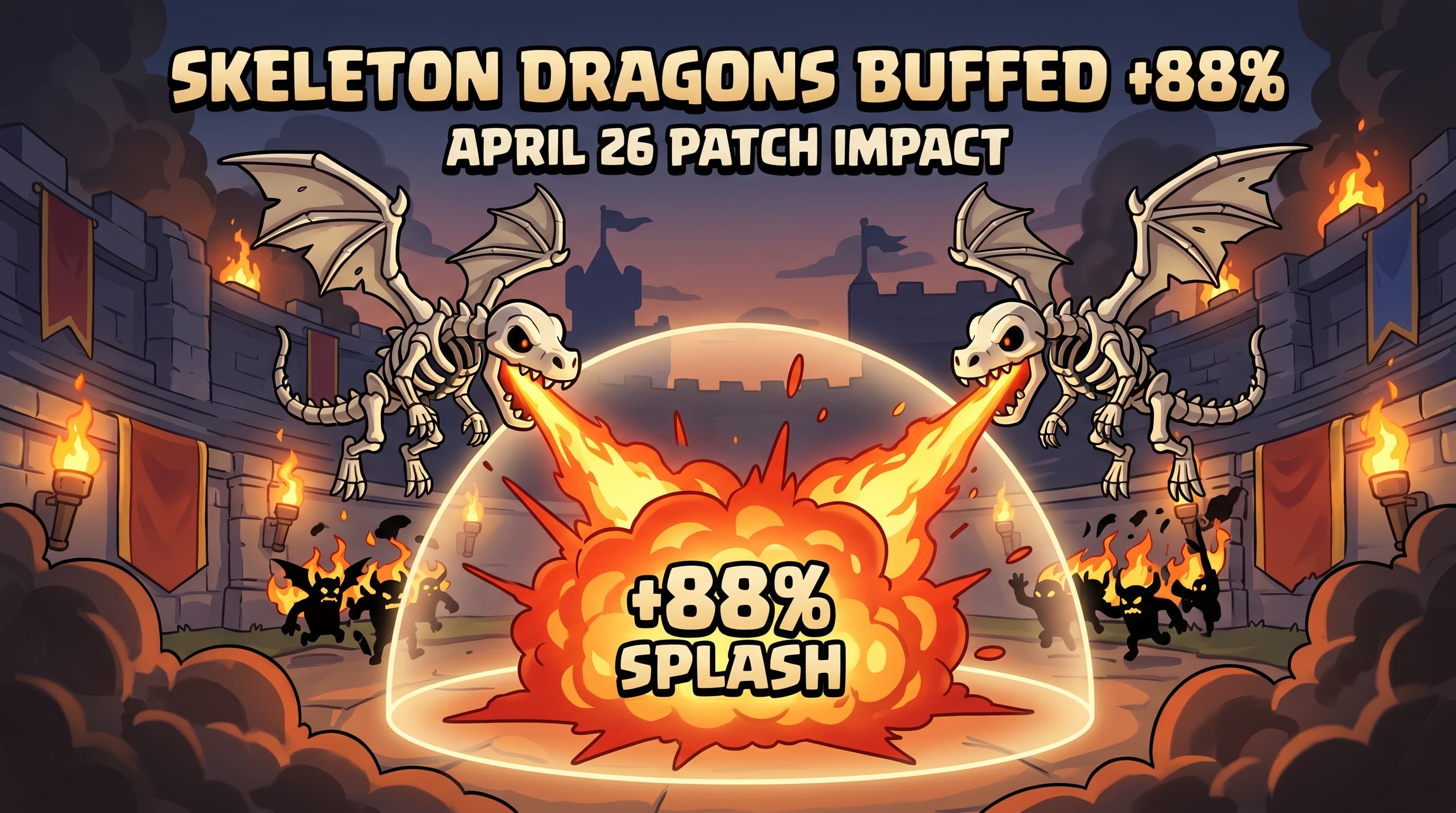
Quick answer: The April 26, 2026 patch increased Skeleton Dragons splash radius from 0.8 to 1.5 tiles — an 88% buff. That single change moves Skeleton Dragons from a niche air-clear option to one of the best swarm and air defense units in the entire game. Expected usage spike from ~3% to 15-25% within a week. Best in beatdown decks, LavaLoon variants, and any deck with a 4-elixir flex slot. Hard counters Minion Horde Evolution, Goblin Gang, Skeleton Army, and most air swarms.
There is exactly one card in the April 26, 2026 patch that should be on every Clash Royale player's radar this week: Skeleton Dragons. The buff is huge, the meta is going to absorb it fast, and if you do not have at least one deck that uses the new version, you are going to lose games to people who do.
The change is short to summarize. The strategic implications are not.
The buff in one line
Splash radius: 0.8 tiles → 1.5 tiles. That is an 88% increase.
The hit-speed cooldown went from 1.9 seconds to 2.0 seconds in the same patch — a 5% nerf to fire rate that is essentially noise compared to the splash change. The splash radius dominates everything else.
Want this kind of analysis for your own deck?
TrophyCoach reads your battle log and writes a personalized action plan against the current meta — free to start.
Why splash radius is the most impactful stat
If you read patch notes for a few seasons, you start to develop intuitions about which stat changes actually matter. Damage changes of 5-10% usually shift card win rates by 1-2 percentage points. Hit speed changes are more impactful because they compound over time. HP changes scale with how much damage the card already absorbs.
But splash radius changes are different. Splash radius does not change a card by a small percentage — it changes which targets a card can clear in a single hit. Below the threshold to clear a certain swarm, the card whiffs entirely. Above the threshold, it clears the swarm cleanly. There is no in-between.
The pre-patch Skeleton Dragons splash radius of 0.8 tiles was just barely large enough to hit two minions in a tight cluster, but it would frequently miss the third. Against Goblin Gang (5 ground troops in two clusters), it would hit two goblins per shot at most. Against Skeleton Army (15 skeletons), it would hit 3-4 per shot.
At 1.5 tiles, the splash radius is now large enough to clear an entire Minion cluster in a single hit, two thirds of a Goblin Gang, and a significant chunk of a Skeleton Army. Two Skeleton Dragon volleys (4 seconds total) clears almost any common swarm in the game.
This is why a simple stat change reshapes the meta. The card is not 88% better — it is now in a completely different category of unit.
The new role
Pre-patch Skeleton Dragons were a niche option you might run in a beatdown deck if you wanted air defense and could not fit Mega Minion or Inferno Dragon. They were not a strong card. Most ladder players cycled past them when building decks.
Post-patch Skeleton Dragons fill three roles simultaneously:
- Air swarm clear — The original role, but now actually good. Minions, Bats, and Minion Horde all melt to two Skeleton Dragon volleys.
- Ground swarm clear — New role. Goblin Gang, Skeleton Army, Spear Goblins, and even Barbarians take significant damage from the splash.
- Beatdown support unit — Two flying troops for 4 elixir is excellent value behind a Lava Hound, Golem, or Royal Giant push. They survive most splash answers and continue dealing damage to whatever is left of the defense.
The card that is closest to this new role is the Wizard. Wizard does similar work for 5 elixir — splash, air target, support unit. Skeleton Dragons now do most of what Wizard does for 1 elixir less, which is a significant tempo win.
Decks that gain the most
LavaLoon and Lava Hound beatdown. Already covered. The deck has always struggled with air-to-air clearing on the opponent's side, and Skeleton Dragons have always been a defensive option. Now they are a strong defensive option that also doubles as offensive support. Slot them in over Mega Minion or Tombstone.
Royal Giant beatdown. The Royal Giant deck family has always run a 4-elixir support slot — historically Mega Minion, Wizard, or Magic Archer. Skeleton Dragons offer better value than Mega Minion at the same cost and free up the Wizard slot for a different card.
Golem beatdown. Golem decks need air defense badly because Lightning + Inferno Dragon counters dominate the matchup. Skeleton Dragons soak Lightning better than Mega Minion (more HP across two units), and they continue providing splash after the Lightning hits.
Three Musketeers — Yes, really. The classic 3M issue is that opponent splash answers (Wizard, Witch, Skeleton Dragons in the past) wreck the formation. Slotting Skeleton Dragons into your own 3M deck gives you the same answer the opponent uses against you, plus a 4-elixir support unit that pairs well with the Musketeers' tempo.
Bridge spam variants. Cards like Bandit, Battle Ram, and Bridge Spam Royal Ghost decks all want a 4-elixir support that can handle defensive swarms. Skeleton Dragons are now the best option in that role.
Hog Cycle (yes, even cycle decks) — Lower priority but worth mentioning. Hog 2.6 has historically not run Skeleton Dragons because the cycle speed mattered more than the air defense. But in a meta where Minion Horde Evolution exists and air swarms are everywhere, a defensive Skeleton Dragons play might actually be worth the cycle hit.
Decks that lose the most
The decks that suffer are the ones that depended on air swarms or ground swarms to break through:
Goblin Curse / Goblin Drill swarm decks — The strategy of overwhelming defenses with cheap goblin swarms gets crushed by Skeleton Dragons in any deck that runs them. Expect 3-5 percentage point win rate drops.
LavaLoon decks not running Skeleton Dragons themselves — Ironically, the Lava Hound mirror match is now decided by who has Skeleton Dragons. The version of the deck without them loses 60-70% of mirrors.
Skeleton Army cycle archetypes — Skeleton Army has been a marginal swarm option for months. With Skeleton Dragons in 25% of decks, Skeleton Army is unplayable as a primary defensive swarm because two volleys clear it.
Counters to Skeleton Dragons
Now the question that decides whether you can keep playing your existing deck: how do you counter Skeleton Dragons in someone else's deck?
Fireball — Two Skeleton Dragons take ~50% HP from a Fireball at equal levels. They survive but at low HP, where any follow-up tower damage finishes them. Acceptable answer for 4 elixir into 4 elixir but not a clean trade.
Lightning — One Skeleton Dragon dies to Lightning, the other survives at low HP. Better than Fireball for 6 elixir, but Lightning is overkill against a 4-elixir target unless you also lock the second hit onto a real threat.
Inferno Dragon — Inferno Dragon kills Skeleton Dragons cleanly once it ramps. The challenge is surviving the splash damage during the ramp window. Acceptable answer in matchups where you can defend the Inferno Dragon.
Mega Knight — Mega Knight's spawn damage hits both Skeleton Dragons if they are tightly clustered, taking them to roughly 30% HP. Combined with the jumps and splash attacks, Mega Knight clears Skeleton Dragons reliably for 7 elixir.
Princess Tower hits — Two Skeleton Dragons fly slowly enough that a Princess Tower can land 2-3 hits each on them before they reach attack range. Without support, the tower alone is enough.
Better defensive structures — Cannon, Tesla, and Inferno Tower all work as anti-air targeting because Skeleton Dragons attack ground targets while flying. Just be aware that the splash damage from Skeleton Dragon shots will still chip your tower if they are within range.
Where to slot it in your deck
The fastest way to integrate Skeleton Dragons into a deck you already play:
- Find your current air-defense slot. Usually Mega Minion, Musketeer, or Wizard.
- Compare elixir cost. If your current slot is 4-elixir (Mega Minion), swap directly. If it is 5-elixir (Wizard, Musketeer), the swap saves you a cycle slot but loses you single-target DPS.
- Test against your current deck list in a 2v2 friendly battle. Skeleton Dragons play differently from Mega Minion — they are slower, they target both ground and air, and they want to be placed behind a tank rather than in front of one.
What this means for the meta in two weeks
Three predictions for where the post-patch meta lands:
Skeleton Dragons usage hits 20-30% by week two. This is a clean S-tier buff and players are already adopting fast.
Wizard usage drops by half. Wizard's role is now better filled by Skeleton Dragons in most beatdown contexts. Wizard will retreat to spell-cycle decks where the single-target DPS still matters.
Skeleton Army drops out of competitive play. Already a marginal swarm option, now genuinely unplayable in any deck that needs to survive a Skeleton Dragons matchup.
The buff is large, the implications are wide, and the right move is to either run Skeleton Dragons in a deck that supports them or have a clear plan for handling them on defense. Doing neither is a fast path to losing trophies this week.
May 2026 Update: -6% Damage Nerf
Impact: significant. Supercell partially walked back the +88% splash buff in the May 4, 2026 balance patch. Skeleton Dragons damage was cut from 161 to 151 per projectile — a 6% reduction. The splash radius stayed at 1.5 tiles, the hit-speed cooldown stayed at 2.0 seconds, and HP was untouched. In other words, the dominant value driver of the April buff (the splash radius that turned the card into a multi-target swarm clear) is unchanged. Only the per-projectile damage was tuned.
The practical effect is small but real. Two Skeleton Dragons projectiles previously dealt 322 damage to a clean target — now they deal 302. That is enough damage drop that several breakpoints shift: a Minion at 159 HP used to die in one hit and now survives at 8 HP, requiring a second projectile or a tower shot to finish. Against Goblin Gang, the splash still wipes the cluster in two volleys. Against Skeleton Army, the splash still clears most of the swarm. The damage nerf does not change the card's role.
Expected usage drop from April peak: 15-25% peak usage will pull back to 10-15% by mid-May. Skeleton Dragons remain in LavaLoon, Lava Hound beatdown, Royal Giant beatdown, Golem beatdown, and the new Three Musketeers shells, but the card is no longer a forced-include. Wizard regains some viability in pure beatdown contexts where the single-target DPS matters more than splash.
Verdict: A-tier, not S-tier. Worth keeping in any deck that already runs them. Not worth panic-swapping out. The splash radius was the buff that mattered; the May 4 damage cut is a tuning pass, not a nerf to the card's identity.
Recommended Next Reads
- Minion Horde Evolution Guide: How Invisibility Changes Air Swarm in Clash Royale — Hard counter mentioned in text: Minion Horde vs Skeleton Dragons matchup
- How to Counter Lavaloon: Best Anti-Air Decks & Defense Strategy — LavaLoon matchups benefiting from Skeleton Dragons integration
Frequently Asked Questions
How big is the Skeleton Dragons buff in the April 26, 2026 patch?
Skeleton Dragons splash radius increased from 0.8 to 1.5 tiles — an 88% buff. Hit-speed cooldown went from 1.9s to 2.0s in the same patch (a 5% nerf), but that is noise compared to the splash change. The card moved from a niche air-clear option to one of the best 4-elixir cards in the entire game.
Are Skeleton Dragons better than Wizard now?
In most beatdown contexts, yes. Skeleton Dragons now do most of what Wizard does — repeating splash on air and ground — for 1 elixir less. Wizard retains an edge in pure single-target DPS, so spell-cycle decks may keep Wizard, but beatdown and bridge spam decks should swap to Skeleton Dragons.
What is the best counter to Skeleton Dragons after the buff?
Inferno Dragon is the cleanest counter once it ramps. Mega Knight clears them reliably for 7 elixir if they cluster. Lightning kills one and leaves the other low-HP. Fireball is overpriced for 4-elixir into 4-elixir. Princess Tower hits alone can finish them without support due to their slow flight speed.
Which decks gain the most from the Skeleton Dragons buff?
LavaLoon, Lava Hound beatdown, Royal Giant beatdown, Golem beatdown, Three Musketeers, and bridge spam decks gain the most. Any deck with a 4-elixir flex slot — especially one currently running Mega Minion — should consider Skeleton Dragons immediately.
Do Skeleton Dragons hard counter Minion Horde Evolution?
Yes. The repeating splash projectiles at 2.0s intervals line up well with the Evolved Minion Horde's invincibility window — each projectile hits the next minion just as the previous one exits invincibility. Two volleys (4 seconds total) clear the swarm cleanly for 4 elixir.
How quickly will Skeleton Dragons usage spike post-patch?
Expect usage to climb from ~3% to 20-30% within two weeks, and Wizard usage to drop by roughly half. This is a clean S-tier buff to a card already sitting in 132 fankit-mapped decks, so adoption will be fast at all trophy levels.