

Quick answer: The three best decks for 4000-5000 trophies are Hog 2.6 Cycle (fast, low-cost, rewards skill over card levels), Giant Double Prince (punishes single-target defenders and overwhelms with split-lane pressure), and Mega Knight Bait (exploits opponents who waste their spells on the wrong targets). All three work at tournament-standard card levels (Level 11) and scale well as you upgrade. Start with Hog 2.6 if you want to improve fundamentally as a player.
Getting past 4000 trophies feels like hitting a wall. You cruised through Arenas with whatever cards you liked, and suddenly every match is a grind. That is not in your head. The 4000-5000 trophy range is where Clash Royale fundamentally changes, and most players who get stuck here are making the same fixable mistakes.
This guide gives you three proven decks that work at this trophy range, explains exactly how to play them, and covers the mistakes that are keeping you from breaking through to Challenger 2 and beyond.
What Changes at 4000-5000 Trophies
Card levels start deciding interactions
Below 4000 trophies, a Level 9 Musketeer kills a Level 9 Balloon in roughly the same number of shots every time. At 4000+, you start facing opponents with Level 12-13 cards while yours might be Level 10-11. That two-level gap changes everything.
A Fireball that used to kill a Musketeer now leaves her alive with a sliver of health. A Log that used to wipe out a Goblin Barrel now leaves one Goblin alive to chip your tower. Your Skeletons die to the tower in one shot instead of two, cutting their defensive value in half.
This means you need to pick a deck where the core interactions are level-resilient. You want cards whose jobs do not depend on one-shotting specific enemies at an exact level.
Opponents actually defend
In Arenas, dropping a Giant at the bridge with support behind it usually works. At 4000+, opponents know to pull tanks with buildings, surround support troops with swarms, and save their spells for your push. If your game plan is "put expensive cards together and hope," you will plateau hard.
Elixir management becomes real
Every match at this range includes at least one moment where the game is decided by a 1-2 elixir advantage. Over-committing 6 elixir on offense and getting punished on the other lane is the single most common way to lose at Challenger 1. The decks below are selected partly because they punish poor elixir management by your opponent while keeping yours tight.
Want this kind of analysis for your own deck?
ClashCoachAI reads your battle log and writes a personalized action plan against the current meta — free to start.
Best Decks for 4000-5000 Trophies
Deck 1: Hog 2.6 Cycle
The best deck for improving as a player. Hog 2.6 teaches you every fundamental skill in Clash Royale: elixir counting, card cycling, defensive placement, and spell value. It is also the most level-resilient deck in the game because your win condition (Hog Rider) only needs to reach the tower — not kill troops.
Card list
Average elixir: 2.6
How to win
Your goal is simple: get Hog Rider to the tower as many times as possible. Each Hog connection deals roughly 400-500 damage depending on level. You need 5-7 clean hits across the match to take a tower.
The key is cycling. At 2.6 average elixir, you cycle back to Hog Rider faster than your opponent cycles back to their counter. If they use a building to stop your Hog, wait for them to use it defensively on something else, then immediately punish with Hog.
Defensive sequence against a beatdown push (Giant + support):
- Drop Cannon in the center (4-3 plant: 4 tiles from river, 3 tiles from the lane) to pull the Giant
- Place Ice Golem in front of the Cannon to tank hits from support troops
- Drop Musketeer behind your tower to snipe the support troop
- Once you defend, immediately counter-push: Hog Rider at the bridge on the opposite lane while their elixir is low
Critical interaction: Ice Spirit + Skeletons together cost 2 elixir and fully defend a lone Prince, Mega Knight (after his jump), or Mini P.E.K.K.A. This is the most important micro-interaction in the deck. Practice it.
Matchup spread
- Strong against: Golem beatdown (out-cycle and punish), Graveyard (Musketeer + Cannon defend everything), slow control decks
- Even against: Logbait (trade spells carefully — save Log for Goblin Barrel, Fireball their Princess), Royal Giant (Cannon placement is critical)
- Weak against: Mega Knight + Inferno Dragon + swarm (they have too many Hog answers), Lavaloon if you cannot get Cannon + Musketeer positioned early
Upgrade priority
Hog Rider first (needs to survive one extra tower shot), then Musketeer (survives Fireball at matching levels), then Fireball, then everything else. Skeletons and Ice Spirit are effective at almost any level.
Deck 2: Giant Double Prince
A beatdown deck that does not require max-level cards to function. Giant tanks tower damage while Prince and Dark Prince shred through defenders with their charge mechanics. At 4000-5000 trophies, most opponents do not have enough swarm cards in rotation to stop both Princes simultaneously.
Card list
Average elixir: 3.8
How to win
This is a two-phase deck. In single elixir (first 2 minutes), play defensively. Use Prince, Dark Prince, and Mega Minion to stop enemy pushes. Goblin Gang handles ground tanks. Electro Dragon deals with Inferno Tower and Inferno Dragon — two cards you will see constantly at this range.
In double elixir, build your push from the back. Drop Giant behind your King Tower. As he crosses the bridge, place Prince behind him on one side and Dark Prince on the other. Your opponent now faces a choice: which Prince do they stop? Whichever one they ignore connects to the tower for 800+ damage.
Core push sequence (10 elixir in double elixir):
- Giant at the back (5 elixir)
- Wait until Giant crosses the bridge
- Prince behind Giant (5 elixir) — he charges into whatever troop they drop to stop Giant
- If they swarm the Prince, Zap immediately (2 elixir)
- If they drop a building, Fireball it (4 elixir) — this usually also clips their tower
Split-lane pressure: When your opponent commits heavy elixir on one lane, drop Dark Prince at the bridge on the opposite lane. His charge + shield makes him a serious split-push threat that demands an answer. If they ignore him, he gets 2-3 tower hits for 600+ damage.
Matchup spread
- Strong against: Single-target decks (P.E.K.K.A. struggles against two Princes), Hog cycle (Giant absorbs Hog pushes, then you counter-push), spell bait (Fireball + Zap handle everything)
- Even against: Logbait (predict their Inferno Tower with Electro Dragon), Lavaloon (race them — your ground push is faster than their air push)
- Weak against: Mega Knight (jumps onto your Princes), heavy air decks if you lose Mega Minion early, Bowler decks that push back both Princes
Upgrade priority
Giant first (extra hitpoints mean 2-3 more tower hits per push), then Prince (charge damage scales heavily), then Fireball, then Dark Prince. Goblin Gang and Zap work fine at lower levels.
Deck 3: Mega Knight Bait
The best deck for punishing opponents who panic-spell. At 4000-5000 trophies, most players Zap or Log the first swarm they see — leaving them defenseless against the second and third wave. Mega Knight provides a massive defensive reset that doubles as your counter-push tank.
Card list
Average elixir: 3.3
How to win
This deck wins by forcing your opponent to choose which threat to spell. You have four bait targets: Skeleton Barrel, Bats, Goblin Gang, and Spear Goblins. Your opponent has one or two small spells. They cannot answer all four.
The bait sequence:
- Drop Skeleton Barrel at the bridge. If they Zap or Log the Skeletons on death, immediately follow with Goblin Gang at the bridge. They have no answer.
- If they ignore Skeleton Barrel and save their spell, the death Skeletons chip for 300+ damage. Follow with Miner to tank for Bats — they now must choose between spelling the Miner connection or the Bats.
Mega Knight is your defensive anchor. When your opponent drops a push at the bridge, place Mega Knight on top of their support troops. His 480 spawn damage wipes out medium-health troops (Wizard, Musketeer, Witch) and his splash keeps swarms clear. After he defends, he walks to the bridge as a tank for your next bait wave.
Inferno Dragon placement: Always place Inferno Dragon behind your tower, never at the bridge. He needs time to lock on and ramp up damage. Against Golem, Giant, or Royal Giant, drop Inferno Dragon 4 tiles behind your tower so he starts ramping before the tank crosses the bridge. If they Zap your Inferno Dragon, punish with Goblin Gang on their push.
Matchup spread
- Strong against: Beatdown (Inferno Dragon melts tanks, bait units clean up support), Hog cycle (Mega Knight on top of Hog stops every push), Bridge spam (Mega Knight spawn damage counters everything they drop)
- Even against: Graveyard (Goblin Gang + Bats clean Skeletons, but Poison hurts), other bait decks (whoever manages spell tracking better wins)
- Weak against: Executioner + Tornado (kills all your swarms in one pull), heavy spell decks with both Fireball and Zap, Bowler + splash comps
Upgrade priority
Mega Knight first (survivability defines your defense), then Skeleton Barrel (death Skeleton count matters), then Inferno Dragon, then Miner. Bats, Spear Goblins, and Goblin Gang work at lower levels because their value is in baiting spells, not raw damage.
Common Mistakes at This Trophy Range
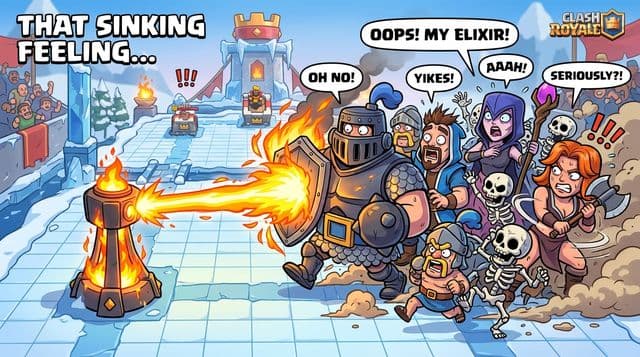 Common mistake: stacking an entire push in one lane only to watch it melt to a single Inferno Tower
1. Playing cards at the bridge with no plan
The number one mistake at 4000-5000 trophies is dropping a troop at the bridge the moment you hit 4-5 elixir. Every card you play should have a purpose: defend a push, start a counter-attack, or bait a specific response. If you cannot explain why you are playing a card, do not play it. Waiting and letting elixir build is almost always better than throwing away 4 elixir on an unsupported push.
2. Ignoring elixir trades
A Wizard costs 5 elixir. Skeletons cost 1 elixir. If Skeletons fully distract and kill a lone Wizard (they can, with tower help), you just gained a 4-elixir advantage. That advantage compounds. Two positive elixir trades of +2 each give you enough extra elixir to build a real push. Track these trades consciously. Ask yourself after every defense: "Did I spend less elixir than they did?"
3. Over-leveling the wrong cards
Players dump all their gold and wild cards into their favorite legendary or their highest-damage troop. This is backwards. Your win condition and your primary defensive card should be upgraded first. A Level 13 Wizard behind a Level 10 Giant accomplishes less than a Level 13 Giant behind a Level 10 Wizard, because the Giant is the card that needs hitpoints to function.
4. Switching decks after every loss
Every deck has bad matchups. Hog 2.6 will lose to certain Mega Knight decks. Giant Double Prince will struggle against Bowler. That does not mean the deck is broken — it means you hit a bad matchup. If you switch decks every 2-3 losses, you never develop the muscle memory and matchup knowledge needed to climb. Commit to one deck for at least 50 games before evaluating whether it works for you.
5. Placing all troops in one lane
Stacking your entire push in one lane gives your opponent maximum value from splash troops and spells. A single Fireball on your clumped Musketeer + Ice Spirit + Skeletons wipes 6 elixir of value. Spread your troops. Place ranged units in the opposite lane where they can still shoot across but cannot be splashed with your push.
Card Level Priority
Not all cards benefit equally from levels. Here is a general priority for upgrading at 4000-5000 trophies:
Upgrade first (biggest impact per level):
- Win conditions (Hog Rider, Giant, Miner) — more hitpoints = more tower connections
- Primary defensive buildings (Cannon, Tombstone) — survive one more hit from the opposing push
- Medium-health troops (Musketeer, Mega Minion, Electro Dragon) — surviving Fireball at matching levels is a make-or-break interaction
Upgrade second (moderate impact):
- Spells (Fireball, Poison) — killing a Musketeer or Wizard with Fireball at matching levels changes everything
- Secondary win conditions (Prince, Dark Prince) — charge damage scales well
Upgrade last (minimal impact):
- Cycle cards (Ice Spirit, Skeletons) — they do their job at any level
- Swarm cards (Bats, Goblin Gang, Spear Goblins) — they die to spells regardless of level
- Zap and The Log — the main purpose is the stun/knockback, not the damage (exception: Log needs to kill Goblin Barrel at matching levels)
Gold efficiency tip: One Common card from Level 11 to Level 12 costs 50,000 gold. One Legendary from Level 11 to Level 12 costs 100,000 gold. Upgrading two Commons gives you more overall power than one Legendary upgrade. Prioritize Commons and Rares in your main deck before Legendaries.
When to Switch Decks
Do not switch decks lightly. But there are legitimate reasons to change:
Switch if your deck requires a card level breakpoint you cannot reach. Example: Hog 2.6 struggles badly if your Musketeer dies to a same-level Fireball (which happens when she is two levels below). If you cannot get Musketeer to at least Level 11, consider Giant Double Prince where no single troop depends on surviving a specific spell.
Switch if you consistently lose to the same archetype and that archetype makes up 30%+ of your matches. At 4000-5000, you will see a lot of Mega Knight, Wizard, and Witch. If your current deck has no answer to Mega Knight, switching to a deck with Inferno Dragon or Prince (who can tank the jump and counter-charge) is a practical decision.
Switch if you have played 50+ games and your win rate is below 45%. That is enough sample size to separate bad luck from a genuine mismatch between the deck and your playstyle.
Do not switch because you lost 3 games in a row. Tilt happens. Take a break, come back, and play 10 more games before deciding. Do not switch because a YouTuber posted a "NEW BEST DECK" — those videos are optimized for clicks, not for your card levels and playstyle.
Do not switch mid-season in the last week. You will not have time to learn the new deck before the season resets. Switch at the start of a new season when you have 4 weeks to develop your skills with the new deck.
Recommended Next Reads
- Best Clash Royale Decks for 5000-5600 Trophies — Challenger 3 Guide (2026) — next trophy range after Challenger 2
- Clash Royale Elixir Management Guide: Win More Games Without Better Cards — core skill at 4000+ (mentioned as key differentiator)
- How to Build a Deck in Clash Royale: Complete Deck Building Guide 2026 — how to adapt these decks to your playstyle
- How to Counter Mega Knight: Best Placements, Counters & Anti-Mega Knight Decks — Mega Knight counters (guide ends with MK Q&A)
- How to Play Hog 2.6 Cycle: Complete Deck Guide & Cycle Math (May 2026) — deeper dive into Hog 2.6 fundamentals
Frequently Asked Questions
What is the best single deck for 4000-5000 trophies?
Hog 2.6 Cycle. It is the most level-independent deck in the game, meaning your skill matters more than your card levels. It also teaches fundamentals (cycling, defending, spell timing) that transfer to every other deck. The downside is the learning curve — expect to lose your first 20-30 games while you learn defensive placements. After that, it becomes the most consistent climbing deck in this range.
Are these decks free-to-play friendly?
Yes. All three decks use mostly Commons and Rares, which are the easiest cards to upgrade. Hog 2.6 has zero Legendaries. Giant Double Prince has zero Legendaries. Mega Knight Bait uses two Legendaries (Mega Knight and Miner), but both are available through trophy road and trade tokens. You do not need to spend money to max these decks — just focus your upgrades on one deck at a time instead of spreading resources across 30 cards.
How long does it take to get from 4000 to 5000 trophies?
With a focused deck and deliberate practice, most players can climb from 4000 to 5000 in 2-4 weeks of regular play (5-10 matches per day). The biggest factor is not the deck — it is avoiding tilt. If you lose two games in a row, stop playing ladder and switch to party mode or challenges for the day. Tilt losses at 4000-4500 can erase 2-3 days of progress in 30 minutes.
Should I use Mega Knight if I keep losing to him?
Using Mega Knight yourself is one option, but a better long-term strategy is learning to counter him. Mega Knight costs 7 elixir and does zero damage to buildings. A 4-elixir Inferno Dragon behind your tower kills Mega Knight before he reaches it. A 3-elixir Knight placed directly on top of Mega Knight after his jump tanks him long enough for the tower to finish him off. The players who climb past 5000 are the ones who learned to profit from opponents dropping 7 elixir on a predictable card, not the ones who started using him themselves.