
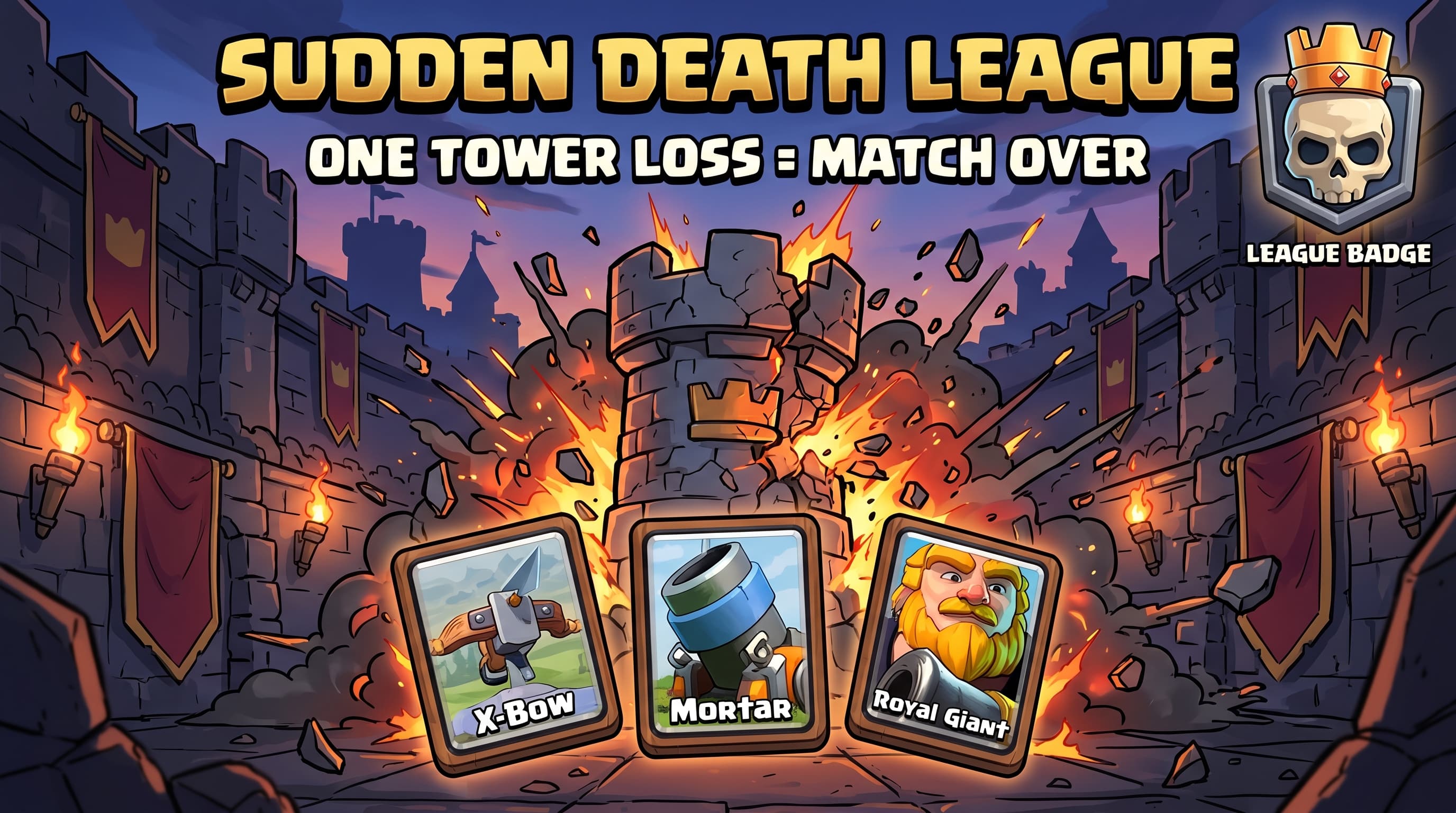
Quick answer: The Sudden Death Competitive League runs May 18 to May 28, 2026 with a one-tower-loss elimination rule - lose any Crown Tower and the match ends instantly - making defensive fortress decks (X-Bow siege, Mortar control, Royal Giant control with Inferno Tower) the highest-EV builds, with 15 wins required for the League Badge and a Top 10K Leaderboard Finisher Badge for elite placement.
10 days, 1 tower lost = match over, 15 wins for the League Badge, 0 second chances. The Sudden Death Competitive League runs from May 18 to May 28, 2026 during Week 3-4 of Siege & Swish Season 83. The format's headline rule - lose any Crown Tower and the match ends instantly - flips standard deck-building priorities. Even-elixir-trade tempo plays become unacceptable; one chip-damage mistake ends the game. Fortress decks (X-Bow siege, Mortar control, Royal Giant control) dominate; all-in spam decks collapse.
What Is Sudden Death?
Sudden Death is a ranked competitive league format with a single rule modification: the first player to lose any Crown Tower loses the match. There is no Crown count tiebreak, no King Tower activation, and no overtime. A single Crown Tower at 1 HP loses to a single Goblin Barrel hit, regardless of how dominant the rest of the match has been.
The format runs May 18 to May 28, 2026 (10 days) and shares the standard Royal Tournament rules otherwise:
- Card levels capped at Level 11
- Heroes, Evolutions, and Tower Troops all allowed
- Standard 3-minute match timer (with a draw if neither tower falls)
Reward structure: 15 wins unlocks the Sudden Death League Badge, and the top 10,000 finishers globally earn a Top 10K Leaderboard Finisher Badge. For broader ranked context, see the Ranked Mode Guide 2026.
How Does One-Tower-Loss Change Deck Building?
In standard Royal Tournament play, a Crown Tower can take 2 fireballs and a Hog Rider hit before falling - players accept chip damage as a cost-of-tempo. In Sudden Death, every chip is potentially lethal because a 50-HP tower loses to a single Skeleton attack.
That changes three first-principle deck-building priorities:
- Defense is non-negotiable. Every deck needs a multi-layered defensive core: a building (Tesla, Cannon, Inferno Tower), a swarm (Skeletons, Goblins), and a splash defender (Bomber, Valkyrie).
- Spell HP becomes critical. Cards that survive a Fireball at full HP (Musketeer 618 HP, Wizard 598 HP, Witch 650 HP) gain value. Cards that die to Fireball (Goblins, Skeletons, Princess) become liabilities when stacked.
- Win-condition trades reverse. You don't need to win the win-condition trade; you need to not lose the tower trade. Decks that can defend a Hog Rider for under 4 elixir without taking chip damage are top-tier.
For deck-building first principles, the Deck Building Guide covers cycle math.
What Are the Best Sudden Death Decks?
Three deck archetypes dominate Sudden Death pre-format testing.
Best Deck #1: Classic 2.9 X-Bow
X-Bow wins Sudden Death because the deck is built around never losing a tower trade. Tesla plus Knight plus Skeletons defends nearly every push under 6 elixir without chip damage. The X-Bow itself wins by slow chip into a single tower, and once your X-Bow connects 3-4 hits, the opponent can no longer defend without losing their own tower. Projected win rate: 62-65%.
Best Deck #2: Mortar Control
Mortar control thrives on the defensive Mortar placement - placing Mortar 3 tiles back from the bridge defends as a building first, then chips as a win-condition. Knight plus Mini PEKKA covers tank defense. The deck's weakness is air-heavy opponents (Lava Hound, Balloon), but those are uncommon in Sudden Death because air-tank decks struggle to defend without chip damage. Projected win rate: 58-62%.
Best Deck #3: Royal Giant Fortress
Royal Giant Fortress is the slowest Royal Giant variant in the meta - it sacrifices push speed for defensive depth. Inferno Tower handles tank threats, Mega Minion plus Hunter handle splash, and Lightning forces tower trades on your terms. The deck wins by defending two pushes cleanly, then committing one Royal Giant to a tower the opponent has spent down on. Projected win rate: 57-60%.
For Royal Giant variants, also see the Cannon Nerf Hog Cycle 7000 Trophies guide for control-cycle decision-making.
Which Decks Are Worst in Sudden Death?
Beatdown decks without strong defense and all-in spam decks both collapse in Sudden Death.
| Archetype | Why It Fails |
|---|---|
| Pure Beatdown (Golem) | Slow setup leaves you vulnerable to chip; one Miner hit can lose tower |
| Lava Hound Loon | Two air win-conditions but defensive holes against ground rush |
| Three Musketeers Bridge Spam | High elixir trades create tower openings |
| Mega Knight Bait | All-in defense fails against second push |
| Goblin Barrel Cycle | Trades chip for chip - fatal in Sudden Death |
| Hog 2.6 (without Cannon) | Cycle-only without strong defensive trades |
The general rule: if your deck wins by even-elixir trades, it loses Sudden Death. Decks that win by defensive elixir advantage thrive. The Mega Knight Guide explains why Mega Knight Bait struggles in defensive formats.
What's the Best Sudden Death Strategy?
Three principles drive Sudden Death win rates:
Principle 1: Defense First, Always
Your first 30 seconds should be defensive observation. Don't commit elixir to a push until you see your opponent's archetype. A 3-elixir lead at the 1-minute mark is worth more than a 200-damage chip lead in Sudden Death.
Principle 2: Defensive Buildings Are Mandatory
Every viable Sudden Death deck runs a defensive building - Tesla, Cannon, Inferno Tower, Bomb Tower, or Tombstone. Buildings provide the stationary anchor that prevents single-push tower losses. Decks without a building have roughly 10-15% lower win rates in Sudden Death testing.
Principle 3: Spell Cycle Carefully
In standard play, Fireball-into-tower for a 1-for-2 trade is acceptable. In Sudden Death it's strongly negative EV - you've spent 4 elixir for chip damage that helps your opponent more than you (since they only need to chip your tower instead of fully destroy it). Save Fireball for value trades worth 5+ elixir.
For comeback principles (relevant when you're 1 chip away from losing), see Comeback Strategy Guide.
How Do Sudden Death Tower Trades Work?
Tower trading is a standard tactic in Royal Tournament: you accept losing 1 tower to gain a 2-tower lead. In Sudden Death, this is suicidal - the moment you lose 1 tower, the match ends.
The corollary: your opponent cannot trade towers either. This means bridge-spam pressure on both sides simultaneously (a common high-tempo tactic) becomes a risk for both players. The first player to commit to dual-lane offense usually loses Sudden Death.
Optimal strategy: single-lane consistent pressure. Pick one lane, build a defensive fortress on the other, and grind chip damage through repeat win-condition rotations.
What's the 15-Win League Badge Threshold?
The Sudden Death League Badge requires 15 wins during the May 18-28 window. The 15-win mark unlocks:
- Sudden Death League Badge (profile cosmetic, season-exclusive)
- Hero Dark Prince Immune emote at the 15-win unlock (per the Siege & Swish Season 83 Guide emote schedule)
Realistic 15-win pace: 3-4 hours of focused play per day at 6,000+ trophies for a top-quartile player. F2P players with smaller Hero collections may struggle - Hero presence in opponent decks is high in Sudden Death because Hero abilities create defensive elixir advantages.
What Is the Top 10K Leaderboard Finisher Badge?
The Top 10K Leaderboard Finisher Badge awards to the top 10,000 players globally by net wins (wins minus losses) at tournament close on May 28, 2026. Realistic top-10K threshold based on prior Sudden Death cycles: 30-40 net wins.
Strategies for chasing top-10K:
- Lock in your single best fortress deck and don't deck-switch.
- Play during off-peak hours (00:00-06:00 UTC for matchmaking against fewer top-tier players).
- Track win rate by archetype matchup - if your deck loses to X-Bow at sub-45%, switch to a deck that beats X-Bow.
Use the Meta Tracker to monitor archetype shifts during the league.
Sudden Death vs Standard Ranked: Key Differences
| Dimension | Standard Ranked | Sudden Death |
|---|---|---|
| Win condition | 2 Crowns OR Crown count tiebreak | First tower lost ends match |
| Tower trades | Acceptable | Suicidal |
| Best archetype | Beatdown / Bridge Spam | Fortress / Siege |
| Spell cycle EV | Positive (chip wins) | Negative (chip loses) |
| Hero EV | High | Mixed (defensive Heroes high, offensive Heroes low) |
| Best card | Hog Rider | X-Bow |
For standard ranked context, see Ranked Mode Guide 2026.
What Common Mistakes Define Bottom-Tier Sudden Death Players?
Five mistakes define the bottom 30% of Sudden Death players in prior cycles:
- Running standard ladder decks unchanged. Beatdown ladder decks lose 5-10 percentage points of win rate in Sudden Death.
- Spell-cycling for chip. Fireball-into-tower is negative EV here.
- Dual-lane pressure. Splitting attacks lets the opponent commit to one lane uncontested.
- Forgetting Hero abilities create elixir advantages. Defensive Hero ability uses (Hero Mega Minion warp, Hero Magic Archer) are critical in Sudden Death.
- Switching decks after one loss. Sudden Death has high variance; commit to a deck for at least 10 matches before evaluating.
The Deck Doctor and Counter Lookup help validate your Sudden Death lineup against the projected meta.
Recommended Next Reads
- How to Counter X-Bow: Positioning, Punish Pushes & Anti-Siege Decks — countering the dominant Sudden Death archetype
- How to Counter Mortar Cycle in Clash Royale: Siege Pressure, Punish Pushes & Anti-Mortar Decks — detailed anti-Mortar defensive setups
- How to Play Evo Royal Giant Cycle: The 56-60% Win Rate Ladder Crusher (May 2026) — Royal Giant Fortress cycle and elixir math
Frequently Asked Questions
When does Sudden Death start and end?
The Sudden Death Competitive League runs from May 18, 2026 to May 28, 2026 (10 days). The leaderboard locks at 09:00 UTC on May 28.
What happens when you lose a tower in Sudden Death?
The match ends immediately when any Crown Tower is destroyed. There is no King Tower activation, no Crown count tiebreak, and no overtime - first tower lost loses the match.
What is the best deck for Sudden Death?
Classic 2.9 X-Bow is projected as the best Sudden Death deck with a 62-65% win rate, followed by Mortar Control (58-62%) and Royal Giant Fortress (57-60%). All three are fortress archetypes built around never losing a tower trade.
How many wins do I need for the Sudden Death League Badge?
You need 15 wins during the May 18-28 window for the League Badge. The Top 10K Leaderboard Finisher Badge additionally requires top-10,000 placement globally by net wins.
Are Heroes allowed in Sudden Death?
Yes - Heroes are allowed (unlike Mega Draft). Hero Dark Prince and Hero Bowler from Siege & Swish Season 83 are both legal. Defensive Heroes (Hero Magic Archer, Hero Mega Minion) tend to outperform offensive Heroes in Sudden Death.
Is Beatdown viable in Sudden Death?
Generally no. Pure Beatdown (Golem, Lava Hound) struggles because slow setup time lets the opponent chip your tower for the win. Beatdown decks with strong defensive cores (Royal Giant Fortress) are the exception.
Can I draw a Sudden Death match?
Yes - if neither tower falls within the 3-minute match timer, the match ends in a draw. Draws count for neither win nor loss toward the 15-win threshold but are tracked toward your win-rate statistic.
What Happens After the Sudden Death League Ends on May 28?
The Sudden Death League closes its leaderboard at 09:00 UTC on May 28, 2026 — two days after the May 26 Q2 update ships Collection Levels, the Seasonal Trophy Road split, and the Mastery rework. Any rewards you earn during the league still pay out in the new economy. For the full list of what changes in the post-league patch window, see the Q2 May 2026 Update Hub.