
Clash Coach AI
How to Build a Deck in Clash Royale: Complete Deck Building Guide 2026
0-14000+ trophies

How to Build a Deck in Clash Royale: Complete Deck Building Guide 2026

Updated Mar 202619 min readclash royalehow to build a deck clash royaleclash royale deck building guidebest deck clash royale 2026deck building tips clash royaleclash royale deck guidehow to make a good deck clash royaleclash royale deck slots 2026

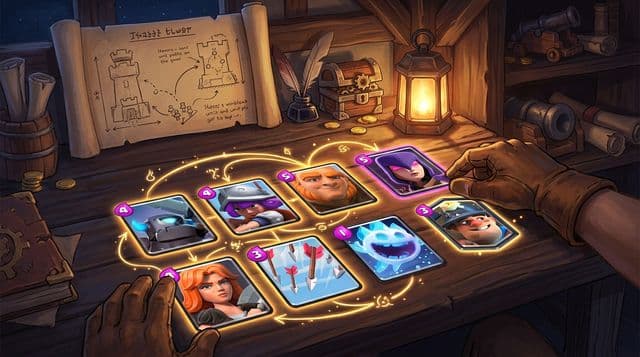
Quick answer: Every winning Clash Royale deck follows a formula: 1 win condition, 1 big spell, 1 small spell, 1 tank killer, 1 splash unit, 1 air counter, and 2 cycle/support cards. Keep your average elixir between 2.8 and 4.2. In the March 2026 system, fill all three deck slots -- one Evolution, one Hero, and one Wild (which can hold an Evolution, Hero, or Champion). Leaving any slot empty is giving your opponent a free advantage.

How to Build a Deck in Clash Royale: Complete Deck Building Guide 2026

**Methodology:** Strategies validated from 300+ ladder replays (snapshot: March 2026) and 50+ live test games per topic.

The difference between a 5000-trophy player and a 7000-trophy player is rarely mechanical skill. It is deck construction. A well-built deck has answers to every archetype, a clear path to tower damage, and an elixir curve that lets you cycle back to your key cards before your opponent cycles back to theirs. A poorly built deck has two tank killers, no win condition, and gets hard-countered by any competent Logbait player.

This guide gives you the complete framework for building decks that work on ladder, in challenges, and in Clan Wars -- including the new March 2026 deck slot system with dedicated Evolution, Hero, and Wild slots.

The 8-Card Formula

Every competitive Clash Royale deck fills eight specific roles. You do not need to memorize a list -- you need to understand why each role exists and what happens to your deck if you skip one. Think of it like a football team: a squad of eleven strikers might sound powerful, but without a goalkeeper, you lose every game.

Your Win Condition Is Your Identity

The win condition is the card that actually takes towers. Without one, you are relying on chip damage and spell cycling to deal tower damage, which takes too long against competent opponents who defend efficiently. Your win condition defines your entire playstyle -- it is the card you build every other decision around.

Win conditions fall into distinct categories. Fast cycle win conditions like Hog Rider, Wall Breakers, and Miner are cheap, deployed at the bridge, and rely on out-cycling the opponent's counter. You play them, they get defended, you cycle through your other seven cards and play them again before the opponent can cycle back to their answer. Heavy beatdown win conditions like Golem, Lava Hound, and Giant are expensive, built from behind the King Tower with support troops stacking behind them, creating an overwhelming push. Siege win conditions like X-Bow and Mortar lock onto the tower from your side of the arena, meaning they never cross the bridge. Spell bait win conditions like Goblin Barrel and Royal Hogs force the opponent to spend their key spell on something else, then punish when that spell is out of rotation. Bridge spam win conditions like Battle Ram and Ram Rider pressure the bridge with fast troops that demand an immediate response.

A common beginner mistake is running two win conditions that do not synergize. Miner + Goblin Barrel works because Miner tanks for the Goblins -- the tower shoots the Miner while the Goblins stab freely. Golem + Hog Rider does not work because you never have enough elixir to support both -- Golem costs 8 and Hog costs 4, leaving zero elixir for defense after a push. If you run two win conditions, one must directly enable the other.

Spells Are Not Optional

Every deck needs exactly two spells: one big and one small. Big spells -- Fireball (4 elixir), Poison (4), Lightning (6), Rocket (6) -- deal high damage to towers and kill medium-HP support troops like Musketeer, Wizard, and Electro Wizard. They are essential for removing the opponent's key defenders when you push and for closing out games when the tower is low on HP.

Small spells -- Log (2 elixir), Zap (2), Snowball (2), Arrows (3) -- handle swarms, reset Inferno Tower, and finish off low-HP troops. They cycle quickly and solve problems that a big spell would be wasteful on. Spending 4 elixir to Fireball a Skeleton Army is a bad trade; spending 2 elixir to Log them is efficient.

The choice between spells should address your deck's specific weaknesses. If your deck has no other answer to Inferno Tower, run Zap for the reset. If your deck struggles against Logbait's Princess and Goblin Gang, run Log for the ground-clearing knockback. If your deck has no air defense besides troops, run Arrows to handle Minion Horde. As a general rule, fast cycle decks (under 3.2 average elixir) pair best with Fireball because it is cheap enough to cycle frequently. Control and beatdown decks pair better with Poison or Lightning because they provide sustained area denial or surgical removal of key targets.

The Cards That Keep You in the Game

Beyond your win condition and spells, three roles form the defensive backbone of your deck: a tank killer, a splash unit, and an air counter. Skipping any one of these creates an automatic loss condition against an entire archetype.

A tank killer prevents Golem, Giant, Mega Knight, and P.E.K.K.A. from reaching your tower. Inferno Tower (5 elixir) is the best stationary option -- it locks on, ramps damage, and melts tanks before they connect with your tower. P.E.K.K.A. (7 elixir) is the best troop option because she kills the tank and then counterpushes with 2,000+ remaining HP, forcing the opponent to defend immediately after their push failed. Mini P.E.K.K.A. (4 elixir) is the budget option -- she delivers high damage per second for her cost but dies quickly to swarms. Inferno Dragon (4 elixir) is the flying option, immune to ground-based resets and capable of melting any tank from the air.

A splash unit clears swarms. Without one, Skeleton Army, Minion Horde, and Goblin Gang overwhelm your pushes and your defenders. Valkyrie (4 elixir) is the strongest all-around option because she doubles as a mini-tank -- she clears ground swarms while absorbing damage meant for your tower or your win condition behind her. Baby Dragon (4 elixir) covers air and ground from a flying position. Wizard (5 elixir) deals the highest splash damage but dies to Fireball + Log, making him a risky choice in spell-heavy metas. Executioner (5 elixir) synergizes with Tornado and hits twice per throw with his boomerang.

An air counter prevents Balloon, Lava Hound, Minion Horde, and flying win conditions from taking free tower damage. Musketeer is the most reliable -- high DPS, single target, and she survives Fireball at equal levels. Electro Wizard provides stun-based resets that neutralize Inferno Dragon and Sparky while hitting two targets. Mega Minion is cheap air defense that survives Fireball. If your splash unit already covers air (Baby Dragon, Wizard, Executioner), your air counter slot opens up for a secondary support card.

Cycle Cards: The Engine of Your Deck

The final two slots go to cheap cards -- 1 to 3 elixir -- that cycle you back to your win condition faster and provide flexible defensive utility. Skeletons (1 elixir) distract single-target troops, add DPS behind a tank, and cycle your deck for almost nothing. Ice Spirit (1 elixir) freezes attackers, retargets them onto your tower or a tank, and cycles equally cheaply. Ice Golem (2 elixir) kites tanks across the arena, absorbs tower shots for your Hog Rider, and deals death damage to Bats and Skeletons. Knight (3 elixir) is the versatile mini-tank that handles most ground interactions alone.

The principle behind cycle cards is straightforward: lower cost = faster rotation. A deck running Skeletons and Ice Spirit at 1 elixir each can cycle through four cards in 2 elixir. A deck running Knight and Guards at 3 elixir each needs 6 elixir to do the same thing. That difference means the first deck can play its win condition three times in the span the second deck plays it twice. Cycle speed is a weapon -- it lets you out-rotate your opponent's counter and attack when they do not have their answer in hand.

The Elixir Curve

Your deck's average elixir cost is not just a number in the corner of the deck builder -- it determines your entire playstyle and how forgiving the deck is when you make mistakes.

Decks between 2.6 and 3.0 average elixir are fast cycle decks. You out-cycle the opponent's counters, chip the tower with repeated small attacks, and rely on defensive mastery to survive their pushes with minimal elixir investment. These decks require the highest skill because every misplaced troop or wasted spell sets you back an entire cycle. Hog 2.6, Miner Control, and X-Bow 2.9 live in this range.

Decks between 3.0 and 3.5 are control decks. You defend efficiently, build counterpushes from surviving defensive troops, and use spells for value. This is the most forgiving range for most players -- you have enough cheap cards to cycle smoothly but enough expensive cards to handle big pushes without scrambling. Logbait, Royal Giant decks, and Graveyard decks live here.

Decks between 3.5 and 4.0 are bridge spam and bait decks. You pressure both lanes, force the opponent to split their defensive resources, and punish any elixir they waste. This range starts to punish mistakes noticeably -- an overcommit on offense leaves you vulnerable to a counterpush because you cannot cycle back to your defenders quickly.

Decks between 4.0 and 4.5 are beatdown decks. You play patiently in single elixir, building advantages through efficient defense, then drop your tank in the back when double elixir arrives and stack a massive push. The risk is severe -- one bad elixir trade in single elixir can snowball into a lost tower because you cannot recover cheaply. Golem, Lava Hound, and Giant decks live here.

The sweet spot for most players is 3.0 to 3.8. Below 3.0 requires hundreds of games of practice to execute consistently. Above 4.0 punishes mistakes harshly and struggles against competent cycle players who attack faster than you can rebuild.

The New Deck Slot System (March 2026)

Starting mid-March 2026, the deck builder uses three dedicated slots that replace the previous four-slot system. Understanding these slots is now a fundamental part of deck construction.

The Evolution Slot holds one Evolution card -- an upgraded version of a base card that gains a unique ability after being played a set number of times in a match. This slot unlocks at Arena 3.

The Hero Slot holds one Hero card. Heroes are special card variants with active abilities that you manually trigger during a match, similar to Champions. Heroes became significantly more accessible in the March 2026 update, with Hero Barbarian Barrel and Hero Magic Archer unlocking as early as Arena 5.

The Wild Slot is the most interesting decision. It can hold a second Evolution, a second Hero, or a Champion. This flexibility means you are choosing between three fundamentally different types of power:

A second Evolution gives you two cards with enhanced abilities that activate passively through the cycle system. This is the most consistent option because evolutions activate automatically -- you do not need to time an ability or manage a cooldown. For most players, putting their two strongest evolutions in the Evolution Slot and Wild Slot provides the most reliable value. If you have Evolved Valkyrie and Evolved Cannon, for example, you get a splash defender and a building that both gain free power upgrades every few cycles.

A second Hero gives you two cards with active abilities you can trigger manually. This is the highest-skill option because you are managing two ability cooldowns alongside your normal card rotation. It works well for experienced players who are comfortable with the added complexity, especially if both Heroes synergize with the same deck archetype.

A Champion (Golden Knight, Skeleton King, Archer Queen, or Monk) provides a unique ability on a longer cooldown. Champions are individually powerful but you only get one ability activation per cycle, making them less consistent than two evolutions over the course of a full match.

The critical rule: never leave a slot empty. Every empty slot is a free upgrade you are handing to your opponent. Even a B-tier evolution is better than no evolution. If you have any Evolution, Hero, or Champion unlocked, fill every slot.

Synergy: Why Eight Strong Cards Can Lose to Eight Average Cards

A common trap in deck building is selecting the eight individually strongest cards in your collection and jamming them together. Mega Knight, Wizard, Witch, P.E.K.K.A., Executioner, Baby Dragon, Valkyrie, and Sparky are all powerful cards -- and a deck containing all of them would lose to 2.6 Hog Cycle every single time. Why? Because those eight cards all serve the same role (defense and splash) and none of them reliably reach the tower. The deck has no win condition, no spells, and no plan to actually deal tower damage.

Synergy means your cards amplify each other. Each card should make at least one other card in your deck better at its job.

How Tanks Enable Damage Dealers

The most fundamental synergy in Clash Royale is a tank absorbing hits while a damage dealer fires freely from behind. Golem walks down the lane drawing every tower shot and defensive troop's attention. Night Witch behind him spawns Bats in peace because nothing is targeting her. Ice Golem placed at the bridge two tiles ahead of Hog Rider absorbs the first tower shot and the Skeleton Army the opponent drops -- the Hog reaches the tower untouched. Knight at the bridge soaks fire while Goblin Barrel's Goblins stab the tower from behind.

Notice the pattern: the tank does not need to deal damage. Its job is to absorb it. The damage dealer does not need to survive. Its job is to deal damage while the tank draws fire. When both cards are played together, the total value exceeds what either card would produce alone.

How Spell Bait Forces Impossible Choices

Spell bait synergy is more subtle but equally powerful. The principle is that multiple cards in your deck die to the same spell, so the opponent must choose which one to spell. The one they leave alive gets full value.

In a classic Logbait deck, Princess, Goblin Gang, and Goblin Barrel all die to Log. If the opponent Logs your Princess, Goblin Gang gets full value on defense and Goblin Barrel gets full value on the tower. If they save Log for Goblin Barrel, Princess chips the tower for free and Goblin Gang provides uncontested defensive DPS. The opponent can only Log once per rotation -- you have three cards that demand it. That imbalance is the deck's entire win condition.

The same principle works with other spells. Minion Horde, Skeleton Barrel, and Bats all die to Arrows. Include all three and the opponent's single Arrows spell cannot cover everything.

How Tornado Creates Combos

Tornado pulls all enemies to a single point. Any card with splash damage at that point deletes everything. Tornado + Executioner pulls the entire push into the boomerang's path. Tornado + Wizard concentrates scattered troops into his splash radius. Tornado + King Tower activation drags a Hog Rider or Battle Ram into King Tower range, activating a third tower for permanent defensive help.

Tornado also works offensively. Pull the opponent's defensive troops away from your push path, or pull their ranged defender into your melee attacker's range. It is the most versatile spell in the game, but it requires a splash partner to reach full value -- running Tornado without Executioner, Wizard, or Baby Dragon wastes half its potential.

How Lumberjack Enables Burst Attacks

Lumberjack drops a Rage spell when he dies. Cards placed directly behind him accelerate the moment he falls. The classic combo is Lumberjack + Balloon: Lumberjack runs ahead, dies to the first defensive troop, and the Rage spell accelerates Balloon's approach and bomb drop speed. The opponent has about half the normal reaction time to respond. Lumberjack + Elite Barbarians creates a Raged melee rush that shreds towers in two seconds without splash defense.

The key is positioning. Lumberjack needs to die before the damage dealer arrives. Place him at the bridge first, then drop the damage dealer two seconds later so it enters the Rage zone right as Lumberjack falls.

Common Deck Building Mistakes

No Win Condition

A deck with Mega Knight, Wizard, Witch, P.E.K.K.A., and Valkyrie looks terrifying but has no way to consistently deal tower damage. Every card in that list is a defender -- none of them reliably reach the tower against a competent player who places one cheap unit in their path. You will defend everything your opponent throws at you and still lose because you never took a tower. Always include a dedicated win condition that is designed to reach or target the tower.

Two Big Spells

Running Fireball and Rocket together wastes a card slot. You only need one big spell per deck. The second slot is better spent on a support troop or cycle card that contributes to both offense and defense every cycle, rather than sitting in your hand waiting for one specific scenario. If you find yourself wanting two big spells, it usually means your deck lacks a proper win condition and you are trying to compensate with spell cycling damage.

All Expensive Cards

A deck averaging 4.5+ elixir gets punished the moment you make one mistake. You leak elixir constantly in single elixir time because the bar fills up while you wait for an opportunity to play your 7-elixir card. Fast cycle opponents run circles around you, playing their Hog Rider three times while you are still cycling to your second Golem. Keep at least two cards at 1-2 elixir for cycling -- they keep your rotation smooth and give you cheap answers to small threats that do not warrant an expensive response.

No Air Defense

If your only air counter is Arrows, a Lava Hound player will destroy you. Arrows kill Lava Pups after the Hound pops, but the Hound itself deals massive tower damage while you have nothing to shoot it down. You need at least one card that targets air with sustained damage -- Musketeer, Mega Minion, Bats, Tesla, or a flying splash unit like Baby Dragon. Check your deck against the question: "What do I play when my opponent drops Balloon at the bridge?" If the answer is "nothing that reaches it in time," your deck has a fatal gap.

Copying Pro Decks Without Understanding Them

A Grand Challenge winning deck played by a top 100 player may require specific interactions that only work at max level with perfect timing. The 2.6 Hog Cycle deck is one of the strongest decks in the game's history, but its defensive sequences -- Cannon + Ice Golem to kite a Golem diagonally while Musketeer shoots from the opposite lane -- require hundreds of games to learn. If you copy the deck but cannot execute those placements, you will lose to every Golem player and conclude that "2.6 is bad" when the problem is execution, not the deck.

Before copying a pro deck, watch three replays of a top player using it. Pay attention to which card they play first, where they place their defenders, and how they respond to different matchups. If you cannot replicate those patterns, the deck will not work for you regardless of how strong it is on paper.

Building Your First Deck: A Walkthrough

If you are new to deck building, this walkthrough builds a deck from scratch using the principles above. Follow it step by step and you will end up with a deck that covers every role, sits at a comfortable elixir average, and can compete on ladder to 6000+ trophies.

Start with your win condition. Pick the card you enjoy playing most or have leveled highest. For this example, Hog Rider -- a 4-elixir fast cycle win condition that rewards aggressive bridge pressure.

Add Fireball as your big spell. At 4 elixir, Fireball is the most versatile big spell in the game. It kills Musketeer, Wizard, and Electro Wizard, and it provides reliable tower chip damage.

Add Log as your small spell. Log clears ground swarms (Goblin Gang, Skeleton Army, Princess) and adds a sliver of tower chip damage every time you play it. Against Logbait opponents, it is your primary answer to Goblin Barrel.

Add Mini P.E.K.K.A. as your tank killer. At 4 elixir, she is the cheapest dedicated tank killer. She deletes Hog Rider, Knight, and Valkyrie on defense, and her remaining HP after a defensive interaction can translate into a counterpush threat.

Add Valkyrie as your splash unit. She clears ground swarms, tanks damage, and counterpushes after surviving defensive interactions. She doubles as a mini-tank for your Hog Rider -- place her at the bridge ahead of Hog and she absorbs the first defensive troop's attention.

Add Musketeer as your air counter. She handles Balloon, Lava Hound, Minion Horde, and Baby Dragon with consistent ranged DPS. On the ground, she provides supporting fire behind your Hog pushes.

Add Skeletons and Ice Spirit as your cycle cards. At 1 elixir each, they keep your average cost low (3.0), cycle you back to Hog Rider quickly, and provide surprising defensive value. Skeletons distract Mini P.E.K.K.A. and P.E.K.K.A. for three full swings. Ice Spirit freezes an entire push for 1.5 seconds, buying your tower time to deal damage.

Fill your deck slots. Put your highest-level Evolution in the Evolution Slot -- if Valkyrie or Musketeer are available as evolutions, they fit naturally because they are already in your deck. Put your best Hero in the Hero Slot. Put your second-best Evolution or a Champion in the Wild Slot.

The finished deck: Hog Rider, Fireball, Log, Mini P.E.K.K.A., Valkyrie, Musketeer, Skeletons, Ice Spirit. Average elixir: 3.0. Every role is covered. The game plan is clear: defend with Mini P.E.K.K.A. and Valkyrie, cycle Hog Rider to the tower repeatedly, use Fireball for value, close out with spell chip in overtime.

Frequently Asked Questions

How do I know if my deck is bad?

If you consistently lose to one specific archetype -- for example, you lose every game against Lavaloon -- your deck has a structural gap. Check whether you are missing an air counter, tank killer, or splash unit. A well-built deck has difficult matchups but no complete auto-losses. If one archetype beats you 90% of the time, the deck is missing a role.

Should I copy meta decks or build my own?

Copy meta decks until you understand why each card is included. Study three different meta decks and ask yourself what role each card fills. Once you can explain every card's purpose in those decks, you have the framework to build effective original decks. Most players below 7000 trophies benefit more from mastering a proven meta deck than from experimenting with untested original builds.

How many decks should I have ready?

Three minimum: one for ladder, one for challenges (where card levels are standardized), and one for Clan Wars. Four is ideal if you play Clan Wars regularly, since Clan Wars require four non-overlapping decks. Resist the urge to maintain ten decks -- spreading your attention across too many decks prevents you from mastering any single one.

Does card level matter more than deck building?

Below 6000 trophies, card levels matter more. A well-built Level 11 deck will still lose to a poorly built Level 15 deck because raw stats overwhelm strategy when the gap is four levels wide. Above 6000 trophies, where card levels start to equalize, deck building and player skill become the primary differentiators. The ideal approach is to build a well-structured deck and then invest all your upgrade resources into leveling those specific eight cards rather than spreading gold across many cards you rarely use.

When should I change my deck?

Only change your deck when a balance update significantly nerfs one of your key cards, or when you have leveled new cards that enable a stronger archetype. Constantly switching decks is one of the most common mistakes in Clash Royale -- every time you switch, you reset your matchup knowledge, your muscle memory for placements, and your understanding of the deck's rhythm. Players who stick with one deck for months and master its nuances consistently outperform players who chase the meta with a new deck every season.

This material is unofficial and is not endorsed by Supercell. For more information see Supercell's Fan Content Policy: www.supercell.com/fan-content-policy.