
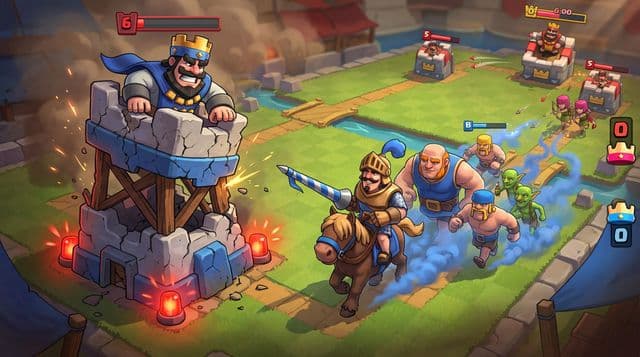
Quick answer: When you are losing a tower in Clash Royale, immediately pressure the opposite lane to split your opponent's elixir, defend efficiently with minimum elixir, and in double elixir commit your strongest push all at once. Never over-defend — every extra elixir wasted on defense is elixir you cannot use to take a tower.
Being down a tower in Clash Royale is not a death sentence. It is a pressure situation that your opponent must manage — and pressure creates mistakes. The players who climb from 5000 to 7000+ trophies are not those who never fall behind. They are the ones who execute cleanly when they are down, converting defensive efficiency into offensive pressure. This guide gives you five concrete strategies for coming back from a tower deficit.
Why Most Players Cannot Comeback
The most common comeback failure is panic over-defense. Your opponent takes your tower and pushes again immediately. You spend 14 elixir stopping it perfectly. They rebuild with 6 elixir they saved. They push again. You spend 12 stopping it. By the time double elixir arrives, you are exhausted and they have been generating pressure the entire game.
The correct mental model: a tower you lost is gone. Your energy goes entirely into taking one of theirs. You defend just enough to prevent the second tower from falling (spend 6–8 elixir maximum on defense), and every remaining elixir goes into offense.
Down a tower is also a psychological trigger for your opponent to play it safe. Safe players make predictable decisions. Predictable decisions are easier to read and punish.
Want this kind of analysis for your own deck?
TrophyCoach reads your battle log and writes a personalized action plan against the current meta — free to start.
Strategy 1: King Tower Activation with Tornado
King Tower activation is the highest-value defensive technique available when you are behind. Once your King Tower shoots even once, it remains active for the entire game — giving you a permanent third tower defending every push.
The Tornado trick is the cleanest way to activate it intentionally. Place a Tornado spell so that it pulls enemy troops into the edge of your King Tower's range. The King Tower automatically fires one shot, registers the enemy, and stays active permanently from that point forward.
Ideal activation scenario: your opponent sends a Hog Rider or Battle Ram toward your Princess Tower. Place Tornado to drag the troop slightly toward the center. The King Tower range extends roughly 9 tiles from its base — you do not need the troop to reach the King Tower, only to enter that radius while the Tornado is active.
Once the King Tower is on, every future push your opponent sends is fought by two Princess Towers and a King Tower simultaneously. Their 10-elixir push now needs to deal with three shooters. The damage reduction on their attacks is dramatic, allowing you to defend more pushes with less elixir — which accelerates your comeback.
If your deck includes Tornado and you are behind, look for the King Tower activation in every push your opponent makes. It is worth spending 2 elixir at a slightly suboptimal defensive moment just to trigger it.
Strategy 2: Opposite Lane Pressure During Their Push
The moment your opponent commits their push, they are temporarily low on elixir. That is your attack window. Send your win condition — Hog Rider, Balloon, Goblin Barrel, Battle Ram — to the tower they are not defending.
This forces an impossible choice. If they defend your opposite-lane push, their main push reaches your tower with no support troops and is easier to stop. If they ignore your opposite-lane push, their open tower takes damage. Neither outcome is good for them.
Opposite lane pressure is most powerful against beatdown decks (Golem, Giant) because they invest 7–8 elixir in a slow-moving tank. By the time their tank crosses the river, your opposite-lane push is already attacking. They have 2–3 elixir. They cannot adequately defend both.
Against faster decks (Hog Rider cycle, Bait), opposite lane pressure requires more precision — their defender cards cycle back quickly. Time your push for the exact moment they play their win condition, not two seconds later when they already have elixir regenerating.
Strategy 3: Double Elixir All-In Commitment
When double elixir starts (at 2:00 remaining in a standard game), every second produces elixir twice as fast. If you are behind on towers, this is your best window. Do not play conservatively.
Commit your entire hand. Build the largest, most expensive push you can assemble. If your deck includes a tank, place it at the back of your side immediately when double elixir begins so it has time to walk forward with full support behind it. Add your best support troops: splash damage behind the tank (Wizard, Night Witch), ranged DPS (Musketeer), and any spell to clear defensive buildings in the path.
Do not hold cards "just in case." The worst outcome of holding back is that you lose on the current tower deficit. The best outcome of committing everything is that your massive push overwhelms their defense and takes the tower. The math favors going all-in.
In double elixir, a 15-elixir push is buildable in roughly 22 seconds. If you land that push with good support, most opponents cannot defend it with their remaining elixir unless they also go all-in. Make them spend everything on defense, and immediately build your second push from whatever defense you can muster.
Strategy 4: Defense First, Elixir Lead Second
Elixir advantage is more valuable than tower HP. If you defend a 10-elixir push by spending only 5 elixir, you have 5 elixir to attack and they have 0 to defend. That gap is enormous. Even if your tower took 600 damage during the defense, you are winning the next exchange.
Disciplined defense means knowing the minimum elixir to stop a push and not exceeding it. Against Giant + Musketeer + Mega Minion (roughly 12 elixir), your Inferno Tower plus a Fireball on the Musketeer costs approximately 9 elixir and stops it completely. If you also add Mini P.E.K.K.A. and Ice Spirit out of anxiety, you spent 13–14 elixir and gained nothing extra while they rebuild with the elixir they saved.
Track the principle: every elixir you over-defend is one elixir you do not counterpush with. Build the habit of calculating the cheapest effective defense, then immediately divert remaining elixir to offense.
The counterpush timing matters. Launch your counterpush the moment their push dies — not five seconds later when they have regenerated 2 elixir back. Immediately after their troops fall, they are at their most vulnerable.
Strategy 5: Mental Reset Between Matches
Tilt is the biggest killer of comebacks across an entire session. Losing a tower on turn one, then making a frustrated deploy that loses a second tower — that is tilt destroying a winnable game. After any tower loss, pause your internal reaction for two seconds before your next card placement.
Ask yourself: what did I learn from that loss? Did they show a specific win condition? Did they reveal they have no air defense? Did they spend Lightning on my Inferno Tower, meaning they do not have it for the next push? Information gathered on defense is worth the tower you traded.
Between matches, reset fully. Do not carry the emotional weight of a loss into the next game. Your opponent in game three does not care about what happened in game two — and neither should your decision-making.
The practical reset technique: take one full breath between matches. Place your next card only after consciously observing the board state, not reacting to the last thing that happened. Elite players describe this as "playing the current board, not the last one."
Comeback Situations by Tower Deficit
| Situation | Time Remaining | Win Probability | Best Strategy |
|---|---|---|---|
| Down 1 tower | 120+ seconds | 55–65% | Opposite lane pressure + efficient defense |
| Down 1 tower | 60 seconds | 35–45% | All-in push, do not hold back |
| Down 1 tower | 30 seconds | 20–30% | Rocket + largest push simultaneously |
| Down 2 towers | 120+ seconds | 20–30% | King Tower activation + double lane pressure |
| Down 2 towers | 60 seconds | 10–15% | Abandon defense, all offensive resources on one tower |
| Down 2 towers | 30 seconds | 5–10% | Best available push to the weaker tower |
Comeback Patterns Against Each Archetype
Against beatdown decks: defend their big push with minimum elixir (Inferno Tower costs 5, stops Giant or Golem, leaves 5+ for counterpush). The moment their tank dies, counterpush immediately with whatever you saved. Beatdown decks have weak rush defense — one fast Hog push or Battle Ram while they are at 2 elixir generates huge tower damage.
Against cycle decks (Hog Rider, Bait): you cannot out-cycle them with counterpushes alone. Instead, identify the one cycle in their rotation where they misplace a card or spend 1 elixir too many on defense. That window — usually 3–5 seconds — is when you pressure. Make every attack count because you will not get many windows.
Against siege decks (X-Bow, Mortar): the building is locked to one side. Push the opposite lane hard. Their building cannot rotate, so the open tower has limited defense. One committed 8-elixir push to the undefended side often takes it clean.
Recommended Next Reads
- Clash Royale Elixir Management Guide: Win More Games Without Better Cards — The 'Defense First, Elixir Lead Second' principle from this guide
- How to Escape Mid-Ladder in Clash Royale: 5000-6000 Trophy Guide (2026) — Common mid-ladder situations where comeback strategy matters most
- Tilt Meter Explained: How TrophyCoach Detects Tilt Spirals in Clash Royale — Manage mental tilt when down a tower — your biggest comeback killer
- Clash Royale Glossary 2026: Every Term, Mechanic & Strategy Word Explained — Review King Tower activation, opposite lane pressure, and elixir advantage terms
Frequently Asked Questions
How do you activate the King Tower in Clash Royale?
Place a Tornado spell so it pulls enemy troops into the range of your King Tower. The King Tower automatically fires once — and remains permanently active from that point forward. The activation range is roughly 9 tiles from the King Tower base. Tornado is the most reliable activator, but you can also use Fisherman to drag troops close enough to trigger it.
How do you win when you're losing in Clash Royale?
Focus on three things simultaneously: defend with minimum elixir (do not over-spend), counterpush immediately after every defense, and pressure the opposite lane during your opponent's attacks. The comeback is built on small elixir advantages compounding over multiple exchanges. Never try to win in one giant push when behind — build pressure gradually and let double elixir amplify it.
What do you do when you're down 1 tower in Clash Royale?
Apply immediate opposite-lane pressure when your opponent commits their next push. Defend the remaining tower with 6–8 elixir maximum, then counterpush hard. Activate your King Tower with Tornado if possible. In double elixir, commit everything to your strongest push without holding back. The goal is to trade towers (1-1) and then win the remaining single-tower game.
What are the comeback mechanics in Clash Royale?
The main comeback mechanics are: King Tower activation (gives you a permanent third shooter), double elixir acceleration (doubles your push capacity at 2:00 remaining), and the overtime sudden death mechanic (first tower to fall loses). When behind, King Tower activation is the single most impactful passive comeback mechanic available — prioritize triggering it early.