
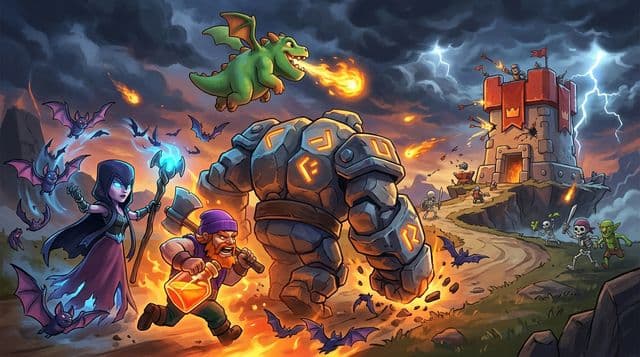
Quick answer: Beatdown decks win by building an unstoppable push in double elixir — a high-HP tank (Giant, Golem, or Mega Knight) with 3-4 support troops stacked behind it. The key is spending the first 2 minutes defending efficiently, building an elixir advantage, then committing everything in the last 2 minutes.
Beatdown is one of Clash Royale's three core archetypes, alongside cycle and control. It works by deploying a large tank (Giant, Golem, or Mega Knight) and stacking damage-dealing support troops behind it. The tank absorbs all damage while support troops destroy the tower.
Unlike cycle decks that win through speed, beatdown wins through raw elixir investment. This makes it powerful in double elixir time and excellent against opponents who run out of counters.
How Beatdown Works: The Core Concept
Beatdown's fundamental principle is forcing your opponent to spend more elixir defending than you spend attacking. A well-built Giant + Musketeer + Witch push costs 10 elixir but forces 12+ elixir of defense.
The three phases of every beatdown game:
- Single elixir (0:00–2:00): Defend passively. Build an elixir lead. Do not commit your tank in single elixir — you cannot cycle back fast enough to support it.
- 2-minute push (2:00–3:00): Start building your push. Drop your tank in the back (King Tower area) and let it walk forward while adding support.
- Double elixir (3:00–4:00+): Commit fully. Both lanes if needed. This is when beatdown is at its strongest — you generate elixir faster than your opponent can cycle to their counters.
Want this kind of analysis for your own deck?
TrophyCoach reads your battle log and writes a personalized action plan against the current meta — free to start.
Beatdown Comparison Table
| Tank | HP | DPS | Best with | Hardest counter | Avg deck elixir |
|---|---|---|---|---|---|
| Giant | 5184 | 0 (no damage) | Musketeer, Witch, Wizard | Inferno Tower | 3.5-4.0 |
| Golem | 6600 (+2 Golemites) | 157 | Night Witch, Baby Dragon, Lightning | Inferno + swarm | 4.2-4.8 |
| Mega Knight | 3300 | 280 (jump: 560) | Miner, Witch, Bats | Inferno Tower, Inferno Dragon | 3.8-4.2 |
| Lava Hound | 3000 (air) | 110 | Balloon, Miner, Tombstone | Mega Minion, Musketeer | 4.0-4.5 |
How to Play the Giant Beatdown Deck
Giant beatdown is the best starting beatdown deck for players new to the archetype. Giant has high HP but deals zero damage — all damage comes from your support troops behind it.
Sample deck
- Giant
- Musketeer
- Witch
- Fireball
- Arrows
- Tombstone
- Skeleton Army
- Baby Dragon
Average elixir: 3.9
Exact plays
- Opening: Never start Giant at the bridge. Always play Giant from the King Tower (back center). This gives your support troops time to stack up behind it before it reaches the bridge.
- Building your push: As Giant walks, add troops behind it in this order — Musketeer first (for ranged DPS), then Witch (for skeleton harassment), then Baby Dragon if you have elixir.
- Defending opposite lane: When opponent sees your push and attacks the other lane, respond with only the minimum defense (Tombstone + one cheap card). Do not split your push.
- Spell usage: Hold Fireball for the opponent's high-elixir defense (Wizard, Musketeer, Executioner) — never waste it on low-cost troops. Arrows for swarms that threaten your Musketeer.
When to commit
Commit your full Giant push when you have 6+ elixir in hand and double elixir just started. If your Giant reaches the bridge and opponent defends with one big card (Inferno Tower, PEKKA), counterpush with all remaining troops to overwhelm the defense.
How to Play the Golem Night Witch Deck
Golem Night Witch is the most powerful beatdown deck but also the most punishing to play — it averages 4.2+ elixir per card, so any misplay leaves you at a severe elixir disadvantage. It dominates double elixir more than any other archetype.
Sample deck
- Golem
- Night Witch
- Baby Dragon
- Mega Minion
- Lightning
- Barbarian Barrel
- Tornado
- Elixir Collector (optional: replace with Dark Prince)
Average elixir: 4.4
Exact plays
- Elixir Collector priority: If you have Elixir Collector in your deck, always play it before any offensive cards. It generates +2 elixir profit over its lifetime.
- Golem timing: Play Golem in the back only when you have 7+ elixir. This ensures you have enough to start adding Night Witch and Baby Dragon before the push reaches the river.
- Night Witch position: Deploy Night Witch directly behind Golem (1 tile behind), not to the side. Her spawned Bats will swarm around the Golem, dealing massive DPS to anything in front.
- Lightning: Reserve it for the opponent's highest-cost defense card (Inferno Dragon, Inferno Tower, Mega Minion). Never Lightning a single troop under 4 elixir cost.
- Tornado: Use Tornado to pull troops into range of your Golem's death damage (the Golem explodes when it dies, dealing splash damage) or to pull the opponent's win condition into your King Tower.
The Golem matchup problem
Golem struggles against Inferno Tower and Inferno Dragon because both reset to 0 DPS when the Inferno loses its target. Solution: Tornado the Inferno Tower away from Golem, or send a cheap troop (Skeleton, Bat) to break the Inferno lock before the Golem takes critical damage.
How to Play Mega Knight Miner Control
Mega Knight is the most versatile beatdown tank — it deals 240 AoE spawn damage and 560 jump damage, making it excellent on defense and offense. The Mega Knight + Miner archetype uses Mega Knight defensively first, then pushes with the Miner.
Sample deck
- Mega Knight
- Miner
- Bats
- Electro Wizard
- Goblin Cage
- Barbarian Barrel
- Zap
- Magic Archer (or Mega Minion)
Average elixir: 3.8
Exact plays
- Mega Knight on defense first: Never play Mega Knight in the back to start a push from scratch. Play it at the bridge or center to respond to an opponent's push — the 240 AoE spawn damage instantly kills all swarms and eliminates support troops.
- Counterpush: After Mega Knight clears a defense, place Miner on the tower and Bats behind Mega Knight. This is the strongest counterpush in the deck.
- Mega Knight placement for offense: Once you've activated a counterpush, you can start placing Mega Knight in the back in double elixir. Time it so it reaches the bridge just as you also send Miner on the tower.
- Bats timing: Bats cost 2 elixir and deal high DPS — but they die to any spell. Deploy Bats only when the opponent's small spell (Zap, Log) is already out of cycle.
Common Beatdown Mistakes to Avoid
The most common beatdown mistake is over-committing in single elixir. Playing a Golem at the bridge in single elixir with no support gives your opponent a free 6+ elixir advantage — they defend cheaply and punish hard on the opposite lane.
| Mistake | What it costs | Correct approach |
|---|---|---|
| Golem/Giant at bridge in single elixir | -5 to -8 elixir deficit | Always play tank from King Tower (back) |
| Using Lightning on cheap troops | -2 to -4 elixir value | Lightning only 4+ elixir targets |
| Splitting push when opponent attacks other lane | Push arrives too weak to win | Defend with 1 card only, keep push intact |
| Not tracking opponent's Inferno | Golem melted before bridge | Always break Inferno lock before it reaches 3 seconds |
| Going beatdown in double overtime | Tower HP gone before push lands | In overtime: pressure with cheap cards, not slow pushes |
Recommended Next Reads
- How to Counter Beatdown Decks in Clash Royale: Giant, Golem, Lava Hound Guide — Common defenses against beatdown pushes
- Clash Royale Elixir Management Guide: Win More Games Without Better Cards — Elixir advantage timing for beatdown
- How to Build a Deck in Clash Royale: Complete Deck Building Guide 2026 — Synergizing tank + support troops
- How to Reach 4000 Trophies & Challenger 1 in Clash Royale — 2026 Guide — Giant beatdown at 3500-4000 trophies
- Clash Royale Mega Knight Guide: Best Decks, Placements & Counters 2026 — Mega Knight as a versatile beatdown tank
Frequently Asked Questions
What is a beatdown deck in Clash Royale?
A beatdown deck uses a high-HP tank (Giant, Golem, Mega Knight, or Lava Hound) as a damage absorber while cheaper support troops behind it deal the actual tower damage. The tank soaks all defensive fire, allowing support troops to survive long enough to destroy the crown tower. Beatdown decks typically average 3.8–4.5 elixir per card.
When should I attack with a beatdown deck?
The ideal attack window is when double elixir starts (3:00 mark). Drop your tank in the back immediately when the double elixir countdown hits 0:00. Use single elixir time exclusively for defense and elixir advantage building — do not commit an expensive push before double elixir unless your opponent gives you an extreme elixir advantage.
What are the best support troops for a Giant beatdown deck?
The three best support troops for Giant beatdown are Musketeer (high single-target DPS, counters air units), Witch (spawns skeletons that distract and slow the opponent's defense), and Baby Dragon (splash damage to clear swarms that would otherwise kill your support). Always deploy Musketeer first, then add Witch and Baby Dragon behind it as you generate elixir.
How do you counter Inferno Tower when playing beatdown?
Use a spell or cheap troop to break the Inferno's lock before it reaches 3 seconds of charge-up. Tornado pulls the Inferno Tower slightly out of range briefly, resetting its lock. A single Skeleton, Bat, or Ice Spirit run next to the Inferno will also reset its targeting. Lightning destroys Inferno Tower in one hit — save Lightning specifically for this if you run it.
Is beatdown good for beginners in Clash Royale?
Giant beatdown is beginner-friendly because it is easy to understand: put Giant in front, troops behind, push forward. Golem beatdown is harder because its high average elixir cost punishes any misplay severely. Start with Giant + Musketeer + Witch as your first beatdown deck. Move to Golem once you are comfortable reading opponent deck types in the first 30 seconds of a match.