
Quick answer: Focus every resource on one deck. A disciplined F2P player can max a single 8-card deck in 12-18 months, reach 6000+ trophies, and compete against spenders. The key is never splitting gold or cards across multiple decks, never wasting gems on chest speed-ups, and never missing Clan War rewards.
Free-to-play in Clash Royale has always been a grind. But as of early 2026, the game is in its most F2P-friendly state since launch. The removal of Elite Wild Cards, simplified upgrade economy, reduced mid-level gold costs, and expanded Trophy Road rewards all benefit players who refuse to open their wallets. The catch: you still need a disciplined plan. Upgrading randomly or chasing every new card will trap you in mid-ladder for years. This guide is the plan.
Is Clash Royale F2P-Friendly in 2026?
More than ever. Three major changes in the past six months have dramatically improved F2P progression:
1. Economy simplification (November 2025). Elite Wild Cards were removed entirely. Books converted into Wild Cards. Magic Coins converted into Gold. The upgrade system now uses only cards and gold — the two resources F2P players accumulate naturally. This single change eliminated the biggest F2P bottleneck: needing rare currency types that were previously locked behind paid Pass Royale tiers.
2. Mid-level cost reductions. Card and gold requirements for levels 11-14 were reduced by approximately 25-40%. Supercell stated the goal was to make reaching the new levels "feel similar to reaching Level 14" under the old system. For F2P players, this shaves 2-3 months off the time to max a deck.
3. Trophy Road expansion to 14,000 (March 2026). Four new arenas (12,000-14,000 trophies) with milestone rewards including a 5-Star Lucky Chest and 5-Star Evolution Box. More trophies means more reward checkpoints for active players. Additionally, gem-based bonus rewards were removed — every reward is now earned directly through wins.
4. Duplicate protection. Players with fewer than 60 max-level cards no longer receive duplicates of max-level cards from chests. This means every chest actually contributes to your progression instead of handing you useless copies.
The bottom line: a new F2P account started today will max its first deck significantly faster than one started in 2024.
Want this kind of analysis for your own deck?
TrophyCoach reads your battle log and writes a personalized action plan against the current meta — free to start.
Resource Priorities: What to Spend First
F2P progression breaks down into three resources: Gold, Gems, and Trade Tokens. Each has an optimal spending hierarchy that most players get wrong.
Gold Priority Order
Gold is the primary bottleneck for F2P players. You will run out of gold long before you run out of cards. Follow this spending order strictly:
| Priority | Action | Why |
|---|---|---|
| 1 | Upgrade your 8 main deck cards | Direct ladder power increase |
| 2 | Purchase Wild Cards from the shop | Targeted card acquisition for your deck |
| 3 | Upgrade win condition to max first | Underleveled win conditions lose entire matchups |
| 4 | Upgrade spells second | Level-dependent interactions (Log not killing Princess, Fireball not killing Musketeer) |
| 5 | Upgrade support troops third | These are less level-dependent than win conditions and spells |
Never spend gold on: Random upgrades to cards not in your main deck. Every gold coin spent on a card outside your core 8 is a coin that delays your competitive viability by one day. Even upgrading a second deck should wait until your primary deck is fully maxed.
Gem Priority Order
Gems are the scarcest resource. A F2P player earns approximately 80-120 gems per month through daily free gifts, Trophy Road, and Crown Chest cycle rewards. That is not many, so every gem matters.
| Priority | Action | Gem cost | Value rating |
|---|---|---|---|
| 1 | Classic Challenges (if 6+ win avg) | 10 gems | Highest card + gold per gem |
| 2 | Grand Challenges (if 9+ win avg) | 100 gems | Best absolute value, but requires high skill |
| 3 | Global Tournament bonus rewards | 500 gems | Strong value if you hit 10+ wins |
| 4 | Unlocking a missing card you need | Varies | Good if it completes your main deck |
Never spend gems on: Chest speed-ups (18-72 gems to save a few hours is catastrophic value), emotes (zero competitive impact), gold purchases (terrible conversion rate), or re-entering challenges after 3 losses.
Trade Token Priority
Trade Tokens let you exchange cards you do not need for cards you do. These are free through Clan Wars and occasionally through challenges.
- Trade for cards in your main deck only
- Prioritize Legendary and Epic tokens — these rarities are the hardest to accumulate naturally
- Never trade away cards from your main deck, even at a surplus
- Join an active clan with 40+ members to maximize trade partner availability
The One-Deck Strategy: Why It Works
The single most important F2P decision is this: pick one deck and upgrade nothing else until it is maxed.
This sounds extreme. It is also the difference between a player who reaches 6500 trophies in 12 months and a player who is stuck at 5000 trophies after two years.
The math behind one-deck focus
To max a single card from Level 1 to Level 15, you need approximately:
| Rarity | Cards needed (total) | Gold needed (total) |
|---|---|---|
| Common | ~9,586 | ~185,625 |
| Rare | ~2,586 | ~185,625 |
| Epic | ~386 | ~185,625 |
| Legendary | ~86 | ~185,625 |
| Champion | ~36 | ~185,625 |
For an 8-card deck with a mix of rarities (say 3 Commons, 2 Rares, 2 Epics, 1 Legendary), the total gold requirement is approximately 1,485,000 gold. A F2P player earns roughly 80,000-120,000 gold per month through all sources. That puts a single deck at 12-18 months to max.
Now consider spreading those resources across two decks. You have doubled the total gold requirement to roughly 3 million. At the same income rate, that is 25-36 months. Three decks? You are looking at 3-5 years.
Every additional deck you split resources toward delays your first maxed deck by 6-12 months.
How to choose your one deck
Your one deck must meet four criteria:
- Low legendary count. Legendaries are the hardest rarity to level. A deck with 0-1 Legendaries maxes 3-6 months faster than a deck with 2-3 Legendaries.
- Historically stable in the meta. Pick a deck archetype that has existed for 2+ years. Supercell nerfs and buffs individual cards, but archetypes like Hog Cycle, Mortar Bait, and Royal Giant have survived every meta shift since 2017.
- Skill-scalable. The deck should reward improvement. A deck that wins purely on card levels will hit a ceiling. A deck that wins on placement, timing, and cycle management will keep climbing as you improve.
- Fun to play 1,000+ times. You will be using this deck for a year or more. If you hate playing it after a week, you will switch decks and waste months of progress.
Best F2P-Friendly Decks for 2026
These decks are selected specifically for F2P viability: low legendary count, historically meta-stable, and strong even at underleveled states.
1. Hog 2.6 Cycle
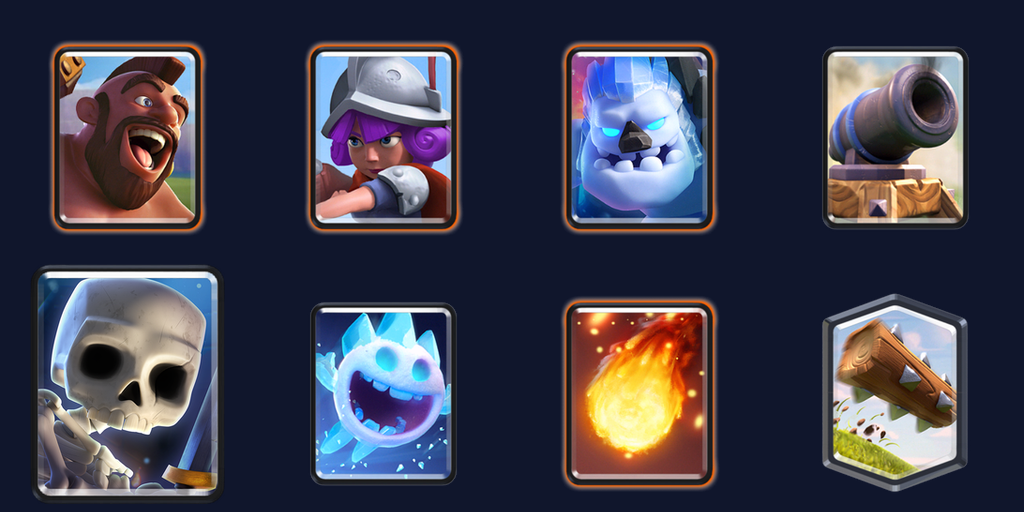
- Legendaries: 1 (The Log)
- Average elixir: 2.6
- Why F2P: Heavy Common/Rare composition. Commons are the easiest rarity to max. The Log is the only Legendary, and it appears frequently in chests. The deck has been top-tier since 2017 and survives every balance patch because its strength comes from cycle speed, not raw card power.
- Strength at underleveled: Wins through outplaying, not out-statting. A Level 13 Hog 2.6 player with good cycle counting beats Level 15 mid-ladder decks regularly.
- Trophy ceiling (F2P): 7000-8000 when maxed, 6000+ when Level 13-14.
2. Mortar Bait
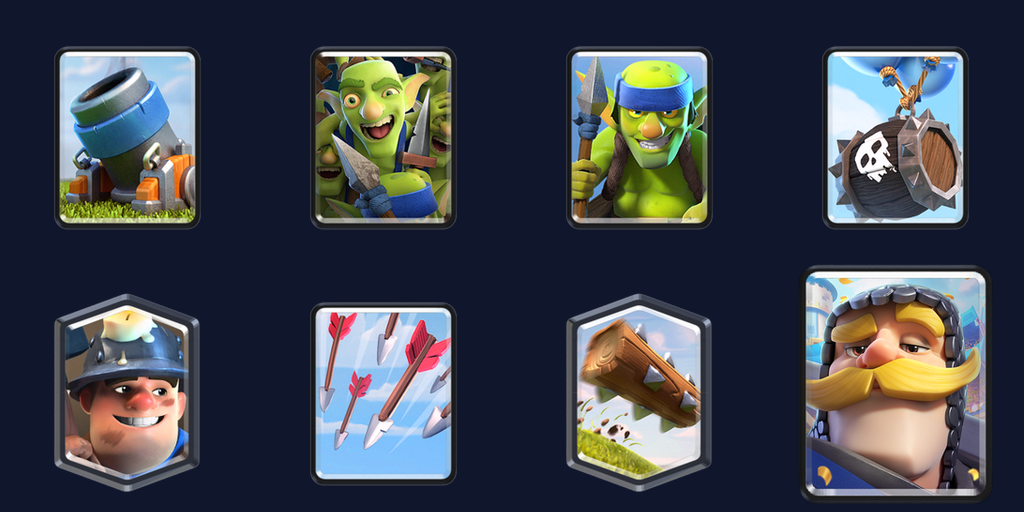
- Legendaries: 2 (Miner, The Log)
- Average elixir: 3.0
- Why F2P: Mortar is a Common win condition — the fastest rarity to max. The bait element (multiple swarm cards) means the deck functions well even when cards are 1-2 levels behind because opponents still struggle to spell everything.
- Strength at underleveled: Swarm cards force responses regardless of level. Miner chip damage is level-independent.
- Trophy ceiling (F2P): 6500-7500 when maxed.
3. Royal Giant Fisherman
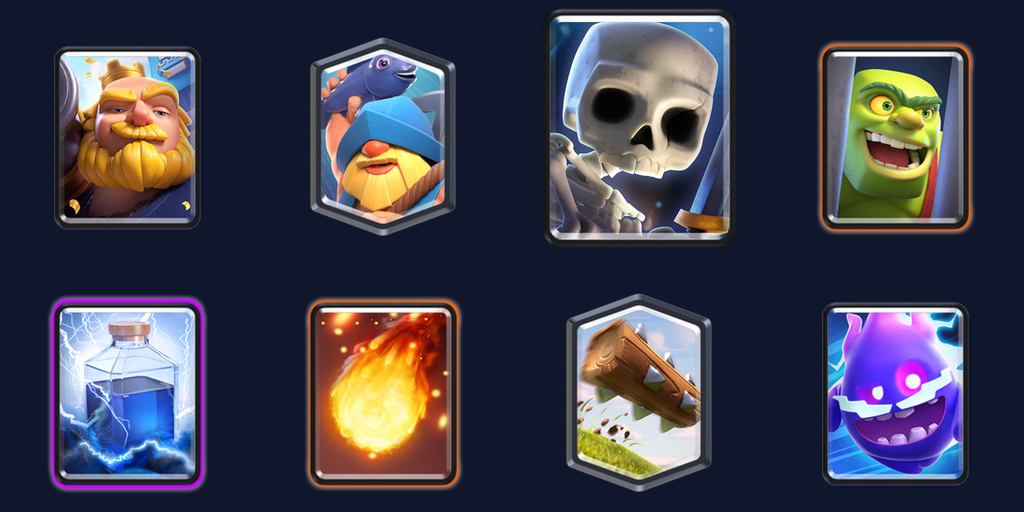
- Legendaries: 1 (Fisherman)
- Average elixir: 3.5
- Why F2P: Royal Giant is a Common card. The deck revolves around a straightforward game plan (RG at the bridge with spell support) that does not require complex setups. Fisherman is obtainable through targeted trading.
- Strength at underleveled: Royal Giant is one of the most level-dependent cards in the game — you need it at Level 14+ to compete. However, because it is Common, reaching Level 14-15 is fast.
- Trophy ceiling (F2P): 7000-8000 when maxed.
4. Hog Earthquake
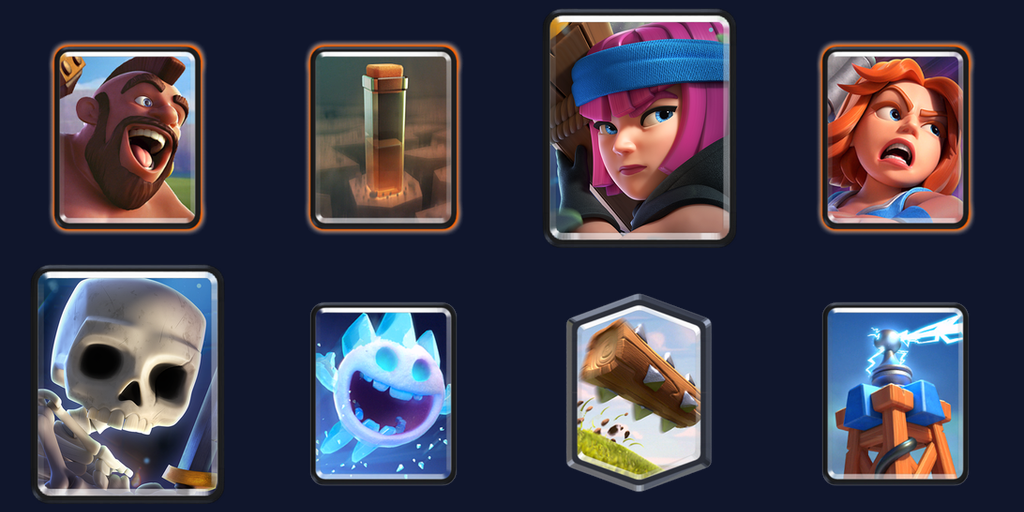
- Legendaries: 1 (The Log)
- Average elixir: 2.8
- Why F2P: One of the cheapest competitive decks in the game. Earthquake destroys buildings and deals sustained tower damage — a strong secondary win condition. Almost entirely Common and Rare cards.
- Strength at underleveled: Low cost means you cycle faster than opponents, compensating for stat disadvantages.
- Trophy ceiling (F2P): 6500-7500 when maxed.
F2P Deck Comparison
| Deck | Legendaries | Avg Elixir | Skill floor | Time to max (F2P) | Best for |
|---|---|---|---|---|---|
| Hog 2.6 | 1 | 2.6 | High | 10-14 months | Players who want the highest ceiling |
| Mortar Bait | 2 | 3.0 | Medium | 12-16 months | Players who like bait/control |
| Royal Giant | 1 | 3.5 | Low-Medium | 10-14 months | Players who prefer straightforward gameplay |
| Hog Earthquake | 1 | 2.8 | Medium | 10-14 months | Players who want a cheap, versatile deck |
Daily and Weekly Routine for Maximum Free Resources
Consistency matters more than any single action. A player who completes every free task daily earns roughly 30-40% more resources per month than a player who logs in once a day to open one chest.
Daily Checklist
| Task | Time required | Resources gained |
|---|---|---|
| Open free chest (every 4 hours, 2-3 per day) | 30 seconds each | Gold + cards |
| Complete daily Crown Chest (10 crowns) | 20-30 minutes | Gold + cards + rare chance at Legendary |
| Request cards from clan (every 7 hours) | 10 seconds | 40 Commons or 4 Rares per request |
| Donate cards to clanmates | 10 seconds per donation | 5 gold per Common, 50 gold per Rare, plus XP |
| Play Clan Wars battles (if war is active) | 10-15 minutes | War Chest progress (biggest single resource source) |
| Check shop for Wild Cards purchasable with gold | 10 seconds | Targeted card acquisition |
Weekly Checklist
| Task | Resources gained |
|---|---|
| Clan War Chest (River Race completion) | Major gold + cards + guaranteed Legendary at top leagues |
| Complete all special challenges | Cards + gold + sometimes gems |
| Global Tournament (play all free attempts) | Performance-based rewards, free entry |
| Use all trade tokens | Convert useless cards into main-deck cards |
Monthly Targets
| Target | Why it matters |
|---|---|
| Earn 80,000-120,000 gold | Enough to upgrade 1-2 cards per month |
| Gain 80-120 gems | Save for challenges or tournament bonus rewards |
| Complete all Clan War weeks | War Chests are the single best F2P resource source |
| Climb to new Trophy Road milestone | Milestone rewards include chests, gold, and gems |
| Collect 75 Hero Fragments (Pass Royale free tier) | Guaranteed monthly hero progression |
The Clan Factor
Your clan is the most important F2P multiplier. An active 50-member clan in a high War League generates dramatically more resources than a 20-member clan that does not complete Wars.
Requirements for your clan:
- 40+ active members
- Completes the River Race every week
- Members donate actively (you should max your donation requests daily)
- Gold League or higher in Clan Wars
If your current clan does not meet these criteria, leave it. The resource difference between a good clan and a bad one is equivalent to roughly 30,000-50,000 gold per month.
Trophy Road Rewards and Optimal Progression Pace
As of March 2026, Trophy Road extends to 14,000 trophies across 32 arenas. Each arena milestone awards a chest, gold, gems, or card rewards.
Key Trophy Road Milestones
| Trophy range | Arena | Notable rewards |
|---|---|---|
| 0-1,000 | Arenas 1-4 | Starter chests, first card unlocks |
| 1,000-2,000 | Arenas 5-7 | Hero Slot unlock at Arena 5 (200 free Hero Coins) |
| 2,000-4,000 | Arenas 8-12 | Larger gold rewards, more card diversity |
| 4,000-5,000 | Arenas 13-15 | Legendary chests, significant gold milestones |
| 5,000-6,000 | Legendary Arena+ | Tournament-level card pool, better chest drops |
| 6,000-8,000 | Challenger to Master | Major gold and gem milestones |
| 8,000-12,000 | Champion to Ultimate | Elite rewards, Evolution Boxes |
| 12,000-14,000 | New Arenas 29-32 | 5-Star Lucky Chest, 5-Star Evolution Box |
Optimal Pushing Pace
Do not rush trophies faster than your card levels can support. Pushing to 6000 trophies with Level 11 cards means facing maxed opponents every game and a negative win rate. Instead:
- Months 1-3: Push to 4,000-5,000 trophies. Focus on learning your deck, not on climbing.
- Months 4-6: Reach 5,000-5,500. Your main deck should be Level 11-12 by now.
- Months 6-12: Push to 5,500-6,500. Main deck at Level 13-14.
- Months 12-18: Reach 6,500-7,500. Main deck at Level 14-15 (maxed or near-maxed).
- Months 18+: Push toward 8,000+. Fully maxed deck, climbing on skill alone.
The Hero system (overhauled in March 2026) now unlocks at Arena 5 with 200 free Hero Coins to choose your first Hero. As F2P, pick a Hero that complements your main deck. You receive 75 guaranteed Hero Fragments per season, so hero progression is slow but steady.
Want this kind of analysis for your own deck?
TrophyCoach reads your battle log and writes a personalized action plan against the current meta — free to start.
Common F2P Mistakes That Waste Months of Progress
Every mistake below costs you real time — weeks or months of delayed progression that cannot be recovered.
Mistake 1: Switching Decks
Cost: 3-6 months of wasted progress per switch.
You hit a losing streak. You watch a YouTube video of a top player using a different deck. You decide to "try it out" and start upgrading new cards. Three months later, you have two half-leveled decks instead of one maxed deck. You are weaker than before you switched.
The fix: commit to your deck for a minimum of 6 months before even considering a change. Losing streaks are normal. They are caused by tilt and matchup variance, not by your deck being bad.
Mistake 2: Spending Gems on Chest Speed-Ups
Cost: 500-1,000 gems per year wasted (equivalent to 5-10 Classic Challenges).
A Silver Chest takes 3 hours. Gemming it open costs 18 gems. Those 18 gems in a Classic Challenge (if you average 6+ wins) would earn approximately 500 gold and 50 cards. The chest contains roughly 150 gold and 15 cards. You are paying 3x the gems for one-third the value.
Mistake 3: Ignoring Clan Wars
Cost: 30,000-50,000 gold per month in missed rewards.
Clan Wars 2 River Race Chests are the single largest source of free resources in the game. A player in a Gold League clan who completes every war earns a chest with guaranteed Legendaries, thousands of gold, and hundreds of cards — every single week. Skipping Wars or being in an inactive clan throws away more resources than any other F2P mistake.
Mistake 4: Upgrading Cards Evenly
Cost: Years of delayed max-level deck.
Some players upgrade every card a little bit. "I will get everything to Level 11 first, then Level 12." This ensures that no card is ever strong enough to compete at your trophy range. A player with eight Level 11 cards loses to a player with four Level 14 cards and four Level 9 cards — because the four maxed cards carry the match.
Always upgrade vertically: take your most important card to the highest possible level before touching the next card.
Mistake 5: Buying Emotes or Cosmetics with Gems
Cost: 250 gems per emote (2-3 Classic Challenges worth of value).
Emotes are fun. They provide zero competitive advantage. As F2P, every gem spent on an emote is a gem not spent on cards, gold, and power. Buy emotes after your deck is maxed. Not before.
Mistake 6: Donating Main Deck Cards
Cost: Directly slows your own progression.
Donating gives gold and XP. But donating cards you need for your main deck means you need to collect those cards again. Donate cards outside your main deck generously — the gold and XP are valuable. Never donate cards you are actively upgrading.
Mistake 7: Ignoring the New Duplicate Protection
Cost: Wasted chest value.
Since February 2026, players with fewer than 60 max-level cards no longer receive max-level duplicates from chests. This means maxing out cheap Common cards you do not use actually benefits your progression — those maxed Commons will no longer appear in chests, funneling drops toward cards you still need. Consider upgrading a few spare Commons to Level 15 specifically to trigger this protection.
Realistic F2P Timelines: How Long Does It Actually Take?
These timelines assume consistent daily play (30-45 minutes), active clan participation, and disciplined resource spending following the priorities above.
Time to Max a Single Deck
| Milestone | Timeframe | Trophy range | What you can expect |
|---|---|---|---|
| Main deck Level 11 | 2-3 months | 4,500-5,500 | Competitive in low Challenger |
| Main deck Level 12 | 4-6 months | 5,000-5,800 | Hold your own in Challenger 2-3 |
| Main deck Level 13 | 6-9 months | 5,500-6,300 | Start winning against maxed players on skill |
| Main deck Level 14 | 9-14 months | 6,000-7,000 | Near-even playing field |
| Main deck Level 15 (max) | 12-18 months | 6,500-8,000 | Fully competitive, climbing on skill |
| Second deck maxed | 24-30 months | — | Flexibility for different matchups |
| Full collection maxed | 5-7 years | — | Not a realistic F2P goal for most |
Factors That Speed Up Progression
- Joining a Legendary League clan (top-tier war rewards)
- Consistently winning 6+ in Classic Challenges
- Completing every special challenge and Global Tournament
- Strategic use of trade tokens for Legendary and Epic cards
- Maxing unwanted Commons to trigger duplicate protection
Factors That Slow Down Progression
- Inactive or low-league clan
- Switching decks even once (adds 3-6 months)
- Spending gems on non-Challenge items
- Missing daily requests and donations
- Upgrading cards outside your main deck
When to Upgrade vs. When to Save
Not every upgrade opportunity is equal. Gold is the bottleneck, so every upgrade decision should pass a cost-benefit check.
Upgrade Immediately When:
- Your win condition is one level below opponents' towers. An underleveled Hog Rider does noticeably less damage and gets killed faster. Upgrade this first, always.
- Your spell misses a critical interaction. If your Log does not kill the opponent's Princess, or your Fireball does not kill their Musketeer, that is a game-losing level gap. Prioritize the spell upgrade.
- You have enough gold and cards to upgrade a main deck card. Never sit on a ready upgrade for your core 8. The sooner it is at max, the sooner you stop needing that rarity.
Save When:
- The upgrade does not change any interaction. Going from Level 12 to Level 13 on Ice Spirit does not change what it kills or how long it survives in most cases. Save the gold for a more impactful upgrade.
- You are close to affording a higher-priority upgrade. If your Hog Rider is 5,000 gold away from Level 14 and your Knight upgrade costs 50,000 gold, save the gold for the Hog.
- The card is not in your main deck. Do not upgrade it. Period. The only exception is upgrading cheap Commons to Level 15 to trigger duplicate protection.
Upgrade Priority Order Within Your Deck
- Win condition (Hog Rider, Mortar, Royal Giant, etc.)
- Primary spell (Fireball, Poison, Lightning)
- Small spell (Log, Zap, Arrows)
- Primary defensive building (Tesla, Cannon, Tombstone)
- Support troops (Musketeer, Valkyrie, etc.)
- Cycle cards (Skeletons, Ice Spirit, Ice Golem)
Level 16: What F2P Players Need to Know
Level 16 was introduced in November 2025 as the new card ceiling. Key facts:
- Ranked play remains capped at Level 15 until May 2026. You do not need Level 16 cards to compete on ladder for several more months.
- Level 16 costs are significant. A Common card requires approximately 7,500 cards and 120,000 gold to upgrade from Level 15 to Level 16.
- F2P recommendation: Do not chase Level 16 upgrades. Focus on maxing your deck to Level 15 first. Level 16 is a long-term goal for after your primary deck is complete.
- The simplified economy helps. With books converted to Wild Cards and Magic Coins to Gold, F2P players now earn the exact currencies needed for upgrades without conversion losses.
Recommended Next Reads
- How to Play Hog 2.6 Cycle: Complete Deck Guide & Cycle Math (May 2026) — deep-dive into the #1 F2P deck recommendation
- How to Counter Mortar Cycle in Clash Royale: Siege Pressure, Punish Pushes & Anti-Mortar Decks — matchup dynamics for Mortar Bait (2nd F2P deck)
- Clash Royale Collection Levels Guide (May 2026): Formula, Rewards, and Strategy — Collection Level progression and its interaction with F2P resource spending
- Clash Royale Elixir Management Guide: Win More Games Without Better Cards — cycle efficiency and deck-building fundamentals for F2P players
- Royal Tournament April 2026 Guide: Level 11 Cap F2P Decks and Strategy — F2P-centric tournament format and strategy
- Chest Tracker — time your next Legendary and special chests, the biggest free progression for F2P players
- Trophy Roadmap Picker — the exact guides, decks, and next milestone for your trophy count
- Pass Royale Milestone Calculator — pick the highest-value Pass Royale first-milestone reward for your account
Frequently Asked Questions
How long does it take to max a Clash Royale account as F2P?
Maxing every card in the game takes 5-7 years as F2P, and that timeline extends with every new card release. However, maxing a single competitive deck takes 12-18 months. That is the realistic goal. Full account max is not a practical F2P objective.
What is the best F2P deck in Clash Royale 2026?
Hog 2.6 Cycle remains the strongest F2P deck due to its low legendary count (1), Common-heavy composition, and decade-long meta stability. It has the highest skill ceiling of any F2P deck and rewards practice more than card levels.
Should F2P players buy Pass Royale?
If you can afford a single purchase, Pass Royale is the highest-value option in the game. It provides a guaranteed 75 Hero Fragments, bonus chest rewards, unlimited challenge retries, and a Strike queue bonus. However, this guide assumes zero spending. You can reach 7000+ trophies without Pass Royale.
How do I get Legendary cards as F2P?
Clan War Chests (guaranteed Legendaries at Gold League+), Trophy Road milestone chests, Crown Chests (low probability), and trade tokens. Do not spend gold on Legendaries in the shop unless it is the specific Legendary your main deck needs and you are within 1-2 copies of the next level.
Is it worth upgrading Champions as F2P?
Champions are powerful but require Champion Wild Cards and significant gold. If your main deck uses a Champion, upgrade it in the normal priority order. If not, do not invest in Champions until your primary deck is maxed.
Should I save gems for Global Tournaments?
Global Tournaments (returning in March 2026) offer strong rewards for top performers, but the 500-gem bonus reward unlock is expensive for F2P players. If you consistently place in the top 10% of tournaments, the value is good. Otherwise, Classic Challenges at 10 gems each provide more reliable returns.
How important are Evolutions for F2P?
Evolutions are deck slot locked (one Evolution slot per deck as of March 2026). Focus on evolving cards that are already in your main deck. Evolution Shards accumulate through gameplay, and the new 5-Star Evolution Box on Trophy Road provides targeted evolution progress. Do not chase evolutions for cards outside your core deck.
What should I do during a losing streak?
Stop playing ladder after 3 consecutive losses. Tilt causes impulsive plays and compounds losses. Switch to Clan Wars, challenges, or 2v2 for the rest of the session. Return to ladder the next day. Do not switch decks — the losing streak is not your deck's fault.