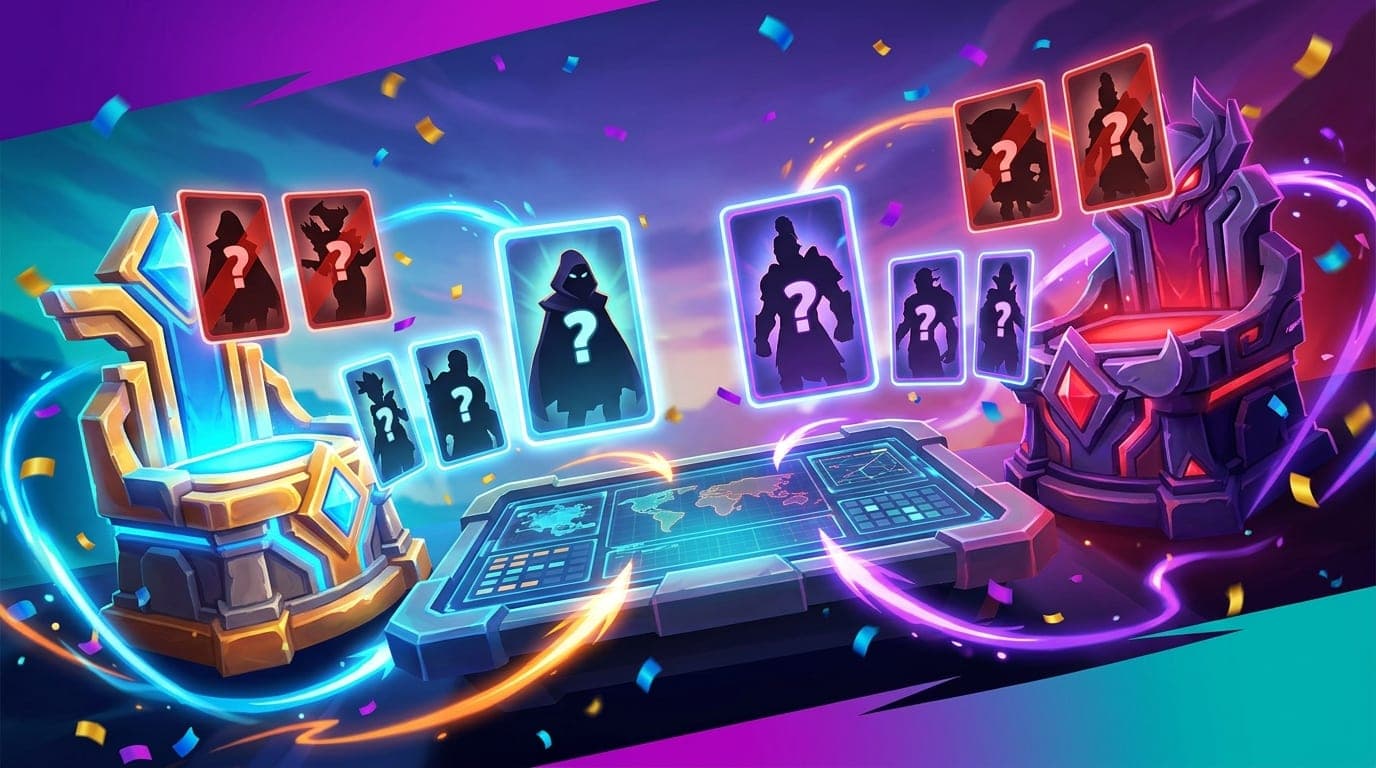
Quick answer: The winning Brawl Stars draft uses 3 steps: ban the map breaker, first-pick a safe role, and save the last pick for a counter - because Diamond+ Ranked turns every match into a best-of-3 information game.
Brawl Stars drafting is the difference between owning strong brawlers and winning Ranked series. From Diamond upward, your team sees the map, bans threats, and builds a 3-brawler composition under pressure; that means the player who prepared 18 map plans has a real edge over the player who only prepared 1 favorite brawler.
What Is a Good Ranked Draft?
A good Ranked draft gives your team 3 separate jobs: lane control, objective pressure, and matchup repair. If 2 players draft the same job, the third pick must fix the shape before it can chase comfort.
| Draft slot | Job | Examples |
|---|---|---|
| First pick | Safe map power |      Gene, Max, Sandy, Belle, Rico Gene, Max, Sandy, Belle, Rico |
| Middle pick | Role completion |      Pam, Brock, Emz, Piper, Colt Pam, Brock, Emz, Piper, Colt |
| Last pick | Counter-pick |      Colette, Gale, Kit, Shelly, R-T Colette, Gale, Kit, Shelly, R-T |
Want this checked against your own account?
Run the free map-fit diagnostic — TrophyCoach reads your last 25 battles and flags the maps where your best brawler quietly loses.
How Should You Choose Bans?
Bans should remove the strongest brawler your team cannot answer on that specific map. A good ban is not emotional; it protects your first 2 picks and blocks the enemy from forcing a simple win condition.
On open Bounty and Knockout maps, ban the best long-range carry if your team lacks equal range. On wall-heavy Brawl Ball maps, ban Rico or the best tank depending on your own comp. On Heist maps, ban the safe-damage pick that beats your damage race.
What Should You First Pick?
First picks should survive multiple answers. Gene, Max, Sandy, Belle, Piper, Rico, and Brock are common safe options because their value is tied to map control rather than a single fragile gimmick.
Avoid first-picking brawlers with 1 obvious hard counter left open. Mortis into Gale, Frank into Colette, and Dynamike into wall break can turn a strong account into a weak draft in 1 pick.
How Do You Build a Counter-Pick Board?
A counter-pick board is a 2-column list: enemy pattern and answer. Build it before queueing, then use the Brawler Map Checker to confirm that your account owns the answers at useful power levels.
| Enemy pattern | Counter examples | Reason |
|---|---|---|
| 2 tanks | Colette, Shelly, Gale | Stops health-stack pressure. |
| 2 marksmen |  Kit, Mortis, Max Kit, Mortis, Max | Punishes exposed backlines. |
| Thrower behind walls |  Brock, Colt, Gray Brock, Colt, Gray | Removes cover or closes distance. |
| Healer bunker |   Crow, Byron, Colette Crow, Byron, Colette | Reduces sustain and forces trades. |
How Should Drafting Change by Mode?
Drafting changes because each mode scores differently. Heist asks for damage math, Bounty asks for star safety, Hot Zone asks for circle control, and Brawl Ball asks for goal pressure.
| Mode | Draft priority | Common trap |
|---|---|---|
| Gem Grab | Carrier plus 2 lanes | Tank carrying 8 gems. |
| Brawl Ball | Goal threat plus defender | Three attackers and no goal-box answer. |
| Heist | Safe damage plus defense | Winning mid while losing safe race. |
| Knockout | Survival plus first pick | Early dive into a 2v3 round. |
| Hot Zone | Area control | Fighting outside the zone at 80%. |
| Bounty | Star safety | Trading 1-for-1 while ahead. |
How Should You Use This Guide in a Real Ranked Session?
Use this guide as a pre-queue checklist, not as a page you read once. Before starting a serious Ranked session, write down 3 decisions: the brawlers you are willing to first-pick, the brawlers you will ban on bad maps, and the brawlers you will stop playing after 2 failed attempts.
The session should be capped by quality, not mood. Play the maps where your account has 2 or more viable choices, skip or delay the maps where your account has 0 viable choices, and stop after 2 losses where the cause is clearly decision-making instead of mechanics. A 45-minute disciplined session beats a 2-hour tilt queue because it preserves your draft standards.
The key test is whether the advice changes an actual pick. If this guide does not change your first pick, ban, upgrade, or practice target, turn it into a 3-column checklist: "use now," "build later," and "ignore this season."
Which Brawlers Fit This Plan Best?
This plan works best when attached to brawlers with repeatable map value. Flexible brawlers are not always the flashiest, but they let you make the same good decision across multiple maps and modes.
| Role | Brawler examples | Why the role matters |
|---|---|---|
| Safe flex | Max, Gene | Gives your draft a stable first or second pick. |
| Control | Sandy, Piper | Wins space without needing constant eliminations. |
| Damage | Belle, Rico | Converts pressure into objectives before the enemy resets. |
| Counter | Colette, Gale, Shelly | Repairs drafts against tanks, divers, and overcommitted comps. |
Use names as role examples, not as a rigid shopping list. If your account already has 2 safe flex picks, the next useful upgrade is usually damage or counter coverage, not a third version of the same job.
How Should This Advice Change by Game Mode?
The advice changes because the 6 major modes reward different forms of value. A brawler that looks perfect in Heist can be average in Bounty, and a Bounty sniper can be too passive for Hot Zone.
| Mode | What matters most | Common decision error |
|---|---|---|
| Gem Grab | Carrier safety and countdown control | Chasing kills with 8 or more gems. |
| Brawl Ball | Goal pressure and goal-box defense | Drafting 3 attackers with no defender. |
| Knockout | First death prevention | Diving before the enemy spends ammo. |
| Hot Zone | Seconds inside the zone | Fighting outside the circle at 80% progress. |
| Heist | Safe damage versus defense math | Winning mid while losing the safe race. |
| Bounty | Star lead protection | Trading 1-for-1 while ahead. |
The practical rule is to translate every recommendation into the mode's scoring language. If it does not help gems, goals, rounds, zones, safe damage, or stars, it is not a priority in that match.
How Should You Review Progress After 10 Games?
Use a 10-game review sample because 1 game lies and 30 games takes too long. After 10 games, mark every loss with 1 primary cause: wrong pick, bad lane, wasted Super, missed objective, or tilt queue.
| Loss cause | Fix for the next 10 games | Success signal |
|---|---|---|
| Wrong pick | Check map role before locking | 2 fewer draft losses. |
| Bad lane | Swap after 1 failed matchup | Fewer first deaths. |
| Wasted Super | Save Super for objective phase | More converted pushes. |
| Missed objective | Call the score condition out loud | Fewer throws while ahead. |
| Tilt queue | Stop at 2 poor losses | Higher session win quality. |
This review keeps the guide honest. If the same mistake appears 4 or more times in 10 games, fix that one leak before changing brawlers again.
When Should You Ignore the Default Recommendation?
Ignore the default recommendation when the map, enemy draft, or your roster makes it false. A strong tier-list pick should sit out if the map removes its range, a top build should change if the enemy comp demands a different Gadget, and a popular upgrade should wait if your current roster already covers that role 3 times.
The best players break rules deliberately. They do not ignore a recommendation because they are bored; they ignore it because 2 visible facts in the lobby point somewhere else. Those facts are usually map shape and enemy composition.
How Does the Brawler Map Checker Fit Into This Guide?
The Brawler Map Checker turns this guide from generic advice into account-specific action. It matters because two players can read the same guide and need opposite next steps: one account needs a Knockout sniper, while another needs a Heist safe breaker or a Hot Zone controller.
Use the checker after reading the guide and before spending resources. If the tool shows 3 weak maps in the same mode, your next upgrade should solve that mode. If it shows 1 weak map only, the better move is usually practice or draft prep, not a rushed Power 11.
What Should Change for Solo Queue, Duo Queue, and Trio Queue?
Queue type changes how you apply this guide because information quality changes. Solo queue rewards safe, self-sufficient brawlers that can survive a weak draft. Duo queue rewards role pairs, such as one carrier and one lane controller. Trio queue rewards planned bans because all 3 players can protect the same strategy.
| Queue type | Best decision rule | Biggest risk |
|---|---|---|
| Solo | Pick self-sufficient brawlers with escape or range | Teammates duplicate your role. |
| Duo | Pair 2 complementary roles before queueing | The random third player leaves a mode gap. |
| Trio | Plan bans and first picks by map | Over-planning and ignoring enemy draft. |
If you are solo, lean toward Max, Gene, Belle, Rico, Sandy, or Brock style picks that do not require perfect support. If you are duo, combine 1 objective piece with 1 lane winner. If you are trio, decide the ban order and backup pick before the draft timer starts.
What Should Change After a Balance Patch?
Refresh this advice after every balance patch because 1 number can move a brawler from safe first pick to risky late pick. Health changes affect lane trades, damage changes affect kill thresholds, cooldown changes affect repeated fights, and Super changes affect objective timing.
The 3-step patch review is simple. First, mark every changed brawler in your roster. Second, replay the maps where that brawler was part of your plan. Third, update your ban sheet only after 5-10 real games, not after one highlight clip.
Patch discipline matters because Brawl Stars players overreact in both directions. A buffed brawler is not automatically S-tier on every map, and a nerfed brawler is not automatically dead. The right question is narrower: did this change alter the brawler's job in your map pool?
What Is the Weekly Operating Plan?
Make this guide more useful by turning the advice into a weekly rhythm. Start the week by checking the current map pool, mark 3 brawlers that fit your strongest modes, and choose 1 weak mode to improve. That gives the week a purpose instead of turning every session into random queueing.
Monday is map review: write the modes where your account has 0, 1, or 2 good picks. Tuesday is build review: check whether your main brawlers have the correct Gadget, Star Power, and Gears for those maps. Wednesday is mechanics practice: play 5 games where the only goal is winning lane without the first death. Thursday is draft practice: write your first pick, backup pick, and ban for 6 maps. Friday is serious Ranked. Saturday is replay review. Sunday is upgrade planning.
| Day | Focus | Output |
|---|---|---|
| Monday | Map pool | 3 strong maps and 3 weak maps. |
| Tuesday | Builds | 2 loadout changes or confirmations. |
| Wednesday | Mechanics | 5 lane-focused games. |
| Thursday | Draft prep | Pick, backup, ban notes. |
| Friday | Ranked | 1 serious session with a stop rule. |
| Saturday | Review | 3 repeated mistakes. |
| Sunday | Upgrades | 1 account decision for the next week. |
The point is not to make Brawl Stars feel like homework. The point is to stop repeating the same losses for 7 straight days. One focused week gives better information than 100 games played with no review.
How Should Different Player Types Apply This?
Apply this guide differently for new players, casual ladder players, Ranked climbers, and Masters-focused accounts. A new player needs simple role clarity. A casual player needs better map selection. A Ranked climber needs draft prep. A Masters-focused account needs matchup notes and a wide Power 11 pool.
| Player type | Best next action | Minimum useful target |
|---|---|---|
| New player | Learn 3 clear roles | 1 lane brawler, 1 control brawler, 1 damage brawler. |
| Casual ladder | Stop forcing bad maps | 2 brawlers per favorite mode. |
| Diamond-Mythic | Prepare draft notes | 8-10 brawlers with known counters. |
| Legendary+ | Build matchup sheets | 12+ Power 11 brawlers across 6 modes. |
This prevents the most common content mistake: giving every player the same answer. The right answer depends on account stage, mode goals, and whether the next session is practice, ladder pushing, or serious Ranked.
What Are the Best Internal Next Steps?
Connect this guide to the rest of your Brawl Stars plan. If the problem is overall strength, read /brawl-stars/guides/brawl-stars-tier-list. If the problem is map fit, read /brawl-stars/guides/best-brawlers-by-mode. If the problem is Diamond+ decision-making, read /brawl-stars/guides/brawl-stars-drafting-guide. If the problem is upgrades, read /brawl-stars/guides/best-brawlers-to-max-first.
The best next step is the one that changes the next session. Do not read 5 more guides if 1 action is obvious. Pick the brawler, update the build, write the ban, or stop queueing the map that your account cannot support yet.
What Should You Deliberately Avoid?
You improve faster when you remove bad inputs. Avoid tier-list hopping after every loss, avoid upgrading a brawler because one opponent beat you once, and avoid treating a content creator's highlight game as proof that the pick works on every map.
Also avoid mixing goals inside one session. A practice session can accept losses if the target is learning a new brawler. A Ranked push session should protect Elo and stop after 2 poor losses. A Mastery session should follow map fit, not force the same brawler into 6 bad rotations.
The cleanest rule is to name the session before queueing. If the session is practice, measure learning. If the session is Ranked, measure draft quality. If the session is upgrade planning, measure map coverage. One named goal makes every decision easier.
What Should You Write Down Before Queueing?
Make this guide concrete by fitting it on one note. Write 5 lines before the session: best map, worst map, safest first pick, highest-priority ban, and stop rule. That note is enough to prevent most panic decisions without turning the game into paperwork.
The note should be specific. "Play better" is useless; "ban Rico on wall maps," "do not first-pick Mortis," and "stop after 2 draft losses" are useful because they change behavior under pressure.
| Note line | Example |
|---|---|
| Best map | The map where your account has 3 playable picks. |
| Worst map | The map where your account has 0-1 playable picks. |
| Safe first pick | A brawler with 2 or fewer hard counters open. |
| Priority ban | The enemy pick that breaks your plan. |
| Stop rule | 2 tilted losses, 3 bad drafts, or 45 minutes. |
This is the smallest useful coaching artifact: 5 lines, 1 session, and at least 1 decision that improves immediately. Keep the note after the session, because the same 5 lines become the fastest way to see whether your next problem is map choice, draft discipline, roster depth, weekly practice focus, or a missing counter-pick you need to build next. Reuse the note for 3 sessions before changing everything again, then compare the results before making the next roster decision.
What Are the Most Common Mistakes When Drafting in Ranked?
Mistake 1 - picking comfort over the map: Brawl Stars Drafting Guide fails when the pick ignores 2 fixed map traits: lane length and wall density. Replace the comfort pick with 1 brawler that wins the visible lane, then use the final 2 picks to cover the objective.
Mistake 2 - building three copies of one role: A 3-brawler team with no carrier, no wall break, or no anti-tank tool loses before the first fight. Lock 1 lane winner, 1 objective piece, and 1 counter-pick in every draft.
Mistake 3 - upgrading specialists before flex picks: A brawler playable on 2 maps is a luxury slot, while a flex pick playable in 3 modes keeps your account alive through bans. Build 8-10 flexible Power 11 options before chasing 1 narrow favorite.
Mistake 4 - ignoring the first 15 seconds: The first lane trade decides most Ranked games because it sets ammo, Super charge, and spawn timing. Spend the first 15 seconds winning position, not fishing for a highlight elimination.
Mistake 5 - playing after two tilted losses: Two straight losses usually means the next draft is rushed and the next lane choice is emotional. Stop after 2 bad series, review the 3 maps that beat you, then queue when the plan is specific again.
Frequently Asked Questions
When does drafting start in Brawl Stars?
Drafting starts in Ranked from Diamond upward. That is where bans, pick order, and best-of-3 adaptation become more important than one comfort pick.
What is the best first pick in Brawl Stars Ranked?
The best first pick is map-dependent, but Gene, Max, Sandy, Belle, Piper, Rico, and Brock are common safe picks because they keep value across multiple enemy answers.
How many brawlers should I know for draft?
You should know at least 8-10 draft-ready brawlers and own 12 Power 11 brawlers for Mythic and above. A 3-brawler comfort pool collapses when 1 pick is banned and 1 is countered.
Should I ban counters or meta brawlers?
Ban the brawler that breaks your team map plan. Sometimes that is a meta brawler, and sometimes it is a specific counter to your first pick.
How do I avoid bad random drafts?
Avoid bad drafts by locking roles early in chat or pings: carrier, lane, damage, defense, and counter. Even 1 clear role call prevents 2 players from drafting the same job.
Can the Brawler Map Checker help with drafting?
The Brawler Map Checker helps with drafting by showing which map roles your roster can actually fill. Use it before Ranked so your counter-pick board is realistic.