
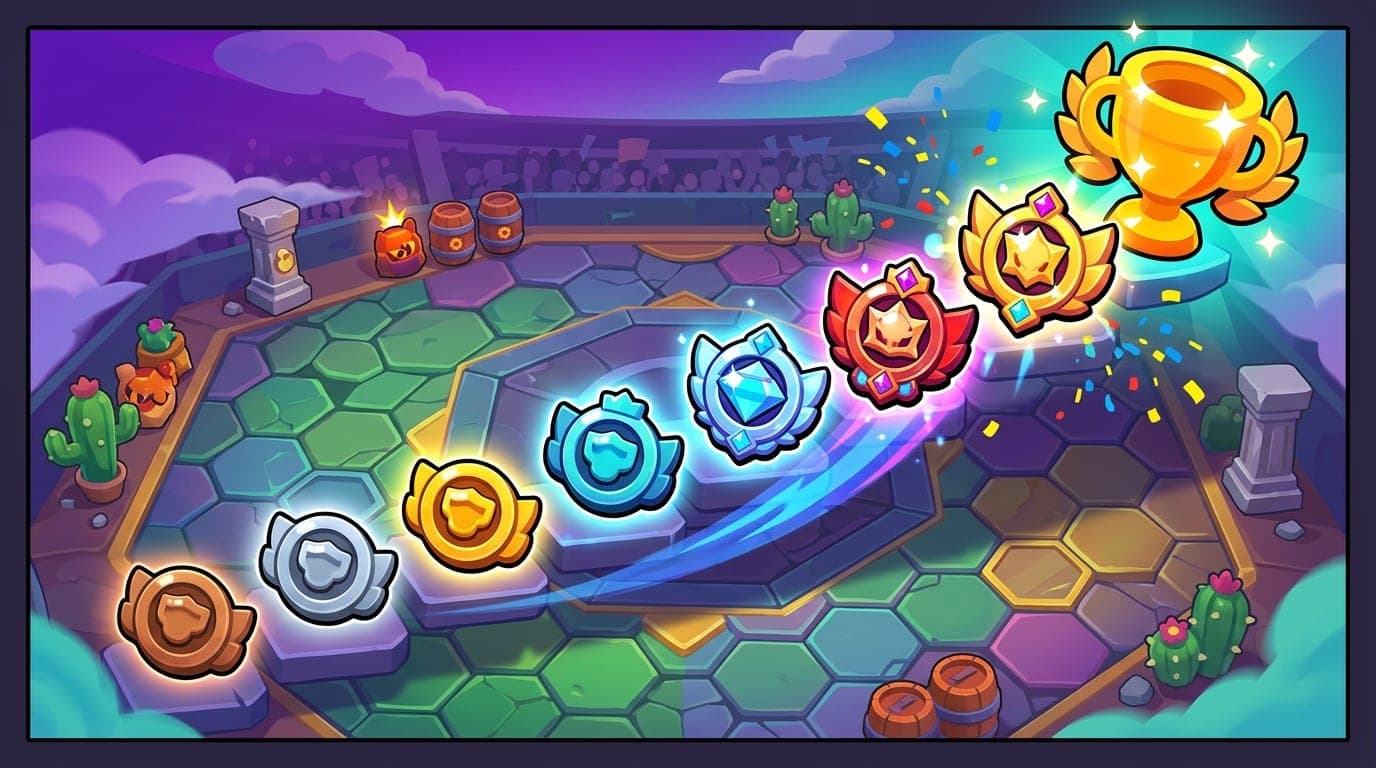
Quick answer: The most reliable way to climb Brawl Stars Ranked is to master a pool of 8-10 flexible brawlers across all 6 ranked modes and draft for the map instead of your comfort picks — because from Diamond upward every match is a best-of-three with bans, and the 18-map seasonal pool is known in advance.
Brawl Stars Ranked runs on 8 rank brackets — Bronze, Silver, Gold, Diamond, Mythic, Legendary, Masters, and Pro — across a fixed seasonal pool of 18 maps in 6 game modes. The format changes twice as you climb: matches become best-of-three with a ban phase at Diamond, and the entry requirement jumps to 12 Power 11 brawlers at Mythic under the Ranked 2.0 rules Supercell shipped on February 25, 2025. Those two thresholds — Diamond's draft and Mythic's roster check — are where most climbs stall, and both are beatable with preparation rather than raw mechanics.
What Is Ranked Mode in Brawl Stars?
Ranked is Brawl Stars' competitive queue: a separate ladder from trophies where you play 3v3 matches in a rotating pool of 6 modes — Gem Grab, Brawl Ball, Knockout, Hot Zone, Heist, and Bounty — for Elo instead of trophies. Each of the 6 modes contributes 3 maps to the season, giving you exactly 18 maps to prepare for, and the pool refreshes every season alongside the Brawl Pass.
Ranked differs from the trophy ladder in three ways that change how you should play it:
- The map pool is fixed and known. On ladder you queue into whatever is rotating; in Ranked you can study all 18 maps before you ever queue.
- Teams are built in a draft, not brought from the menu. From Diamond upward you see the enemy team's picks develop and can counter-pick.
- Progress is gated by roster width. You need 3 brawlers at Power 9 or above to unlock Ranked at all, and 12 brawlers at Power 11 to play at Mythic and above — Ranked rewards a deep account, not one maxed main.
Want this checked against your own account?
Run the free map-fit diagnostic — TrophyCoach reads your last 25 battles and flags the maps where your best brawler quietly loses.
What Are the Ranked Tiers and How Does Elo Work?
Ranked's 8 brackets each split into three tiers (I, II, III), except Pro, which sits alone at the top as the entry point to competitive play. Elo per tier scales as you climb: Legendary tiers take 750 Elo each and Masters tiers take 1,000 Elo each under Ranked 2.0, which is why the Legendary-to-Masters stretch feels three times longer than Gold ever did.
| Bracket | Match format | Roster requirement | Season reset behavior |
|---|---|---|---|
| Bronze – Gold | Best-of-1, no bans | 3 brawlers at Power 9+ | Gold III and below reset to Silver I |
| Diamond | Best-of-3 with bans | Roster check begins | -6 minor ranks from ending rank |
| Mythic – Legendary | Best-of-3 with bans | 12 brawlers at Power 11 | -6 minor ranks from ending rank |
| Masters (I-III) | Best-of-3 with bans, 1,000 Elo per tier | 12 brawlers at Power 11 | -6 minor ranks from ending rank |
| Pro | Best-of-3 with bans | 12 brawlers at Power 11 | -6 minor ranks from ending rank |
Two Ranked 2.0 rules punish coasting. First, floor protection is gone above Diamond: a Mythic player who loses more than they win demotes back into Diamond, which pre-2025 was impossible. Second, Elo losses grow harsher from Legendary upward, so a 55% win rate that carried you through Mythic stops being enough — win quality (playing favored maps, dodging nothing) matters more the higher you go.
Rank Boost — the accelerated Elo you earn while below your previous peak — only applies up to Mythic, so the boost carries you back through the easy brackets after a reset but never inflates the Legendary+ climb.
How Do You Unlock Ranked and What Should You Upgrade First?
Ranked unlocks once you have 3 brawlers at Power Level 9 or higher. That's the floor; the real planning target is the 12 Power 11 brawlers Mythic demands, and upgrading the wrong 12 is the most expensive mistake in the game mode.
Each season also grants every player 3 fully maxed trial brawlers usable only in Ranked, and they count toward the roster requirement — check the current season's trial set before spending resources, because a trial brawler you planned to max is a free slot for a month.
Prioritize upgrades in this order:
- Coverage before depth. One viable brawler for each of the 6 modes beats three for Brawl Ball. Knockout and Bounty share long-range DPS picks (Piper, Belle, Angelo); Gem Grab and Hot Zone share area-control picks (Sandy, Gene, Emz) — smart picks let 8 brawlers cover all 18 maps.
- Flex picks over specialists. A brawler who is playable on 10 of the 18 maps (a Max, a Stu, a Gene) is worth two brawlers who are dominant on 2 maps each, because bans and enemy picks will regularly take your specialist plan away.
- Tanks and throwers last. Both classes are the most map-dependent in the game — a Frank or a Dynamike is a top-5 pick on 3-4 maps and near-unplayable on 8 — so they round out a 12-slot roster rather than anchor it.
If you want this analysis run against your actual account, the free Brawler Map Checker reads your profile by player tag and grades which of your brawlers fit the current ranked map pool — it's the fastest way to see whether your next Power 11 should be a gap-filler or a depth pick.
How Does Drafting Work From Diamond Upward?
Drafting decides more Ranked matches than mechanics do from Diamond on: every match becomes a best-of-three where each player submits a ban before picks, and picks alternate between teams so later picks can counter earlier ones. The team that treats the draft as half the game wins series 2-0 that mechanically better teams lose 1-2.
What Should You Ban?
Ban for the map, not against your nightmares. The correct ban on Snake Prairie (a bush-heavy Gem Grab map) is a bush-control assassin; the correct ban on an open Bounty map like Shooting Star is the longest-range sniper you don't intend to pick. Before each season, note the 2-3 strongest brawlers on each of the 18 maps — your ban on any map should come from that shortlist, adjusted for what your own team wants to keep available.
How Should You Use Pick Order?
First pick takes the map's single strongest available brawler; last pick takes the best counter to the enemy's committed composition. The practical rules:
- Early picks: choose map-power, low-counterability brawlers (a Sandy on Hot Zone, a Belle on open Knockout). Never early-pick a brawler with one hard counter still unbanned.
- Late picks: answer what you see. If the enemy committed two squishy sharpshooters, a Kit or a Mortis late pick punishes them; if they stacked tanks, the last slot belongs to a shredder like Colette or Rico.
- Communicate roles. A draft that lands two throwers or zero mode-carry (no gem carrier in Gem Grab, no goal threat in Brawl Ball) has lost before the loading screen — decide who fills which role during bans, not after picks.
How Do You Prepare an 18-Map Plan?
Build a one-line plan per map: best pick, backup pick, priority ban. That's 54 decisions made once per season instead of improvised 20 times per session. The seasonal pool is published in-game at reset; walk the 18 maps and fill the three columns, then update after each balance patch. Players who do this convert map knowledge directly into Elo because from Diamond up, every opponent who didn't is drafting blind.
How Do the 6 Ranked Modes Differ and What Wins Each One?
The 6 ranked modes split into two families: objective-control modes (Gem Grab, Hot Zone, Heist) where you win by holding or breaking a fixed point, and elimination modes (Knockout, Bounty, and functionally Brawl Ball) where picks and positioning decide short, unforgiving rounds. Your 18-map plan gets much easier once you internalize what each mode actually scores.
| Mode | Win condition | Composition shape | Most common throw |
|---|---|---|---|
| Gem Grab | Hold 10 gems for a 15-second countdown | 1 gem carrier + 2 lane controllers | Carrier walking mid with 8+ gems |
| Brawl Ball | Score 2 goals (or lead at full time) | 1 goal threat + 1 defender + 1 lane winner | All 3 chasing the ball carrier |
| Knockout | Win 2 of 3 elimination rounds | 2 long-range + 1 flex/anchor | First-pick aggression into a 2v3 round |
| Hot Zone | Fill the zone meter to 100% first | 2 area controllers + 1 counter-pick | Fighting outside the zone at 80%+ |
| Heist | Break the enemy safe (or lead on damage) | 1-2 safe-damage threats + 1 defender | Full-team defense with zero safe pressure |
| Bounty | Hold more stars at the timer (20 to start) | 2-3 long-range, high-survival picks | Trading 1-for-1 while ahead |
Three mode-specific rules pay immediate Elo:
- Gem Grab: the countdown, not the gem count, is the objective. A team holding 10 gems at 15 seconds wins by retreating as a unit; the moment your carrier crosses mid to "help," you've offered the enemy their only win condition. Assign the carrier during the draft — usually the pick with escape tools (Max, Gene, Stu), never the tank.
- Knockout and Bounty: respawns don't exist (Knockout) or cost a star (Bounty), so the first death decides most rounds. These are the modes where range advantage converts most directly to wins — which is why open maps like Shooting Star make snipers like Piper and Belle near-mandatory picks or bans.
- Heist: damage math beats fighting. A Colt or Rico who trades his life for 40% safe damage came out ahead; a team that wins every mid fight but never touches the safe loses on the clock. Count safe HP out loud in your duo — it changes decisions.
Hot Zone rewards the same area-control brawlers as Gem Grab (Sandy, Emz, Gene), which is exactly the kind of overlap your 12-slot roster should exploit: every upgraded brawler should earn its slot in at least 2 of the 6 modes.
Which Brawlers Should You Power Up First for Ranked?
Flexibility per slot is the upgrade metric that matters: the best first-12 roster is the one that leaves you with a playable, unbanned pick on all 18 maps. Exact tier placements shift with every balance patch, but the archetypes below have stayed draft-relevant across seasons because their value comes from range, mobility, or area control rather than one exploitable gimmick.
| Archetype | Examples | Modes covered | Why it holds value |
|---|---|---|---|
| Long-range sniper |    Piper, Belle, Angelo Piper, Belle, Angelo | Knockout, Bounty, open Heist | Range decides elimination modes; strong early picks |
| Area controller |    Sandy, Gene, Emz Sandy, Gene, Emz | Gem Grab, Hot Zone | Zone denial wins both objective modes |
| Mobile flex |    Max, Stu, Mortis Max, Stu, Mortis | Brawl Ball, Gem Grab carry | Escape tools make safe gem carriers and goal threats |
| Safe-breaker |    Colt, Rico, Spike Colt, Rico, Spike | Heist, plus lane duty elsewhere | High DPS doubles as safe pressure and control |
| Late-pick counter |    Kit, Colette, Shelly Kit, Colette, Shelly | Any (drafted last) | Punishes committed enemy comps — tank shred or assassin denial |
How to use the table: take one column from each row before doubling anywhere, and check the current season's 3 trial brawlers first — a trial that fills the sniper slot means your coins go to the flex row this month. Your 6th through 12th Power 11s should chase map coverage gaps, which is exactly what the Brawler Map Checker surfaces from your real roster: it flags the ranked maps where you currently have zero graded-viable picks.
Two archetypes deliberately missing from a first-12: pure tanks (Frank, Bull) and throwers (Dynamike, Barley, Sprout). Both swing between top-pick and unplayable based on 3-4 specific maps in the pool, so they're luxury slots 13-16 — worth owning, wrong to prioritize. The exception is a season whose published pool is unusually tank- or throw-friendly (3+ walls-and-bushes maps); read the pool at reset before locking the month's upgrade path.
What Are the Most Common Mistakes That Stall a Ranked Climb?
Mistake 1 — Queueing solo at your rank ceiling: Ranked from Diamond up is a coordination game, and solo queue puts you with two strangers against possible 3-stacks. Playing your serious sessions in a duo or trio is worth more Elo than any brawler upgrade; save solo queue for brackets you out-skill.
Mistake 2 — One-tricking into the ban phase: From Diamond, your signature brawler gets banned the moment anyone recognizes your profile. If losing your best pick drops your win rate below 50%, you don't have a Ranked pool yet — you have a ladder main. Build to 8-10 playable brawlers before grinding Legendary.
Mistake 3 — Upgrading for love, not coverage: Spending coins taking a 13th Brawl Ball brawler to Power 11 while owning zero viable Heist picks means roughly 3 of the 18 maps are near-automatic losses. Audit coverage before every upgrade — or let the Map Checker audit it for you.
Mistake 4 — Ignoring the reset math: Ending a season at Legendary I and starting the next at -6 minor ranks (Mythic I) is by design, and Rank Boost stops helping at Mythic. Players who take a two-week break mid-season and coast back late often finish a full bracket below their skill because the harsher Legendary Elo losses eat lazy games.
Mistake 5 — Playing every map that appears: In best-of-1 brackets you can dodge nothing, but your session choice is still yours: if the current rotation slot is a map where your pool is weak, that's the moment to farm mastery on ladder instead. Elo lost on your 3 worst maps routinely cancels an evening of wins on your good ones.
How Long Does It Take to Climb to Masters?
Masters is a multi-season project for most players, and the math explains why. The Bronze-through-Gold brackets move fast — best-of-1 matches, generous Elo, and Rank Boost after your first season carrying you back toward your previous peak. The climb changes character at three points:
- Diamond: matches become best-of-3, so each result costs 2-3 rounds of time. A Diamond session of 10 series is 20-30 rounds — plan sessions around series, not games, and stop at 2 consecutive series losses (tilted drafting compounds much faster in a ban format).
- Legendary: tiers cost 750 Elo each while losses start out-weighing wins at equal counts. A 55% series win rate that cleared Mythic can produce near-zero net Elo here; the fix is almost always draft quality and duo queueing, not grinding more volume at the same standard.
- Masters: 1,000 Elo per tier with no floor protection below it. Reaching Masters III from Legendary III means netting 3,000+ Elo at the least forgiving gain/loss ratio in the mode.
The season reset compounds the timeline: ending at Legendary II means restarting at -6 minor ranks (Mythic II), so a player hovering at their ceiling re-climbs the same two brackets every month. That's by design — it keeps Masters populated only by players who beat Legendary repeatedly, and it's why widening your brawler pool (which survives resets) is a better investment than any single hot streak (which doesn't).
A realistic benchmark: if you can't hold a positive record in Legendary across 20+ series with your full pool available, Masters isn't blocked by time — it's blocked by drafting or roster coverage, and those are fixable this season.
Frequently Asked Questions
How many brawlers do you need for Ranked in Brawl Stars?
Ranked unlocks with 3 brawlers at Power Level 9 or above, but Mythic and higher requires 12 brawlers at Power Level 11. The 3 seasonal trial brawlers count toward both numbers while active.
Do you lose your rank at the end of a Brawl Stars season?
Ranked resets every season: Diamond I and above drop exactly 6 minor ranks from their ending rank (two full brackets), while Gold III and below reset to Silver I. Rank Boost accelerates Elo gains until you approach your previous peak, but only up to Mythic.
Can you get demoted in Brawl Stars Ranked?
Demotion is possible above Diamond since the Ranked 2.0 update on February 25, 2025 removed floor protection for Mythic and up — a Mythic player on a losing streak can fall back into Diamond. Below Mythic, bracket floors still hold within the season.
When do bans start in Brawl Stars Ranked?
Bans begin at Diamond I, where matches switch from best-of-1 to best-of-3 with a ban phase before picks. From Bronze through Gold III there is no banning and each match is a single round.
How many maps are in the Brawl Stars ranked pool?
The ranked pool contains 18 maps per season — 3 maps in each of the 6 modes (Gem Grab, Brawl Ball, Knockout, Hot Zone, Heist, and Bounty). The pool is fixed for the whole season, so all 18 are worth preparing individually.
Is Masters hard to reach in Brawl Stars?
Masters requires sustained winning through Legendary's 750-Elo tiers into Masters' 1,000-Elo tiers, with harsher Elo losses than lower brackets and no floor protection. Most players who reach it queue in duos or trios, maintain 8-10 draft-ready brawlers, and keep a written pick/ban plan for all 18 maps.
What is Pro rank in Brawl Stars?
Pro is the single bracket above Masters III and the top of the Ranked ladder, introduced with Ranked 2.0 in February 2025. It has no tier subdivisions and functions as the gateway to Brawl Stars esports competition.