
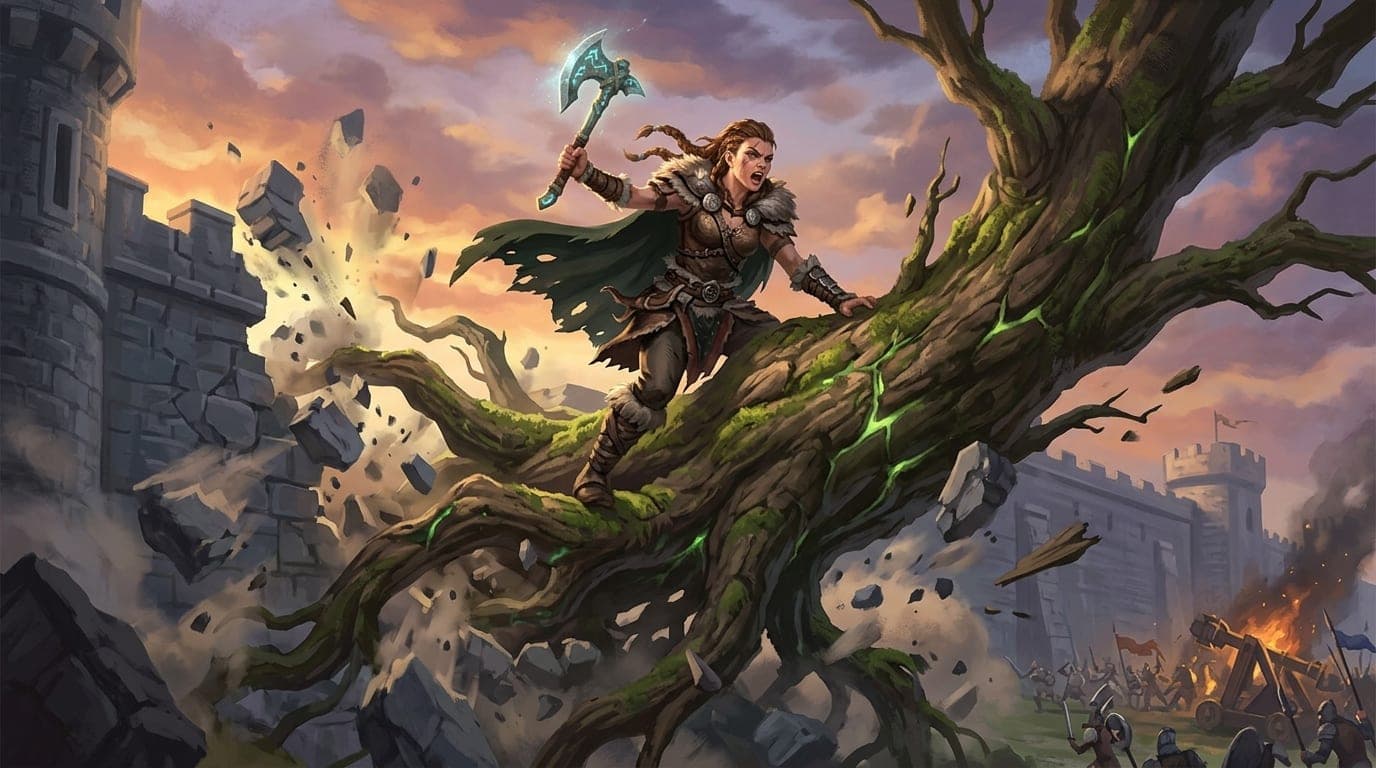
Quick answer: Root Rider Smash is a ground army where 7-10 Root Riders — high-hitpoint units that target defenses and auto-break walls — push through a base behind your heroes, and it remains the most forgiving TH15-TH17 attack in July 2026 because the Root Riders self-navigate walls and soak damage even after the 2026 balance nerfs trimmed their range and splash support.
Root Rider Smash is the army most high-Town-Hall players reach for when they want a 3-star without frame-perfect timing, and it is still the most forgiving TH15-TH17 attack in July 2026. Root Riders are heavy ground units that target defenses and break walls automatically, so the army removes the two hardest parts of most attacks: pathing and wall control. The 2026 balance patches did nerf the archetype — Root Rider range and some splash support were reduced, and the troop itself lost a slice of its old power — but the smash still 3-stars a wide band of war bases, and this guide covers its current composition, hero funneling, spell package, and exactly why it stays beginner-friendly.
What Is the Current Root Rider Meta in 2026?
The current Root Rider meta is "strong but no longer untouchable." After the 2026 balance changes, Root Riders remain one of the best ground troops at TH16 and a core TH17 option, but they share the top meta with RC Charge Super Yeti, Queen Charge LavaLoon, and Hydra air armies rather than dominating alone. The most common 2026 variants are Root Rider Yeti, Root Rider Valkyrie Dive, and straight Root Rider Smash with hero support.
Impact: significant. The nerfs changed how you use Root Riders, not whether you use them. Reduced splash support means you lean harder on Overgrowth and Rage to control the base, and the community consensus is that a clean Root Rider Smash still clears most TH16 war bases and a large share of TH17 bases. Honest framing for a beginner: the archetype is easier than Queen Charge LavaLoon and more forgiving than any hero-charge army, which is why it remains the recommended first high-TH attack even in its nerfed state.
Want this checked against your own base?
Run the free Upgrade Priority Advisor — TrophyCoach reads your live profile and ranks exactly what to upgrade next, heroes checked against your Town Hall caps.
Run the free upgrade checkWhat Is the Best Root Rider Smash Army Composition?
The best composition centers on 7-10 Root Riders as the wrecking core, all 4-5 heroes for funneling and durability, 2-4 support troops such as Valkyries or Super Wizards, and a spell package built around Rage, Heal, and Overgrowth. Counts scale with Town Hall and army camp space.
| Component | TH15 range | TH17 range | Job |
|---|---|---|---|
| Root Riders | 7-9 | 9-12 | Break walls, target defenses, soak fire |
| Heroes | 4 (King, Queen, Warden, Champion) | 5 (+ Dragon Duke) | Funnel and tank alongside the Riders |
| Support troops (Valkyrie, Super Wizard) | 2-4 | 3-6 | Clean the core and add DPS |
| Siege | Battle Blimp or Siege Barracks | Siege Barracks | Deliver Clan Castle troops mid-push |
| Spells | Rage, Heal, Overgrowth, Freeze | Rage, Heal, Overgrowth, Freeze | Keep the Riders alive and control poison towers |
Two honest caveats for July 2026. First, exact Root Rider counts and camp space shift with balance patches and the arrival of TH17 and the Dragon Duke hero, so confirm your numbers against a fresh army before war. Second, the "Smash" label covers a family of armies — pure Root Rider Smash, Root Rider Yeti, and Root Rider Valk Dive — and the right variant depends on the base's core density. Start with the pure smash to learn the fundamentals.
How Do You Funnel With Heroes for Root Rider Smash?
Funnel by deploying your heroes and a few support troops on the edges to clear the buildings that would pull the Root Riders sideways, so the Riders commit straight into the base instead of circling the outside. A good funnel is the single biggest factor in a Root Rider 3-star, because the Riders are strong but they still path toward the nearest defense — a bad funnel sends them around the perimeter.
The funnel has a clear sequence. First, drop support troops or a couple of Root Riders on two adjacent sides to shave the corner buildings. Second, send the heroes behind that clear so they tank and add damage on the main axis. Third, release the main Root Rider group into the funnel you just cut, aimed at the densest defensive line. The King and Champion tank the front, the Queen adds ranged DPS, and the Warden's ability shields the whole push as it crosses the core.
The mistake to avoid is deploying all Root Riders in one spot with no funnel. They will fan out toward the closest defenses on each side and never reach the middle. Two clean funnel sides turn a scattered attack into a straight wrecking line.
How Should You Use Overgrowth, Rage, and Heal Spells?
Use Overgrowth to freeze the buildings and poison towers that would slow your push, Rage to speed the Riders through the core, and Heal to carry them across the heaviest defensive fire. A standard TH16-TH17 package is 2-3 Overgrowth, 2-3 Rage, 1-2 Heal, and 1-2 Freeze, tuned to the base.
| Spell | Count (TH16-TH17) | Where it goes |
|---|---|---|
| Overgrowth | 2-3 | On buildings blocking the path and on poison-bomb towers |
| Rage | 2-3 | On the Root Rider core once it is inside the base |
| Heal | 1-2 | Under the Riders as they cross the defensive core |
| Freeze | 1-2 | On Infernos, Scattershots, or the Monolith |
| Poison | 1 | On the enemy Clan Castle and Heroes |
There is a timing rule specific to Root Riders that trips up new players: do not Rage them while they are mid-wall-break. Rage accelerates the Riders past the point where the wall-breaking animation completes, so they route around the wall instead of through it. Rage them once they are already inside the compartment, and the extra speed becomes pure damage instead of broken pathing.
Why Is Root Rider Smash Beginner-Friendly at TH15+?
Root Rider Smash is beginner-friendly because the troop removes the two hardest attacking skills — wall breaking and pathing — from the player's job. Root Riders break walls automatically, so you never place Wall Breakers or Jump spells to open the core, and they target defenses, so the army walks toward the buildings that matter without micro.
That leaves the player with a shorter checklist than any hero-charge army. You funnel with heroes on two sides, you send the Riders into the densest defensive line, and you spend Rage and Heal to carry them through the middle. Compared to a Queen Charge Hybrid — which demands precise Healer placement, charge timing, and a separate swarm-release window — the smash is far more forgiving of a 2-3 second timing error. A missed spell in a Root Rider Smash usually costs one Rider; a missed spell in a queen walk can end the attack.
The forgiveness is exactly why it survives nerfs as the recommended entry army. Even trimmed, a high-hitpoint self-navigating troop is easier for a developing player to 3-star with than any army that depends on frame-perfect execution.
Which Bases Does Root Rider Smash Beat and Struggle Against?
Root Rider Smash beats bases with a strong but reachable core, because the Riders' hitpoints let them tank through a dense middle that would melt a swarm — and the 2026 splash nerfs to defensive support actually let ground Riders path through the core more reliably. It struggles against bases that spread defenses into isolated pockets, because the Riders lose focus chasing far-apart buildings and run out of time.
| Base trait | Result vs Root Rider Smash | Adjustment |
|---|---|---|
| Dense defended core | Favorable — Riders tank and grind it down | Rage the core, Heal across it |
| Spread, ringed defenses | Unfavorable — Riders lose focus and stall | Switch to Root Rider Valk Dive or an air army |
| Heavy poison / Multi-Gear towers | Slows the push | Overgrowth the poison towers early |
| Deep maze walls | Riders auto-break but lose time | Add a Rage inside the maze, not at the wall |
When a base spreads its defenses into far corners with no central mass, the honest call is to bring a different archetype. Match the army to the layout using our war attack strategies guide, and if the base has an exposed flank, a Queen Charge Hybrid may 3-star it more cleanly.
How Do You Practice Root Rider Smash Before War?
Practice in friendly challenges by posting a war base and running the smash 10-15 times, grading only the funnel on the first 5 reps and only the Rage timing on the next 5. The funnel and the "don't Rage mid-wall-break" rule are the two habits that decide most Root Rider attacks, and both are free to drill in friendly challenges.
Set a specific pass condition per rep block. First 5 reps: the Root Riders must commit straight into the core, not circle the outside — if they circle, your funnel was too thin. Next 5 reps: every Rage lands after the Riders are already inside a compartment, never during a wall break. Final 5 reps: your Overgrowth lands on the poison towers before they slow the push. After 15 reps you will know your exact Rider count and spell sequence for that base shape.
The reason to drill this specific army is that its forgiveness makes players lazy. Because a smash "usually works," beginners stop grading their funnel — and then a war base with a spread core punishes them. Ten graded reps a week keeps the fundamentals sharp.
How Do You Scout for a Root Rider Smash?
Scout by finding the densest line of defenses and the two funnel corners, then checking for poison towers and spread pockets that would break the Riders' focus. A 20-second scout answers whether the smash fits this base or whether you should bring a different army.
| Scout question | What you are looking for | Decision it drives |
|---|---|---|
| Core density | A central mass of defenses to grind | Whether the smash fits at all |
| Funnel corners | Two adjacent sides with cuttable buildings | Where heroes and support go |
| Poison / Multi-Gear towers | Towers that slow or drain the push | Where Overgrowth lands |
| Spread pockets | Isolated far-corner defenses | Whether to switch archetypes |
Run the same base through TrophyCoach's War Coaching tool — it reads any base on a public war log and helps confirm whether the core is dense enough for a smash before you spend a war hit. Pair it with the Upgrade Priority Advisor so your Root Riders, heroes, and lab upgrades stay ahead of the bases you face.
How Do You Build the Right Spell Package for the Base?
Build the spell package by counting the base's threats and assigning a spell to each: one Overgrowth per poison or Multi-Gear tower on your path, one Rage per compartment you need to blitz, one Heal per stretch of open defensive fire, and one Freeze per single-target defense that one-shots your Riders. The package is a response to the base, not a fixed recipe, and reading it correctly is what separates a smash that grinds out a 3-star from one that stalls at 90%.
Start from a default and adjust. A neutral TH16-TH17 default is 2 Overgrowth, 2 Rage, 1 Heal, and 1-2 Freeze, then you shift slots based on what you scout.
| If the base has… | Add… | And cut… |
|---|---|---|
| Two or more poison / Multi-Gear towers | A third Overgrowth | One Freeze |
| A single fortified core to blitz | A third Rage | One Heal |
| A long open kill-zone of point defenses | A second Heal | One Rage |
| Two Infernos plus a Monolith | A second Freeze | One Overgrowth |
| A deep maze with poison behind it | Overgrowth on the poison | A spare Rage held for the core |
The decision that new players get wrong most is over-loading Rage. Rage feels powerful, so beginners bring four and Heal one, then watch their Riders die crossing the core because there was no sustain. For most bases, sustain (Heal plus Overgrowth) keeps the Riders alive long enough that two Rages are plenty to finish. Bring the third Rage only when the base has a single hard core you must burst before the poison towers drain you — and in that case, Overgrowth the poison first so the Rage is pure damage. Confirm your read against the base with our war attack strategies guide before you lock the army.
How Do You Read a Base That Counters Root Rider Smash?
Read a countering base by looking for three specific traits that break the Riders' strengths: defenses spread into isolated far-corner pockets, a poison-tower ring layered behind maze walls, and single-target Infernos or a Monolith positioned so no one Rage or Freeze covers them together. When you see two or more of these, the smash is the wrong tool and you should switch armies rather than force it.
The tell-tale anti-Root-Rider base scatters its defenses so the Riders never build a focused wrecking line — they split toward the nearest defense on each side and grind slowly across open ground, running the clock out at 80-90%. A second common counter buries poison towers deep behind maze walls so the Riders take poison damage the whole time they auto-break through, arriving at the core already weakened. A third stacks the Monolith next to a max Inferno so a single Freeze cannot neutralize both, and the pair deletes Riders faster than Heal can save them.
| Counter trait | Why it beats the smash | Your call |
|---|---|---|
| Spread far-corner pockets | Riders lose focus, run out of time | Switch to Valk Dive or air |
| Poison ring behind maze walls | Riders arrive weakened from poison | Overgrowth-heavy, or switch |
| Monolith + Inferno paired | One Freeze can't cover both | Two Freeze, or a different army |
| Very wide anti-ground design | No central mass to grind | Bring an air army |
The honest coaching point is that recognizing a counter early is a skill worth more than any spell trick. A player who switches to an air army against a wide anti-ground base 3-stars it; a player who forces the smash out of stubbornness 2-stars and loses the war. When two counter traits show up, respect the base and change your plan. TrophyCoach's War Coaching tool helps you spot these patterns on any base with a public war log before you commit a hit.
What Are the Root Rider Smash Variants?
The three main variants in 2026 are pure Root Rider Smash, Root Rider Yeti, and Root Rider Valkyrie Dive, and each solves a different base problem. Pure smash relies on the Riders and heroes alone; the Yeti and Valk variants add a burst-damage troop to crack a hard core or a deep pocket the Riders would grind on too slowly.
| Variant | What it adds | Best against |
|---|---|---|
| Pure Root Rider Smash | Just Riders, heroes, and spells | Bases with a single reachable dense core |
| Root Rider Yeti | Super Yetis behind the Riders for burst and Yetimite spawns | Fortified central cores that need extra DPS |
| Root Rider Valkyrie Dive | Valkyries diving compartments the Riders open | Spread cores where you need to clean side pockets |
Choose the variant by the base, not by habit. If a base has one central mass of defenses, the pure smash or Yeti version grinds it down. If the base spreads its core into two or three pockets, the Valk Dive version cleans the pockets the Riders break open. The Yeti addition is the most popular high-TH pairing because the Super Yetis soak fire alongside the Riders and their Yetimites flood buildings on death, adding raw building destruction the Riders alone can be too slow to reach.
The reason to learn the pure smash first is that every variant shares the same funnel, the same "don't Rage mid-wall-break" rule, and the same Overgrowth-on-poison-towers habit. Once those fundamentals are automatic, adding Yetis or Valkyries is a small step rather than a new army.
How Do You Adjust Root Rider Smash for TH17?
Adjust for TH17 by adding the fifth hero, the Dragon Duke — unlocked at TH15 in March 2026 — to your funnel or your core push, running a larger 9-12 Root Rider count in the expanded army camps, and leaning on the extra spell slots for an additional Rage or Overgrowth. TH17 bases pack more overlapping Infernos, Scattershots, and the Monolith, so the smash needs more sustain to cross the core.
The hero math changes most at TH17. With all five heroes — Barbarian King, Archer Queen, Grand Warden, Royal Champion, and Dragon Duke — you have more funneling power and more tanking on the main axis, which lets the Root Riders commit deeper before support troops are needed. The Warden's ability timing matters even more here: pop it as the Riders and heroes cross the heaviest defensive line, not early on the funnel, so the shield lands where the burst damage is.
At the very top of TH17 the smash shares the meta with RC Charge Super Yeti and Hydra air, so treat Root Rider Smash as your forgiving default and reach for those sharper armies only when a base's core is too fortified for the Riders to grind in time. For a full picture of when to pick each high-TH army, see our war attack strategies guide, and to keep your five heroes leveled in the right order, use the Upgrade Priority Advisor.
What Are the Most Common Root Rider Smash Mistakes?
Mistake 1 - no funnel: Dropping all Root Riders in one spot with no side clears sends them fanning toward the nearest defenses and around the outside. Cut two adjacent funnel corners with heroes and support first.
Mistake 2 - Raging during a wall break: Rage accelerates the Riders past the wall-breaking animation, so they route around instead of through. Rage only after the Riders are already inside a compartment.
Mistake 3 - ignoring poison towers: Poison and Multi-Gear towers quietly drain the push. Drop Overgrowth on them early so the Riders keep their hitpoints for the core.
Mistake 4 - forcing the smash on a spread base: A base with isolated far-corner defenses breaks the Riders' focus and runs the clock out. Switch to Valk Dive or an air army when there is no central mass.
Mistake 5 - saving spells too long: Holding Rage and Heal for a perfect moment usually means the Riders die at 80%. Spend Rage as soon as the core is reached and Heal as the Riders cross the heaviest fire.
Frequently Asked Questions
Did Root Riders get nerfed in 2026?
Yes. The 2026 balance patches trimmed Root Rider range and reduced some defensive-splash support around the archetype, and the troop lost a slice of its old raw power. Root Riders remain one of the strongest ground troops at TH16 and a core TH17 option, so the nerfs changed how you use them rather than retiring the army.
Is Root Rider Smash still good at TH17 in 2026?
Yes. Root Rider Smash and its Root Rider Yeti and Valk Dive variants are core TH17 war armies in 2026, sharing the top meta with RC Charge Super Yeti and Hydra. It stays the most forgiving TH17 option because the Riders self-navigate walls and soak defensive fire.
How many Root Riders do you need?
You need roughly 7-9 Root Riders at TH15 and 9-12 at TH17, scaled to your army camp space, plus all heroes and a few support troops. Confirm the exact count against a fresh army because camp space and troop stats shift with each balance patch.
Why do my Root Riders path around walls instead of through them?
Your Root Riders path around walls because you Raged them during the wall-breaking animation, which speeds them past the point where the break completes. Wait until the Riders are already inside a compartment before dropping Rage.
Is Root Rider Smash easier than Queen Charge?
Yes, Root Rider Smash is more forgiving than a Queen Charge because the Riders break walls and target defenses automatically, removing the pathing and wall-control skills that a queen walk demands. A missed spell in a smash usually costs one Rider, while a missed spell in a queen walk can end the attack.
What spells does Root Rider Smash use?
Root Rider Smash uses Overgrowth to control poison towers and blocking buildings, Rage to speed the Riders through the core, and Heal to carry them across the heaviest fire, plus 1-2 Freeze for single-target defenses. A typical TH16-TH17 package is 2-3 Overgrowth, 2-3 Rage, 1-2 Heal, and 1-2 Freeze.