
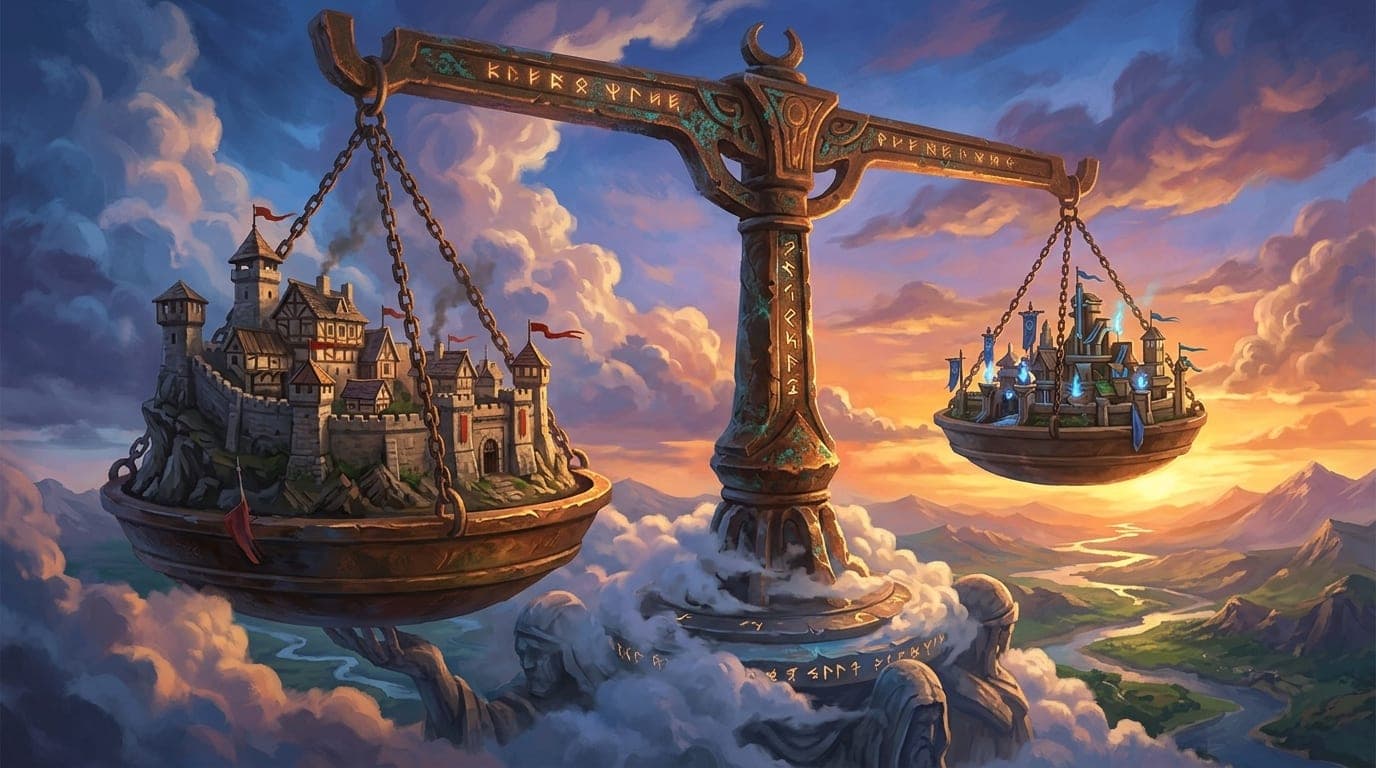
Quick answer: War weight is a hidden numerical value Supercell assigns to every defense, hero, troop, spell, trap, and wall, and Clan War matchmaking sums each participating base's weight to find an opponent — and since Supercell's 2026 matchmaking changes now weigh offense as well as defense, engineered and rushed bases barely lower your matchup difficulty anymore.
War weight is the most misunderstood system in Clash of Clans, and it explains why one clan gets crushed by a stronger opponent while another with identical Town Hall levels gets a fair fight. Every upgrade you buy — a Wizard Tower level, a hero level, a wall ring — adds a hidden number to your base's war weight, and Clan War matchmaking pairs clans by the total weight of the bases that opt in. This guide explains what war weight actually is (as reverse-engineered by the community), the history of engineered bases and Supercell's countermeasures, how defense and offense both count in 2026, and how to build a roster that avoids brutal mismatches.
What Is War Weight in Clash of Clans?
War weight is a numerical value Supercell assigns to all Troops, Spells, Heroes, Traps, Walls, and Defenses, and upgrading any of them raises your base's weight. Defenses carry the most weight per item, which is why a base full of maxed defenses "weighs" far more than a base of the same Town Hall level with defenses left at low levels. Supercell has never published the exact numbers, so everything the community knows about war weight comes from years of reverse-engineering by data-gathering players.
The important mental model is that weight is a per-item running total, not a Town Hall label. Two TH15 bases can have wildly different war weights: one that maxed every defense sits near the top of the TH15 range, while one that rushed to TH15 and left defenses at TH12 levels sits far lower. Matchmaking cares about that running total, not the Town Hall number over your base.
Want this checked against your own base?
Run the free Upgrade Priority Advisor — TrophyCoach reads your live profile and ranks exactly what to upgrade next, heroes checked against your Town Hall caps.
Run the free upgrade checkHow Does Clan War Matchmaking Actually Work?
Clan War matchmaking works by summing the war weight of every base that opts into the war, then searching for an enemy clan with a similar total weight. When you start a war search, the system takes your participating roster's combined weight and looks for an opponent whose combined weight is close, so the two clans are — in theory — evenly matched.
This total-weight approach is why your roster composition matters more than your clan's average Town Hall. If you pull in a few maxed high-weight bases for a war, your clan's total weight jumps and the system finds a heavier opponent — which can leave your lower bases facing enemies well above their pay grade. Matchmaking matches the clan totals, then both clans mirror their rosters top-to-bottom, so the weight you bring shapes the difficulty every one of your members faces.
What Weighs More: Defense or Offense?
Historically defenses carried the overwhelming majority of war weight, while heroes, troops, and spells added far less — which is exactly the loophole that made engineered bases possible for years. Under the classic model, you could upgrade offense heavily while keeping defenses low, and your base's war weight stayed low even though your attacking power was maxed.
Impact: significant. Supercell's 2026 matchmaking changes altered this balance by taking offense into account more directly, so upgrading heroes, troops, and spells now moves your weight and your matchup difficulty in a way it did not before. The practical result is that you can no longer hide a maxed offense behind a low-weight defense — the system sees the attacking power you bring to war and matches accordingly.
| Item type | Classic weight contribution | 2026 direction |
|---|---|---|
| Defenses | Very high — the bulk of your weight | Still the largest single factor |
| Heroes | Low relative to defenses | Weighed more directly in matchmaking |
| Troops and spells | Low | Weighed more directly in matchmaking |
| Traps and walls | Low to moderate | Minor factor |
The honest caveat: Supercell does not publish the current formula, and the community is still measuring how much the 2026 changes shifted each item's contribution. What is clear from the update and from clan-level experience is that the offense-ignoring loophole is largely closed.
What Are Engineered Bases and Why Did Supercell Kill Them?
Engineered bases were villages built to exploit the old weight formula: players stopped upgrading defenses while continuing to max heroes, troops, and spells, producing a base with huge offensive power and artificially low war weight. A clan stacked with engineered bases could bring maxed attackers to war while presenting a low total weight, so matchmaking paired them against genuinely weaker opponents that their maxed offense would then triple.
Supercell has spent years fighting this. The 2026 matchmaking improvements are the latest step: by weighing offense more directly, the system removes most of the advantage of upgrading attack while neglecting defense. The community consensus in 2026 is blunt — engineering "not really works anymore," and the recommended approach is to build a solid, as-strong-as-possible war base rather than trying to game the formula.
This is genuinely good news for normal clans. For years, engineered clans distorted the ladder and handed unfair wars to honest opponents. With the loophole largely closed, a clan that upgrades naturally is far less likely to be sandbagged by a roster of hidden maxed attackers.
Do Rushed Bases Still Affect Matchmaking?
Rushed bases — villages that raced up Town Hall levels while leaving defenses far behind — used to lower a clan's total weight and pull in easier wars, but their impact has shrunk. A rushed base still carries less defensive weight than a maxed base of the same Town Hall, but the 2026 emphasis on offense means the gap no longer produces the easy matchups it once did.
The community read in 2026 is that rushed bases "are not that much of a thing anymore" as a matchmaking strategy. A rushed base is still a liability in the war itself — it is easy for the enemy to 3-star and it struggles to earn stars against opponents with real defenses — so the modern recommendation is to grow at a balanced pace rather than rush and hope the weight math saves you. For a balanced upgrade path that keeps your war weight honest and your base strong, see our upgrade priority guide.
How Do You Build a Roster That Avoids Mismatches?
Build a roster that avoids mismatches by keeping your participating bases within a tight weight band, avoiding a mix of maxed and rushed bases in the same war, and rotating out the one or two extreme-weight bases that distort your clan total. The goal is a roster where every base can realistically 3-star its mirror, not one where your top base drags the total up and your bottom bases inherit unwinnable matchups.
| Roster mistake | Why it causes hard wars | Fix |
|---|---|---|
| Mixing maxed and rushed bases | The maxed bases inflate total weight; rushed bases face heavier mirrors | Group bases into similar-weight war rosters |
| Pulling in one very high base | Spikes the clan total, hardens everyone's mirror | Sit the outlier out or run a heavier war deliberately |
| Bringing under-developed heroes | Weak offense meets a mirror matched to your weight | Keep heroes and troops upgraded alongside defenses |
| Random opt-ins each war | Total weight swings wildly, matchups feel unfair | Set a consistent war roster and stick to it |
The cleanest habit is a fixed war roster that grows together. When every base upgrades at a balanced pace, your clan total moves smoothly and matchmaking keeps finding opponents your members can actually beat. Sudden weight swings — from a new maxed base opting in or a rushed base joining — are what produce the "why did we get this monster clan?" wars.
How Do You Scout Your Own War Weight Before Searching?
Scout your own weight by comparing your participating bases' defense levels, hero levels, and lab progress, and flagging any base that is far above or below the rest. You cannot see the raw weight number in-game, but you can read the signals: a base with all defenses maxed and one with defenses two Town Halls behind will sit at opposite ends of the weight range even at the same Town Hall.
Practical war-council checklist before you hit search: confirm no single base is dramatically heavier than the rest, confirm your rushed bases are not padding the roster to chase easy wars, and confirm your heroes and troops are upgraded enough that your offense matches the weight you are bringing. If your clan has been getting hard wars, the usual cause is one heavy base spiking the total or a mix of maxed and rushed bases in the same search.
TrophyCoach's War Coaching tool helps here by reading any clan's public war log, so before a war — or before recruiting a new member — you can scout how a base's development and war history compare to your roster. Pair it with the Upgrade Priority Advisor so every member upgrades in the order that keeps their base's weight and strength in step.
Why Does Your Clan Keep Getting Hard Wars?
Your clan keeps getting hard wars usually because of one of four causes: a heavy base is spiking your total weight, your roster mixes maxed and rushed bases, your bases carry high defensive weight but under-leveled heroes and troops, or your opt-in roster changes every war so the total swings unpredictably. Matchmaking is doing its job — it is matching the weight you bring — so the fix is almost always on your side of the roster, not in the algorithm.
The most common single culprit is the heavy base. When one maxed member opts in with a much higher weight than everyone else, the clan total jumps, matchmaking finds a heavier opponent, and every base below the heavy one inherits a mirror it cannot beat. Sitting that base out — or committing to a deliberately heavier war where everyone is ready — usually restores fair matchups. The second most common culprit is under-developed offense: if your defenses are maxed but your heroes are three levels behind, you bring high weight but low attacking power, and the mirror matched to your weight out-attacks you.
How Does War Weight Change by Town Hall?
War weight climbs at every Town Hall because each new level unlocks higher defense tiers, extra buildings, and stronger heroes — all of which add weight — so a base's weight rises steadily as it upgrades within a Town Hall and jumps again when it moves up. A freshly upgraded TH16 with TH15-level defenses weighs far less than a maxed TH16, which is why "new to a Town Hall" bases sit at the bottom of their level's weight range.
The practical takeaway is that your weight is a moving target, not a fixed Town Hall bracket. A base gains weight every time it finishes a defense, a hero level, or a wall ring, so a clan whose members are mid-upgrade across the board will search lighter than the same clan two weeks later when those upgrades finish. Clans that struggle with inconsistent matchups often have members finishing large defensive upgrades between wars, which quietly raises the clan total from one war to the next.
At the top end, TH18's new defenses — the Smasher and Longshot Guardians and the Super Wizard Tower formed by merging two Wizard Towers — add fresh high-weight items, so maxing a TH18 pushes weight well above a maxed TH17. That is expected and healthy: the weight reflects real defensive strength, so a maxed TH18 gets matched against comparably strong opponents rather than sandbagging weaker ones.
What Does a War Weight Mismatch Look Like? A Worked Example
A mismatch looks like two 15-base rosters at the same average Town Hall producing very different total weights because one clan maxed its defenses and the other did not. Compare two clans searching with 15 members each, all at TH15-TH16 on paper.
| Clan A (balanced) | Clan B (spiky) | |
|---|---|---|
| Top 3 bases | Maxed TH16 | Two maxed TH16 + one brand-new TH17 |
| Middle 9 bases | Maxed TH15 | Mixed maxed TH15 and rushed TH15 |
| Bottom 3 bases | Near-max TH14 | Two rushed TH14 + one fresh TH15 |
| Total weight | Smooth, mid-range | Spiked high by the TH17 and second maxed TH16 |
| Result | Fair mirrors top to bottom | Heavier opponent; rushed middle inherits unbeatable mirrors |
Clan A searches at a smooth, predictable weight, so matchmaking finds an opponent where every base faces a mirror it can realistically 3-star. Clan B looks similar on the Town Hall roster, but the brand-new TH17 and the second maxed TH16 spike the total weight upward. Matchmaking pairs Clan B against a genuinely heavier opponent — and because both clans mirror their rosters top to bottom, Clan B's rushed middle and bottom bases inherit mirrors far above their real strength. Clan B "feels" like it got a monster war, but the algorithm simply matched the weight Clan B brought.
The fix in the example is roster discipline: Clan B should either sit the fresh TH17 out until its neighbors catch up, or commit to a deliberately heavy war where every base is ready for the tougher mirror. The lesson generalizes — a roster whose weight is spiked by one or two outliers hands its weakest members the hardest attacks. Keep upgrades balanced across the roster with the upgrade priority guide so your clan total moves smoothly instead of spiking.
How Is CWL Matchmaking Different From Regular War?
CWL matchmaking is completely different: Clan War League ignores war weight, Town Hall levels, and troop, hero, and defense levels entirely, matching clans purely by their current league tier. Once a clan's league placement is set, the system randomly groups it with 7 other clans in the same league — a group of 8 — that chose the same war size, and those clans fight a round-robin over the season.
Impact: significant. This is the single most important thing to understand about the two war modes. In regular Clan Wars, matchmaking balances the two clans' total war weight, so building a strong, balanced base helps you get fair matchups. In CWL, none of that applies — your league tier is the only input, so a clan can be matched against opponents with much higher or lower Town Halls in the same league. That is by design and cannot be gamed with weight.
| Factor | Regular Clan War | Clan War League (CWL) |
|---|---|---|
| Primary match input | Total war weight of participating bases | Clan's current league tier |
| Considers Town Hall / hero / defense levels | Yes, via weight | No, ignored entirely |
| Opponent structure | One opponent per war | Group of 8 clans, round-robin |
| Attacks per member per war | 2 | 1 |
| Can weight tricks help? | Barely, after 2026 changes | No, weight is not used at all |
The practical consequence for roster planning is that CWL rewards raw roster strength and one-attack discipline, not weight management. Because CWL gives each member only one attack per war and matches by league rather than weight, you often face bases stronger than your own, so your best attackers should target the bases they most reliably 3-star. In regular war, weight discipline keeps matchups fair; in CWL, attack skill and roster depth carry you because the matchmaker offers no weight-based protection at all.
What Is the X.5 or "Point-Five" Base Concept?
The X.5 base — also called a "point-five" — is a community term for a base that has upgraded its offense to the next Town Hall's potential while keeping defenses one Town Hall behind, sitting "half" between two levels in weight terms. It was the engineered-base idea in miniature: a TH15.5 base, for example, might run TH16-level heroes and troops on a base with TH15 defenses to carry strong offense at a lower defensive weight.
Impact: small. The point-five approach mattered a great deal under the old defense-heavy formula, but the 2026 matchmaking changes that weigh offense more directly have blunted its edge, just as they did for full engineering. A point-five base still exists — plenty of players naturally upgrade offense first — but it no longer reliably buys easier war matchups the way it did before. The modern advice is the same as for engineering: build balanced, and let your weight reflect your true strength rather than trying to sit in a gap in the formula.
Understanding the concept still helps you read your roster, though. If a clanmate is a heavy point-five — maxed offense, lagging defenses — they bring strong attacks but weak defense to war, so they may over-perform on offense and under-perform holding stars. Balancing your roster around who attacks well versus who defends well is a legitimate strategy that has nothing to do with gaming the weight formula.
What Are the Most Common War Weight Mistakes?
Mistake 1 - chasing the weight formula: Building engineered or point-five bases to game matchmaking barely works after the 2026 changes and leaves you with a weak base. Build a strong, balanced war base and let your weight reflect real strength.
Mistake 2 - one heavy base opting in: A single maxed member spikes the clan total and hardens everyone's mirror. Sit the outlier out or commit to a deliberately heavier war where everyone is ready.
Mistake 3 - mixing maxed and rushed bases: A roster split between maxed and rushed bases produces unfair mirrors for the rushed half. Group bases into similar-weight war rosters.
Mistake 4 - maxing defense but not offense: High defensive weight with under-leveled heroes brings a hard mirror your weak offense cannot beat. Keep heroes, troops, and spells upgraded alongside defenses.
Mistake 5 - a random opt-in every war: Letting a different mix join each war swings your total weight and makes matchups feel random. Set a consistent war roster and grow it together.
Frequently Asked Questions
Can you see your war weight in Clash of Clans?
No, Clash of Clans does not display a raw war weight number in-game. War weight is a hidden per-item value that the community has reverse-engineered over years, so you can only estimate your weight from your defense levels, hero levels, and lab progress relative to other bases.
Do engineered bases still work in 2026?
No, engineered bases barely work in 2026. Supercell's matchmaking changes now weigh offense more directly, so upgrading attack while neglecting defense no longer hides your war weight — the community consensus is that engineering "not really works anymore," and a strong all-around war base is the better strategy.
Does upgrading heroes increase war weight?
Yes. Heroes have always added some war weight, and after Supercell's 2026 matchmaking changes, offensive upgrades including heroes are weighed more directly in matchmaking. You can no longer max heroes cheaply in weight terms while keeping a low overall matchup difficulty.
Do rushed bases give easier wars?
Rushed bases used to lower a clan's total weight and pull in easier matchups, but that effect has shrunk since the 2026 changes emphasized offense. A rushed base still carries less defensive weight, but it is a liability in the war itself because it is easy to 3-star, so rushing for weight is no longer recommended.
Why did my clan get matched against a much stronger clan?
Your clan was matched by total war weight, so a stronger-looking opponent usually means your participating bases summed to a similar weight — often because one heavy maxed base spiked your total, or because your defenses are maxed while your offense lags. Tightening your roster to a consistent, similar-weight group usually fixes repeat mismatches.
Does the number of participants change matchmaking?
Yes. Matchmaking sums the weight of every base that opts in, so both the number of participants and which bases join change your clan's total weight and therefore your opponent. A consistent war roster produces steadier matchups than letting a random mix opt in each war.