
Quick answer: The best CHAOS Mode decks are built around cards with the highest modifier ceiling — Mega Knight, Sparky, Inferno Dragon, and Three Musketeers all hit S-tier because their Epic modifiers swing entire matches. S-tier picks for the July 2026 return are Mega Knight Sparky Beatdown, Three Musketeers Goblin Giant, and Sparky Goblin Giant Lumberjack. Hog Cycle, 2.6 Cycle, and Logbait drop to B-tier because small cards gain less from random modifiers.
CHAOS Mode is the only Clash Royale format where a 3-elixir card can become more valuable than an 8-elixir card mid-match. 150 modifiers across 50 cards means every match resolves into one of roughly 1,140 possible 4-modifier combinations per side, and the decks that consistently win share three properties: high-ceiling cards (Sparky, Mega Knight, Inferno Dragon, Three Musketeers) whose Epic modifiers swing the match by themselves, redundant win conditions so a bad modifier roll doesn't end the match, and AoE spells that stay reliable when modifiers go random. CHAOS is leaving rotation until July 2026 for a substantial rework — refreshed 50-card pool, partially-replaced modifiers, a new Triple Draft format, and a brand-new Secret Badge — but the structural principles in this tier list will carry through the rework because the modifier-ceiling logic is format-agnostic.
What Makes a Deck Good in CHAOS Mode?
Three properties separate S-tier CHAOS decks from C-tier:
1. Modifier ceiling on individual cards. Some cards have Epic modifiers that transform them into match-ending threats — Sparky's "+50% damage" Epic essentially gives her a one-shot on Princess Towers, Mega Knight's Epic spawns a second Mega Knight on death, Three Musketeers' Epic adds a fourth Musketeer. Other cards have ceiling-capped modifiers that barely change their value: a Skeleton with +20% damage is still a Skeleton. Decks built around high-ceiling cards consistently outperform decks built around low-ceiling utility cards.
2. Redundant win conditions. A single-win-con CHAOS deck dies when its main card gets a useless modifier. If your Hog Rider rolls a "+5% move speed" modifier in pick 4 while your opponent's Sparky just got the +50% damage Epic, you have no answer. Decks with two or even three potential win cons (Mega Knight + Sparky, Three Musketeers + Goblin Giant) survive bad rolls because at least one of their threats will get a useful modifier across the four picks.
3. AoE spells over single-target spells. Random modifiers hit AoE spells less brutally than single-target spells. A Fireball with "+10% radius" is still a Fireball — it kills swarms, it damages towers. A Snowball with a random movement modifier might do nothing useful. Decks with Fireball, Poison, Earthquake, and Log as their spell package stay reliable when modifiers are random. Decks with Zap, Snowball, and Arrows as their spells have higher variance.
The fourth, subtler property: small-card-heavy decks underperform because their modifier draws are less impactful per pick. A deck of 8 expensive heavy cards (Golem, Mega Knight, Sparky, P.E.K.K.A.) gives every modifier pick high upside. A 2.6 cycle deck of cheap utility cards has the same number of picks but lower ceiling per pick, even if the deck plays better on ladder.
Want this kind of analysis for your own deck?
TrophyCoach reads your battle log and writes a personalized action plan against the current meta — free to start.
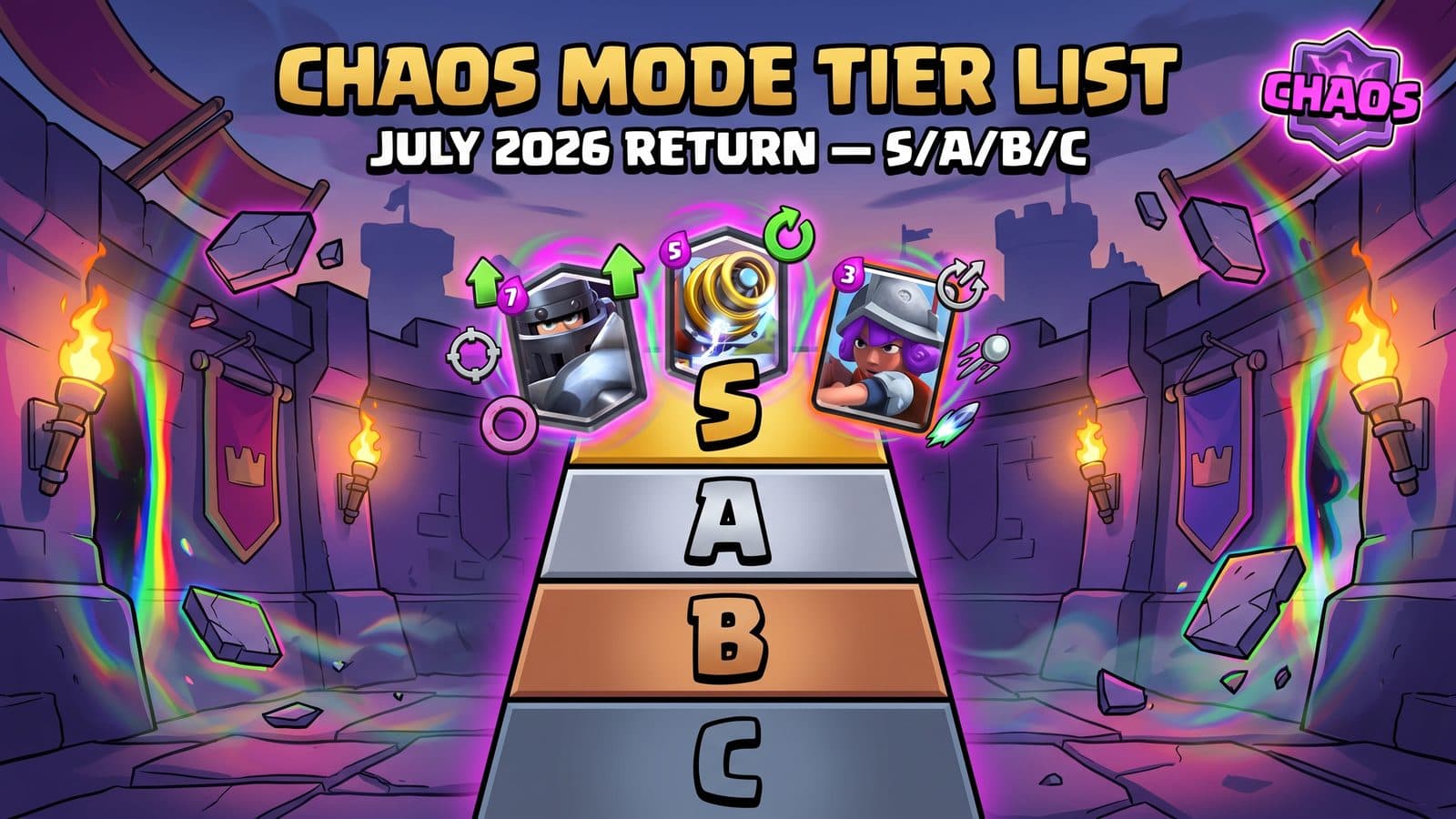
The CHAOS Mode Tier List (S/A/B/C)
| Tier | Archetype | Why It's Ranked Here |
|---|---|---|
| S | Mega Knight Sparky Beatdown | Two top-3 modifier ceilings in one deck |
| S | Three Musketeers Goblin Giant | Two swing payoffs + dual win cons |
| S | Sparky Goblin Giant Lumberjack | Sparky Epic + redundancy + Rage chain |
| A | Lava Hound Balloon | Two air win cons, hard to defend post-modifier |
| A | Royal Giant Sparky Lightning | RG carry + Sparky ceiling + heavy spell |
| A | PEKKA Mega Knight Mirror | Mirror amplifies Epic modifier value |
| B | Hog 2.6 Cycle | Low ceiling per card |
| B | Classic 2.6 Cycle | Same problem as Hog Cycle |
| B | Goblin Barrel Logbait | Small-card-heavy, low modifier upside |
| B | X-Bow Cycle | One-trick win condition, dies to bad rolls |
| C | Mortar Cycle | Same issue as X-Bow with weaker base |
| C | Skeleton Army Cycle (gimmick) | Almost no ceiling on any card |
S-Tier CHAOS Decks: 3 Builds That Dominate
S-Tier Build 1: Mega Knight Sparky Beatdown
Cards: Mega Knight, Sparky, Inferno Dragon, Wizard, Knight, The Log, Fireball, Tombstone. Average elixir: 4.4.
Mega Knight Sparky Beatdown is S-tier because it stacks three of the top five modifier-ceiling cards in the game: Mega Knight, Sparky, and Inferno Dragon. When the game offers you two modifier choices at the 50-second mark, the probability that at least one option enhances a match-winning card is roughly 70% with this deck — versus roughly 25% for a generic Hog Cycle build. Mega Knight is the #19 most-trafficked card guide on the site for a reason: his base power is high, and his Epic modifier (spawn a second Mega Knight on death) is the single highest-impact card modifier in the mode. See the Mega Knight Guide for the full ceiling analysis.
The base game plan during the first 50 seconds (before any modifiers): defend cheaply with Knight, Wizard, and Tombstone. Do not overcommit. The moment your first modifier hits, your push plan changes — if it enhances Mega Knight, you start him at the back of the King Tower and stack Sparky behind. If it enhances Sparky, the Knight + Sparky combo at the bridge becomes your primary threat. If it enhances Inferno Dragon, your defense becomes nearly impenetrable and you switch to a chip plan with Fireball cycling.
S-Tier Build 2: Three Musketeers Goblin Giant
Cards: Three Musketeers, Goblin Giant, Battle Ram, Ice Golem, Mega Minion, Heal Spirit, Earthquake, The Log. Average elixir: 4.0.
Three Musketeers Goblin Giant earns S-tier on the strength of its dual high-elixir payoffs. The Three Musketeers Epic modifier in the original pool added a 4th Musketeer, doubling Three Musketeers' lane DPS and making her uncounterable by a single Fireball. The Goblin Giant Epic modifier — which spawned 4 Spear Goblins per Goblin Giant attack instead of 2 — turned him into a self-replenishing army. Either one wins the match on its own; both together are devastating.
The deck also benefits from redundancy. If the opposing player gets the Inferno Dragon freeze modifier (the natural counter to Three Musketeers), you pivot to Goblin Giant + Battle Ram pressure on the opposite lane. Battle Ram with its own ceiling modifiers (which add Barbarian count on impact) becomes a third threat that demands a separate defensive response.
Heal Spirit is the key support card — when modifier escalation makes pushes more durable, healing them is disproportionately valuable. Earthquake covers buildings, the universal CHAOS-pool anti-X-Bow and anti-Inferno-Tower answer.
S-Tier Build 3: Sparky Goblin Giant Lumberjack
Cards: Sparky, Goblin Giant, Lumberjack, Electro Wizard, Knight, Tornado, Fireball, Zap. Average elixir: 4.1.
Sparky Goblin Giant Lumberjack is the third S-tier deck and the highest skill ceiling of the three. Sparky's Epic modifier is the single biggest ceiling in the mode — her base attack already deals 1,300+ damage at Level 14, and the modifier pushes it to nearly 2,000 damage per shot, enough to one-shot Princess Towers below 60% HP. The challenge with Sparky is keeping her alive long enough for that modifier to land, and that's where Lumberjack's death Rage and Goblin Giant's Spear Goblins do the work.
Tornado is the deck's defensive linchpin and offensive amplifier. On defense, it kites enemy win conditions into the Sparky/Electro Wizard kill zone. On offense, it pulls clumped defenders into a single Sparky shot for 7+ kills on a single attack. Electro Wizard's stun keeps key threats locked while Sparky charges.
The deck's weakness is the opening 50 seconds, when no modifiers are active and Sparky is just an 6-elixir slow card that any Inferno Dragon or Mini P.E.K.K.A. shreds. Survive that window with Knight + Electro Wizard defense and Fireball cycling, then deploy Sparky once your first modifier hits.
A-Tier CHAOS Decks: 3 Solid Picks
A-Tier Build 1: Lava Hound Balloon
Lava Hound Balloon is A-tier because it carries two air win conditions and air-targeting defenses are rare in the CHAOS card pool. The Lava Hound Epic modifier spawned 8 Lava Pups instead of 4 on death, and the Balloon Epic added a second Balloon that spawns on impact. Either modifier is match-winning, and together they create a defensive nightmare. The reason it's A-tier and not S-tier: when neither air modifier rolls, the deck has lower base power than the Mega Knight or Three Musketeers builds, which both function well even at modifier zero.
Suggested cards: Lava Hound, Balloon, Skeleton Dragons, Mega Minion, Inferno Dragon, Tombstone, Fireball, Arrows.
A-Tier Build 2: Royal Giant Sparky Lightning
Royal Giant + Sparky in one deck is a two-win-con shell where both threats have ceiling modifiers. Royal Giant's Epic modifier extended his range from 5 to 8 tiles — long enough to hit the King Tower from his own side of the river. Combined with Sparky's damage Epic, the opponent has to defend two completely different attack patterns. Lightning is the deck's third pillar — even without modifiers it kills the Inferno Tower or Mini P.E.K.K.A. defending against your Royal Giant.
Suggested cards: Royal Giant, Sparky, Lightning, Knight, Electro Wizard, Tombstone, Zap, Fisherman.
A-Tier Build 3: PEKKA Mega Knight Mirror
PEKKA Mega Knight is the highest-elixir deck in the tier list, and that's the point — every modifier you pick boosts a 5+ elixir card. Mirror is the secret weapon: if you get a great Epic modifier on Mega Knight at pick 4, Mirror lets you stack a second modifier-enhanced Mega Knight in the same push for double the death-spawn effect. The deck's weakness is that you need to survive single elixir without much cheap defense, which is why Tornado and Electro Wizard are non-negotiable.
Suggested cards: PEKKA, Mega Knight, Mirror, Tornado, Electro Wizard, Bandit, Poison, Zap.
B-Tier and Why They Underperform in CHAOS Mode
Hog 2.6 Cycle drops to B-tier in CHAOS Mode because every card in the shell has a low modifier ceiling. Hog Rider's best modifier (charge speed +25%) is a marginal upgrade compared to Sparky's +50% damage or Mega Knight's death-spawn. Cannon, Ice Spirit, Skeletons, and Ice Golem all have modifiers that barely change their function. Musketeer has decent modifiers but the deck's overall ceiling-per-pick is roughly 40% of the S-tier builds. The deck still wins matches — its cycle speed alone overwhelms slower opponents — but in a Best-of-3 streak for a Secret Badge, its variance is too high.
Classic 2.6 Cycle (Hog removed, generic cycle) has the same issue plus no real win condition. In CHAOS, this is the deck people pick when they want a "safe" option, and it's usually the wrong call. Variance is what wins CHAOS — picking against variance is picking against the game's central mechanic.
Goblin Barrel Logbait is B-tier for a subtler reason: the deck's win pattern is chip damage from many small cards (Goblin Barrel, Princess, Dart Goblin), and modifiers on small cards are inherently low-impact. Princess's best modifier slightly extends her range. Goblin Barrel's modifier adds one extra Goblin. None of these are match-winning. Meanwhile, your opponent's Mega Knight modifier or Sparky modifier is doing 1,500+ tower damage per hit. You can win Logbait matches in CHAOS, but you'll win 40% instead of the 55% Mega Knight Beatdown gets.
X-Bow Cycle sits at the B/C border because X-Bow's modifiers are decent (range and hit speed), but X-Bow is itself a one-trick deck — if your X-Bow modifier doesn't roll, the deck has no Plan B. Single-win-condition decks are punished hardest by CHAOS's randomness.
Modifier Categories That Matter Most
The 150 modifiers in the original CHAOS pool fall into four functional categories, and their value differs sharply:
Damage modifiers (~45 of 150): The most impactful category by far. Sparky +50% damage, Mega Knight death-spawn, Three Musketeers +1 musketeer, Dart Goblin Sparky-darts — all damage-category modifiers. Build for damage modifiers by stacking high-damage win cons.
Spawn modifiers (~30 of 150): Second most impactful. Barbarian Hut spawning Mega Knights (the single strongest modifier in the original pool), Tombstone spawning Skeleton Giants, Witch doubled skeleton spawn rate. Decks that include 1–2 spawning buildings or troops get a 20% boost in expected value.
Movement/utility modifiers (~50 of 150): Lowest ceiling. +X% speed, +X% range, slightly larger radius. These rarely swing matches. If your deck is dominated by cards whose modifiers are in this category, drop the deck for one with higher-ceiling alternatives.
Death-effect modifiers (~25 of 150): Mid-tier impact. Cards that gain death effects (Golem spawning an extra Golemite, Lava Hound spawning extra Pups, Skeleton Giant exploding) provide consistent value but rarely solo-win matches.
For the complete searchable database of all 150 modifiers with power-tier rankings, use the CHAOS Modifier Database. The tool filters by card, modifier rarity, and category — useful for building optimized decks before queueing.
How to Read the Match-Start Modifier Reveal
The 10-second modifier selection window at the start of every match is where most CHAOS matches are decided, and the typical player wastes it. Use the 10 seconds tactically:
Seconds 0–3: Read both options for the modifier card identity. Which two of your cards are being offered modifiers? If both options enhance support cards (Wizard, Knight), neither pick will swing the match — accept whichever fits your defensive plan. If one option enhances a win condition (Mega Knight, Sparky, Royal Giant), pick that even if the specific modifier is mediocre.
Seconds 3–6: Determine the lane implication. A modifier that buffs your defensive splash (Wizard +20% radius) tilts you toward a defensive game plan — let the opponent push first, defend, counterpush. A modifier that buffs your win condition tilts you toward immediate offense.
Seconds 6–9: Plan your first 30 seconds post-reveal. Which lane will you push? Which lane will you defend? CHAOS opponents often telegraph their plan in the first 20 seconds after modifier reveal — if they immediately drop a tank at the back, they got a tank-amplifying modifier and you should pre-place your defensive anchor on that lane.
Second 10: Lock the pick. Never time out — the game picks for you, often the worse option.
Reading opponent picks at the 50-second, 100-second, and 150-second marks is equally important. If their Ice Wizard suddenly freezes your entire push, you know they took the freeze modifier and you should spread your defenders going forward. If their Fireball starts pulling a Tornado before impact, they took the Tornado modifier and you cannot stack defenders near towers anymore. The parent CHAOS Mode Guide covers the broader read-and-adapt framework in detail; this tier list focuses on which decks make those reads easiest to execute.
How the July 2026 CHAOS Rework Affects This Tier List
Supercell announced (April 2026) that the July 2026 CHAOS return will include a refreshed 50-card pool with some cards removed and new ones added, partially-replaced modifiers, a new Triple Draft format where you pick from three modifiers instead of two, and a brand-new Secret Badge. They cited engagement data that 41% of players unlocked one Secret Badge, 7% unlocked two, and only 2.4% unlocked all three — the rework is partially aimed at making badges more accessible and partially aimed at nerfing dominant strategies.
What we expect to change: the Barbarian Hut + Mega Knights modifier (the strongest single modifier in v1) is the most likely cut. Sparky's damage Epic may be nerfed by 10–20%. The 50-card pool may add evolution cards for the first time, which would shift the meta substantially. What won't change: the structural principles in this tier list. Cards with high modifier ceiling, decks with redundant win conditions, AoE spells over single-target — these will remain the dominant deck-building criteria regardless of which specific cards are in the v2 pool. Bookmark this guide; we'll publish a revised tier list once the v2 modifier list is public in July.
For broader context on evolution cards (which may join the v2 pool), see Evolution Cards Guide. For deeper deck-building theory that applies across modes, see Deck Building Guide. For the badge meta, see CHAOS Mode Badges Guide.
Frequently Asked Questions
What's the best deck for CHAOS Mode in 2026?
The best deck for CHAOS Mode in 2026 is Mega Knight Sparky Beatdown — Mega Knight, Sparky, Inferno Dragon, Wizard, Knight, The Log, Fireball, Tombstone. It stacks three of the top five modifier-ceiling cards in the game (Mega Knight, Sparky, Inferno Dragon), so roughly 70% of your modifier picks will offer a match-swinging option. Average elixir is 4.4, which is heavier than ladder norms but optimal for CHAOS.
Why does Sparky dominate CHAOS Mode?
Sparky dominates CHAOS Mode because her Epic modifier — a roughly +50% damage boost — pushes her attack from 1,300 to nearly 2,000 damage per shot at Level 14, enough to one-shot a Princess Tower below 60% HP. No other card in the original 50-card pool has a comparable damage-ceiling modifier. Even decks that don't run Sparky have to plan defenses against her every match.
Is Hog Cycle good in CHAOS Mode?
Hog Cycle is B-tier in CHAOS Mode, not S-tier. The shell wins matches on raw cycle speed, but Hog Rider, Cannon, Ice Spirit, and Skeletons all have low-ceiling modifiers that barely change their functions. Compared to Mega Knight or Sparky decks where every modifier pick can swing the match, Hog Cycle's modifiers feel marginal. It's playable but not optimal for a 3-win streak attempt.
How do modifiers work in CHAOS Mode?
CHAOS Mode modifiers work like this: at match start and every 50 seconds after, you're offered two random modifiers (the July 2026 rework will change this to three), each tied to one of your deck's cards. You pick one, with no skip option. Modifiers escalate in rarity — picks 1 and 2 are Common, pick 3 is Rare, pick 4 is Epic. Maximum of 4 active modifiers per match. Your opponent picks independently and you cannot see their choices until their cards behave differently in play.
When does CHAOS Mode return to Clash Royale?
CHAOS Mode returns to Clash Royale in July 2026 after going on hiatus in April 2026 for a substantial overhaul. The return version will include a refreshed 50-card pool (some cards removed, new ones added), partially-replaced modifiers, a new Triple Draft pick format, Deck Builder UI improvements, and a brand-new Secret Badge. The exact return date has not been announced.
What are the best CHAOS Mode badges?
The best CHAOS Mode badges in the original event were the Secret C.H.A.O.S. Badge (Legendary tier, earned from 3 consecutive match wins), the Modifier Master badge (10 different Epic modifiers used), and the Chaos Champion badge (50 total wins). Supercell's engagement data showed 41% of players unlocked one badge, 7% unlocked two, 2.4% unlocked all three. See CHAOS Mode Badges Guide for the full badge breakdown.
Should I play CHAOS Mode for trophies or rewards?
Play CHAOS Mode for rewards, not trophies — CHAOS Mode wins do not award ladder trophies, but they do count toward daily win requirements for Magic Lucky Chests, Snippet collection during album events, and the exclusive Secret Badge. If your goal is trophies, play Ranked Ladder. If your goal is rewards or the badge, CHAOS is the most efficient mode in the game during event windows because the random-modifier format makes matches faster on average.