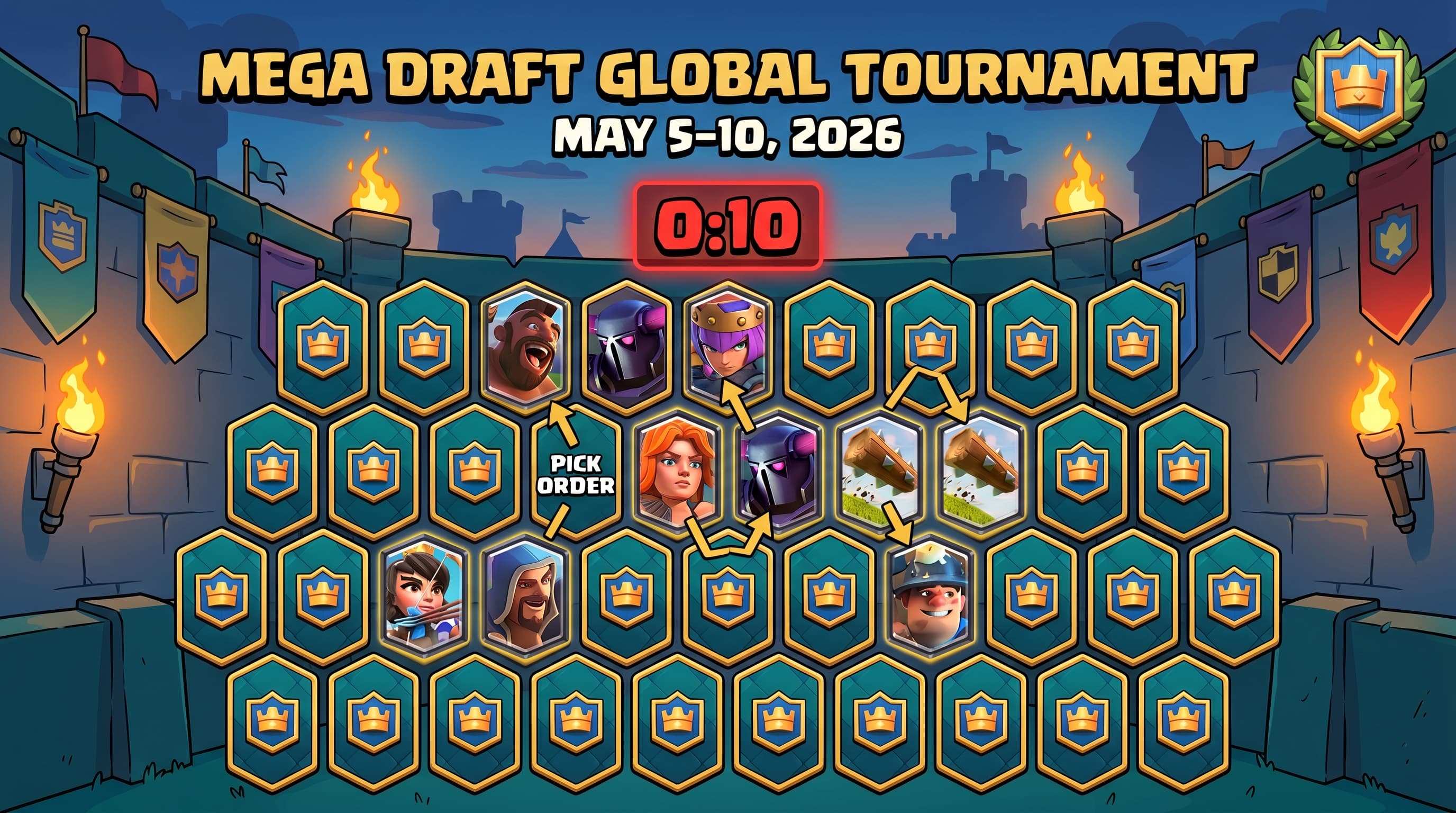
Quick answer: The Mega Draft Global Tournament runs May 5 to May 10, 2026 with a 36-card shared pool where players alternate picks under a 10-second timer (down from 15s), capped at Level 11, with no Tower Troops, Evolutions, or Heroes allowed - 12 wins enters the leaderboard, with the Royal Tournament Badge and Top 10K Leaderboard Finisher Badge as rewards.
6 days, 36 cards in the shared pool, 10-second pick timer, 8 picks per player, 0 Tower Troops, 0 Evolutions, 0 Heroes. The Mega Draft Global Tournament runs from May 5 to May 10, 2026 during Week 1 of the Siege & Swish Season 83 calendar. The format is the most stripped-down draft event in Clash Royale - no Heroes, no Evolutions, no Tower Troops - and the 10-second pick timer (cut from 15s) punishes hesitation hard. 12 wins enters the leaderboard; Top 10K finishers earn both a Royal Tournament Badge and the Top 10K Leaderboard Finisher Badge.
What Is Mega Draft?
Mega Draft is a competitive draft format where both players pick from a single shared 36-card pool rather than from individual offerings. Picks alternate: Player A picks, then Player B picks, then Player A picks two cards, then Player B picks two, and so on until each player has built an 8-card deck. Once a card is picked from the shared pool it is removed for both players, which means counter-drafting (denying your opponent's key cards) is a core mechanic.
Three restrictions define the format:
- No Tower Troops - both players use the default Princess Tower
- No Evolutions - including this season's heavily-nerfed Evos from the May 2026 Balance Changes Breakdown
- No Heroes - including the new Hero Dark Prince and Hero Bowler
Card levels are capped at Level 11 (Tournament Standard), so collection depth is irrelevant. Use the Tournament Decks Tool to study Lvl-11 archetypes before queueing.
How Does the 36-Card Shared Pool Work?
The 36-card pool is randomized per match from the full Lvl-11-eligible card list. Each match starts with a fresh pool, so meta-picks reset every game. Within the pool the picking sequence is:
| Pick # | Player | Notes |
|---|---|---|
| 1 | A | First pick - secure highest-floor card |
| 2-3 | B | First two-pick - usually counter-draft |
| 4-5 | A | A's two-pick |
| 6-7 | B | B's two-pick |
| 8-9 | A | A's two-pick |
| 10-11 | B | B's two-pick |
| 12-13 | A | A's two-pick |
| 14-15 | B | B's two-pick |
| 16 | A | Final pick |
The first pick is positionally weakest (only 1 card before opponent counters), but each subsequent two-pick can be coordinated. Pre-game prep should focus on first-pick high-floor cards and two-pick synergy bundles.
Why Does the 10-Second Pick Timer Matter?
Mega Draft cuts the pick timer from 15 seconds to 10 seconds, a 33% reduction. That single change shifts the format from "thoughtful drafting" to "muscle-memory drafting." Players who hesitate on a borderline pick risk an auto-pick of whatever the system chooses - usually the alphabetically-first card remaining in the pool.
The practical consequences:
- Pre-cache your first-pick options. Have a top 3 list memorized.
- Decide your archetype early. Cycle, Beatdown, or Control - lock the choice before pick 4.
- Don't agonize over tier-3 picks. Picks 6-7 are usually fillers; pick the highest-elixir-rotation match and move on.
For format-comparable timer experience, Triple Draft League Guide April 2026 used the same 10-second timer in late-stage rounds.
What Are the Best First-Pick Cards in Mega Draft?
The best first-pick cards in Mega Draft are high-floor, low-ceiling cards - cards that work in any deck regardless of the rest of your draft. These are the universal staples.
| Card | Why It's a Great First Pick | Floor / Ceiling |
|---|---|---|
| Knight | Fits every archetype, defensive + offensive | A+ floor / B+ ceiling |
| Skeletons | Cheapest cycle in the game | A floor / B ceiling |
| Log | Universal swarm clear | A+ floor / A ceiling |
| Tornado | Pulls everything, defensive king | A floor / A+ ceiling |
| Mini PEKKA | Single-target win-condition support | A floor / A ceiling |
| Musketeer | Air + ground DPS | A floor / A ceiling |
| Fireball | Universal mid-cost spell | A floor / A ceiling |
Avoid first-picking specialty cards like Mortar, X-Bow, Sparky, or Three Musketeers. These cards have high ceilings but require specific deck shells your opponent can deny in subsequent picks.
What's the Best Pick Order Strategy?
A clean Mega Draft pick order has three phases:
Phase 1: Picks 1-5 (Foundation)
Lock in your archetype and primary win-condition first. If you first-pick Knight, on picks 2-3 you should grab a win-condition (Hog Rider, Royal Giant, Goblin Drill, Battle Ram) and a cycle card (Skeletons, Ice Spirit). Pick 4-5 should add a defensive splasher (Bomber, Dart Goblin) and a spell (Log, Fireball).
Phase 2: Picks 6-11 (Synergy)
Now you fill archetype-specific synergies. If you've drafted a Beatdown shell, this is when you grab Tornado, Lightning, and air defense. Counter-draft sparingly - deny only one critical card for the opponent's archetype, otherwise you're wasting picks.
Phase 3: Picks 12-16 (Filler)
Final picks complete your elixir curve (target average elixir 3.4-3.8) and add a secondary win-condition if your primary is single-threat. Picks 14-16 should be quick - the timer will cost you more here than the marginal pick value.
For first-principles deck-building, see the Deck Building Guide.
How Do You Counter-Draft Effectively?
Counter-drafting is denying your opponent's key cards to weaken their deck. The strongest counter-draft picks are cards that gate entire archetypes:
| Card | Denies | When to Counter-Draft |
|---|---|---|
| Log | Goblin Barrel, Princess shells | If opponent first-picks Goblin Barrel |
| Inferno Tower | Beatdown wins (Golem, Giant, RG) | If opponent first-picks a tank |
| Tornado | Pull-into-Tower decks | If opponent picks Executioner |
| Mini PEKKA | Tank-killer slot | If opponent picks Golem or Royal Giant |
| Lightning | Three Musketeers, Cannon Cart | If opponent picks Three Musketeers |
The general rule: don't counter-draft until pick 4 or later. Picks 1-3 should be foundation; counter-drafting too early signals your deck weaknesses to the opponent.
Use the Counter Lookup to memorize archetype gates before queueing.
What Is the 12-Win Threshold?
The Mega Draft leaderboard requires 12 wins to enter. The 12-win mark unlocks:
- Royal Tournament Badge (cosmetic, displays on profile)
- Top 10K Leaderboard Finisher Badge (only if your final win-loss ratio puts you in the top 10,000 globally)
The win-loss tracker resets at the start of the tournament window (May 5, 2026 09:00 UTC). Losses are not capped, but the leaderboard ranks by total wins minus losses, so loss-padding to chase wins is counterproductive.
Realistic 12-win pace: 2-3 hours of focused play per day for a B-tier player at 6,000+ trophies. F2P players with smaller card pools may struggle because Lvl-11 cap doesn't fully equalize - card familiarity still matters.
Are Heroes and Evolutions Allowed in Mega Draft?
No. Mega Draft excludes:
- All Heroes (Hero Dark Prince, Hero Bowler, Hero Magic Archer, Hero Mega Minion, Hero Barbarian Barrel, etc.)
- All Evolutions (no Evo cards in the shared pool)
- All Tower Troops (default Princess Tower only)
This is by design - Mega Draft is meant to be the purest skill-test format in the Royal Tournament rotation. Players who depend on Hero kits or specific Evolutions for their win rate will see lower performance than in Hero Draft-format events.
What Are Common Mega Draft Mistakes?
Five mistakes define the bottom 30% of Mega Draft players in prior format data:
- First-picking specialty cards (Mortar, X-Bow). Always pick high-floor cards first.
- Ignoring elixir average. Drafting 8 cards at 4+ elixir each leaves you cycle-locked.
- Counter-drafting too early. Picks 1-3 should be foundation, not denial.
- Hesitating on filler picks. Picks 14-16 should take under 3 seconds each.
- Forgetting the Lvl 11 cap. Cards you don't own at Lvl 11 in real play behave differently here - test in Friendly Battles before the tournament.
The Arena Simulator and Deck Doctor help validate Mega Draft archetypes before queueing.
How Does Mega Draft Compare to Other Drafts?
| Format | Pool Size | Pick Type | Timer | Heroes? | Evos? |
|---|---|---|---|---|---|
| Mega Draft (May 2026) | 36 (shared) | Alternating | 10s | No | No |
| Triple Draft | 3 per slot (offered) | Pick from 3 | 10s | Yes | Yes |
| Hero Draft | Standard with Hero pool | Hero offering | 15s | Yes | Yes |
| Standard Tournament | Full collection | Personal deck | N/A | Yes | Yes |
Mega Draft is the highest-skill draft format because the 36-card shared pool eliminates "lucky offering" variance - if you misdraft, it's pick-order strategy not RNG. For Hero Draft, see Hero Draft Tier List Balloon Festival; for Triple Draft, see Triple Draft League Guide April 2026.
Recommended Next Reads
- Hero Draft Tier List Siege & Swish (May 2026): Best Picks Post-Patch — Heroes excluded from Mega Draft but present in other draft events
Frequently Asked Questions
When does Mega Draft end?
Mega Draft runs from May 5, 2026 to May 10, 2026 (6 days). The leaderboard locks at 09:00 UTC on May 10.
How many wins do I need for the Royal Tournament Badge?
You need 12 wins in Mega Draft to qualify for the Royal Tournament Badge. The Top 10K Finisher Badge requires you to also place in the top 10,000 globally by net wins.
Are Hero Dark Prince and Hero Bowler in the Mega Draft pool?
No - Mega Draft excludes all Heroes, including Hero Dark Prince and Hero Bowler from the Siege & Swish Season 83 Guide release.
What happens if I run out of time on a pick?
The system auto-picks a card if your 10-second timer expires. Auto-pick choice is not officially documented but observed behavior is the alphabetically-first remaining card in the pool. Plan ahead.
Is Mega Draft easier than Triple Draft?
No - Mega Draft is harder. Triple Draft offers you 3 cards per slot to choose from; Mega Draft requires you to pick from a shared pool with counter-drafting and a tighter 10-second timer.
What is the card level cap in Mega Draft?
The level cap is Level 11 (Tournament Standard). Card levels are equalized at Lvl 11 regardless of your collection.
Can I use the same deck across all my Mega Draft matches?
No - each Mega Draft match starts with a fresh randomized 36-card pool and a new draft. You build a new deck every match.
How Does the May 26 Q2 Update Affect Mega Draft?
Mega Draft is a tournament mode with fixed Tournament Standard (Level 11) card levels, so the Q2 update's Collection Levels and Seasonal Arena II level-15 boost do not change in-mode play. What does change: Hero Tombstone and Princess Evolution drop on May 26, 2026 as new ladder cards, and future Mega Draft pools will include them once they cycle into the rotation. For the full list of ladder changes that ship alongside the patch, see the Q2 May 2026 Update Hub.