
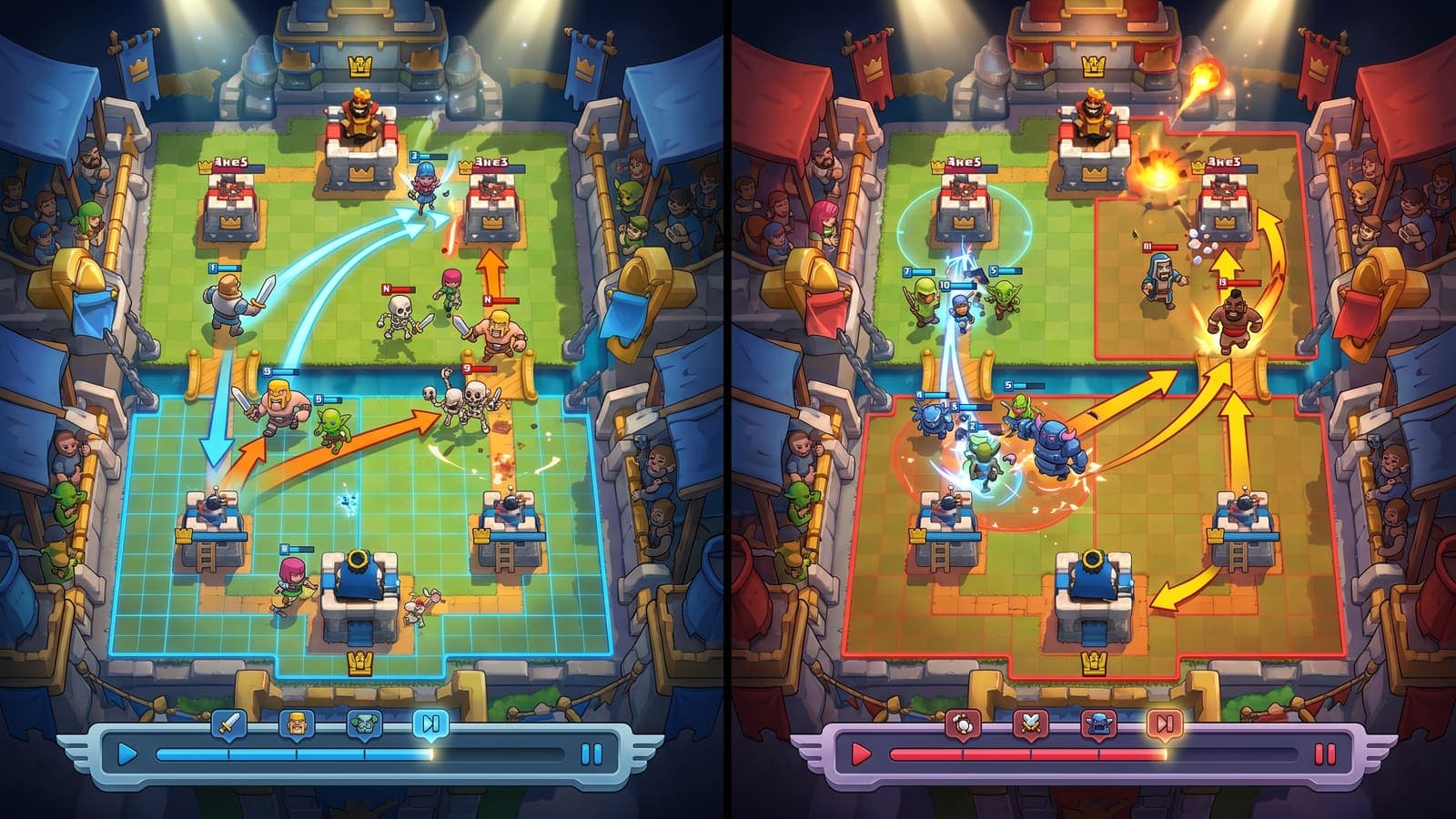
Quick answer: The Pro Replay Breakdown Series is an ongoing collection of tactical analyses dissecting high-trophy Clash Royale matches. Each breakdown documents both player decks, the key elixir-trade decisions, defensive placement choices, and why the winning play worked. New entries publish on an irregular cadence tied to notable VODs - check the index below for the latest breakdowns.
The Pro Replay Breakdown Series exists to answer the question that beginner and intermediate players ask after watching a top-ladder VOD: why did that win condition push connect when mine doesn't, and how would I have read the match differently? Each entry isolates one high-leverage match, freezes the decision points, and walks through the tactical logic behind the winning play. The aim is transferable patterns — the techniques you should apply in your own matches at any trophy range.
How to Use This Series
Impact: significant. Each breakdown follows a consistent structure designed for active learning rather than passive watching:
- The matchup at a glance — both decks, archetype clash, predicted favored side based on raw matchup data.
- Key moment timestamps — the 3-6 moments in the match where the outcome was decided.
- Per-moment tactical analysis — what each player saw, what they chose, and why the winning choice worked.
- The transferable lesson — one pattern you can apply in your own games immediately.
- VOD link and replay code (when available).
The breakdowns are written archetype-agnostic — you don't need to play the featured decks to extract value. The decision frameworks (when to defend with a building vs a troop, when to leak elixir, when to mirror an opening play) generalize across the meta.
Want this kind of analysis for your own deck?
TrophyCoach reads your battle log and writes a personalized action plan against the current meta — free to start.
Current Series Entries
Why a 0-Evolution Xbow Deck Beat the Top-Ladder Mohamed Light Match
Date: Early May 2026. Trophy range: 9,000+. Decks: Mohamed Light's signature Miner Cycle (with Hero Mini P.E.K.K.A.) vs Betfas's 0-Evolution Xbow 2.9.
The setup. Betfas — widely regarded as the strongest Xbow player on the live ladder in 2026 — fielded an Xbow 2.9 deck with zero Evolution cards against Mohamed Light, who ran his standard top-ladder Miner Cycle. Most observers predicted a Mohamed Light win because Miner Cycle's chip pressure typically outpaces Xbow's setup tempo in the current meta. The result surprised the community (Reddit post with 284 upvotes).
Why 0-Evo Xbow was the right call. Mohamed Light's deck is fully optimized around Evolution timing — his cycle math assumes specific Evo windows during the 6,000+ trophy meta. By running 0-Evolution Xbow, Betfas denied Mohamed's deck the read it expected. The opening 2 minutes played out as a normal Xbow setup vs Miner cycle exchange; the divergence appeared at double elixir when Mohamed couldn't predict an Evolution payoff that wasn't coming.
Key tactical moments:
-
Minute 1:30 — Betfas placed Xbow at the bridge defensively (not in the standard back-line Xbow setup). The placement looked passive but baited Mohamed into committing Miner for chip damage. The Miner connected for ~75 damage but Betfas's Tesla + Knight defense killed the trailing skeletons cleanly. Lesson: passive Xbow placements can be more valuable than aggressive ones when the opponent's win condition is a low-damage chip card.
-
Minute 2:00 (double elixir start) — Mohamed committed a Hero Mini P.E.K.K.A. lunge across the bridge expecting Betfas to be holding Tesla + Knight. Betfas had cycled into Skeletons + Ice Spirit defensively and survived the trade. Lesson: cycle decks at start-of-double-elixir often over-commit because they expect the same defensive hands they saw in single elixir — a deliberate cycle delay catches this.
-
Minute 2:45 — Betfas activated King Tower with a defensive Earthquake into his own crown tower path. The activation was the decisive moment of the match: it neutralized Mohamed's lethal Miner-only chip plan and forced him into a Sparky-level commitment that Betfas could counter. Lesson: defensive King activation is high-EV against chip-focused win conditions; don't reserve it only for swarm spam decks.
The transferable pattern: Against an opponent whose deck telegraphs Evolution timing, deliberately breaking from the expected meta build can surprise them more than running a more powerful but predictable list. Betfas's 0-Evo Xbow was strictly weaker on raw stats but stronger against this specific opponent's preparation.
Reading a Hog 2.6 Mirror Match — When to Defend, When to Counter-Punch
Format: Evergreen tactical breakdown. Trophy range: 7,500+. Decks: Identical Hog 2.6 on both sides.
The Hog 2.6 mirror is the cleanest tactical test in Clash Royale because both players have identical resources and identical possible plays. Differences in winning come down to decision quality and read patterns.
Key tactical patterns:
-
Opening cycle priority (0:00-1:00): The first player to commit Hog at the bridge typically loses 50-150 damage with no return. The optimal opening is 2-3 cycles of Skeletons + Ice Spirit at the back to establish the cycle order before committing your win condition. The mirror match rewards the cycle 2-step ahead, not the player who pushes first.
-
The 1:30 "first read" window: Once both players have shown 6+ of their 8 cards, the first player to correctly read the opponent's cycle state gains an information edge that compounds for the rest of the match. The read is simple — count cards each side has played and identify which cards are coming back online next.
-
The 2:00 double elixir transition: Double elixir massively favors the player behind in trophies, because the same elixir budget produces 2× the pressure rate. If you're ahead in tower damage at the 2-minute mark, expect a defensive commit from your opponent. If you're behind, commit your highest-tempo Hog cycle the instant double elixir starts.
The transferable lesson: Mirror matches are won by information, not by hand strength. Track which cards your opponent has played and predict the next cycle slot — the player who can predict the next 2 cards in the opposing hand will win the long-tempo trade chains that decide the match.
Mortar Cycle vs Mega Knight Bridge Spam — The Defensive Loops That Decide the Match
Format: Evergreen tactical breakdown. Trophy range: 6,500+. Decks: Mortar Cycle (Mortar, Bomber, Knight, Skeletons, Ice Spirit, Fireball, Log, Goblin Drill) vs MK Bridge Spam (Mega Knight, Royal Ghost, Bandit, Magic Archer, Lumberjack, Fireball, Log, Skeletons).
This matchup is roughly 52-48 favored toward Mortar Cycle in the current meta — but only when the Mortar player executes the defensive loop pattern. Mortar Cycle's win condition is chip damage from the Mortar tower; the MK Bridge Spam deck's win condition is overwhelming pressure with 3-4 cards stacked at the bridge.
Key tactical patterns:
-
Mortar placement (0:30 first commit): Always place Mortar at the back-left or back-right corner of the King Tower, never at the bridge or middle of the map. The corner placement positions Mortar to reach the opposing princess tower but stay outside the MK's spawn radius. Bridge placements lose to MK 90% of the time because MK's spawn-jump area damages the Mortar on landing.
-
The defensive loop (1:00-2:00): Mortar Cycle's defensive sequence against MK Bridge Spam is a fixed loop: Knight in front of MK to bait splash, Skeletons behind to clean up the Bandit/Ghost trail, Log to clear Lumberjack rage drop. Repeat this loop 3-4 times across the match. Each loop costs ~7 elixir to break a ~9 elixir MK push, generating a small but compounding elixir advantage.
-
Double elixir chip-pressure (2:00+): Once double elixir starts, commit Mortar every cycle even if you can't establish it. The chip damage from a half-defended Mortar is worth more than the elixir cost when the alternative is letting MK Bridge Spam build pressure. Mortar is at its best when it's perpetually dying — a Mortar that survives 30 seconds is a Mortar that's overspending on defense.
The transferable lesson: Cycle decks vs Bridge Spam are won by trading on rotation, not on individual exchanges. Every individual MK push beats an individual Mortar setup; only the cumulative cycle-rotation pressure of consistent Mortar commits wins the match across 3-4 cycles.
Future Entries (Planned)
The series will expand with additional breakdowns as notable matches surface. Topics queued for the next 2-4 weeks:
- First-week Hero Tombstone meta breakdown (post-June 2026 update)
- Princess Gambit match analysis (the new sudden-death random-card mode strategy)
- Seasonal Arena II auto-ban impact (real top-8 ban examples from top ladder players)
- Goblin Drill mirror match — the timing-window reads (high-trophy meta staple)
How to Suggest a Breakdown
Have a top-ladder match or VOD you'd like to see broken down? The series is curated based on community signal. Submit suggestions via the contact form with the VOD link and a 1-sentence explanation of why the match is interesting.
What Skills Will You Learn From This Series?
Impact: significant. The Pro Replay Breakdown Series develops three transferable skills:
-
Card-cycle tracking. Counting which cards each player has used and predicting the next 2-3 cards in their hand. This is the single highest-impact skill at any trophy range.
-
Defensive placement reads. Reading the opponent's deck composition and committing the right defensive unit at the right tile — the difference between a defensive trade that costs you 1 elixir and one that costs you 4.
-
Tempo decision-making. Knowing when to commit pressure (you're ahead in cycle), when to leak elixir (you're behind in cycle but ahead in elixir), and when to defensively over-commit (you can't afford to lose the next tower swing).
Recommended Next Reads
- How to Play Hog 2.6 Cycle: Complete Deck Guide & Cycle Math (May 2026) — Learn Hog 2.6 mirror match fundamentals referenced in breakdown
- How to Counter Mortar Cycle in Clash Royale: Siege Pressure, Punish Pushes & Anti-Mortar Decks — Mortar Cycle vs MK Bridge Spam breakdown deep dive
- May 2026 Clash Royale Balance Changes Breakdown — Balance context for pro replay meta assumptions
Frequently Asked Questions
What is the Pro Replay Breakdown Series?
The Pro Replay Breakdown Series is an ongoing collection of tactical analyses from TrophyCoach dissecting high-trophy Clash Royale matches. Each breakdown documents both decks, the key elixir-trade decisions, defensive placement choices, and the transferable pattern from the match. Entries are written for any trophy range, not just top ladder.
Are these real VODs or hypothetical matchups?
Both. Some entries (like the Mohamed Light vs Betfas breakdown) reference specific notable VODs sourced from r/ClashRoyale and pro creator streams. Others (like the Hog 2.6 mirror and Mortar Cycle vs MK Bridge Spam breakdowns) are evergreen tactical patterns drawn from aggregated match data and live ladder play. Both formats teach transferable patterns.
What trophy range is this series aimed at?
6,000 trophies and above, but the tactical patterns scale down to 4,000+. The decision-making frameworks (card cycle tracking, defensive placement reads, tempo decisions) are universal — the specific decks and stats reference top-ladder meta, but the underlying logic applies to any level.
How often are new breakdowns published?
Irregularly. Roughly one new breakdown every 2-3 weeks during normal meta. Major balance changes or new card releases (like the upcoming Hero Tombstone in June 2026) typically trigger a faster cadence to capture the new meta.
Where do you source the match data?
A combination of: notable VODs from top creators (Mohamed Light, Surgical Goblin, OJ, SirTag, Boss CR), r/ClashRoyale high-engagement match posts, and aggregated tracked-deck data from the Meta Tracker tool. All match references are cited where applicable.
Can I request specific matches to be broken down?
Yes. Use the contact form with a VOD link and a brief explanation. The series is curated based on community signal — high-interest matches with broad tactical applicability get priority.
What's the difference between this and the Counter Lookup tool?
The Counter Lookup tool is a fast reference for "what beats card X" lookups. The Pro Replay Breakdown Series is deeper tactical analysis — entire-match decision logic rather than per-card counter data. Use Counter Lookup for in-the-moment ladder play; use the Series for off-ladder skill development.
Where to Go Next
- Tools: Meta Tracker · Counter Lookup · Deck Doctor · Deck Finder
- Tactical guides: Deck Building Guide · Elixir Management Mastery Guide · Comeback Strategy Guide
- Q2 update tactical impact: Q2 Update Hub · Seasonal Trophy Road Guide
- Discuss a match with an AI coach: TrophyCoach on ChatGPT or Google Gemini